|
Tom Chavez
Hmmm. Things are quiet on this forum.… Speech is silver, silence is golden. Speech is human, silence is divine. I'm only human….
Mahabharata 2: Ganga and Santanu
Mahabhisha was born in the race of Ikshvaku. He was emperor of all the earth, truthful and heroic. He performed a thousand Asvamedha-sacrifices and a hundred Rajasuyas and ultimately attained heaven.
Once, all the celestials and great sages assembled with Lord Brahma, and Mahabhisa was also there. Ganga, Queen of rivers, was present and the wind displaced her garment. The celestials averted their gaze when she was thus exposed, but Mahabhisha stared at her with eyes of desire, and she reciprocated with her own glances.
The celestials did not appreciate their behavior. Brahma then cursed Mahabhisha to be born on earth for his impropriety. He told Ganga to also go for reciprocating his offense, but she would be free to return if ever he should become angry with her.
In the meantime, Ganga met the eight Vasus who had been cursed by Vasishtha to take birth on earth also. They made an agreement that she would give them birth and then drown them so they could return immediately and not have to remain on earth.
………
One time a king named Pratipa was doing penances on the bank of the Ganges when Ganga, assuming the form of a beautiful female, arose from the river and sat upon his right thigh.
The monarch inquired, “What do you want?”
The damsel replied, “Please accept me as your wife.”
He said, “I cannot, because I have vowed never to join with a woman who is not of my order. Also you are seated on my right thigh, which is for daughters or daughters-in-law, whereas the left thigh is for a wife. Therefore, I accept you for my son!”
Although the son was not yet born she agreed, on the condition that the son should not judge the propriety of her acts.
Pratipa later got a son, who was none other than the former Mahabhisha, and named him Santanu, who was dedicated to virtue. Pratipa told Santanu that if he should meet a celestial damsel who solicited him for children, he should accept her and not judge the propriety of her actions.
After Pratipa installed Santanu on the throne and retired to the forest, Santanu would frequently hunt along the banks of the Ganges. It was a passion with him.
One day on the banks of the river he saw her. She was like a vision of beauty, with sparkling ornaments and refined dress. Her complexion glowed golden, her eyes large and lustrous, and her hair, which she combed with her fingers, was long. He stood rooted to the spot drinking her beauty with his eyes. It seemed to him that a goddess from the high heavens had descended on earth.
Santanu approached her. She turned on hearing a noise and looked at him. A blush suffused her face as she shyly looked at the ground. Her toe traced patterns in the dust as her beautiful fingers twined and untwined in her hair. Then, she also glanced at at the monarch with eyes expressing affection.
He took her reluctant hand in his and said, “You are so very beautiful. Please be my queen. I am Santanu, the king of Hastinapur [Delhi]. I love you. I cannot live without you.”
The maiden smiled and said, “The moment I looked at you I knew that I had to be yours. I will become your wife and obey your commands, but there is a condition. You must not interfere with anything I do, be it agreeable or disagreeable, nor ever speak to me unkindly. As long as you agree to this I will stay with you, but if you interfere or speak an angry word I shall immediately leave you, never to return.”
“So be it,” said the love-lorn monarch and he led her to his city.
They were both pleased to obtain each other as spouses. They enjoyed life together without thought of the passing time. Ganga bore the king a son. His joy was immense. At last, a son and heir had been born to adorn the time-honored throne of the great Pauravas. Santanu hastened to the queen’s chambers. He was told that she was not there, that she had gone to the banks of the river Ganges with the new-born child clasped in her arms. He could not understand.
He hurried to the river bank. There his horrified eyes saw a scene which he could never blot out from his memory. Ganga, his dear beloved Ganga, had just flung their new-born child into the river. She looked as though relieved of a great burden. He wanted to ask, but he dared not, remembering the promise he had given her, that he would never oppose her or displease her.
Santanu begot seven beautiful male children, shining like celestials. But as soon as each was born Ganga threw the baby in the river, and they all drowned. The king, although greatly distressed, spoke not a word lest he lose his wife.
But when the eighth child was born and his wife was about to throw it into the river, the king, desiring to save the child, spoke.
“Don’t kill him! Who are you? How can you murder your own sons? Your sins are great!”
A strange smile came to the lips of Ganga. She spoke very gently to the king. She said, “My lord, by our agreement, the time has come when I must leave you. You have broken your promise. I will not kill this child. I am Ganga, daughter of Jahnu. I have lived with you to accomplish the purpose of the celestials. The eight Vasus were cursed by Vasishtha to assume human forms. Only a celestial could become their mother. I promised to free them from the curse as soon as they were born. Be blessed, O King. This child shall remain as your son. I will take him with me and give him back to you when the time comes. I will call him Devavrata. His other name will be Gangeya (given by Ganga).”
Santanu asked, “What was the fault of the Vasus that they were cursed by Vasishtha?”
Ganga said, “The sage Vasishtha had his hermitage on the bosom of Mt. Meru. That sacred spot was full of blooming flowers all year round, and the woods abounded with fruits, berries, sweet roots and water.”
“Virtuous Vasishtha had a cow named Nandini, a surabhi cow of plenty, capable of granting all desires. One day the Vasus, with their wives, came to enjoy those delightful woods and mountains. One wife saw that cow possessing large eyes, full udder, fine tail, beautiful hooves and other auspicious signs and pointed it out to her husband Dyu.
Dyu said, ‘This cow belongs to the Rishi who uses this hermitage. Any mortal who drinks the sweet milk of this cow will remain in unchanging youth for ten thousand years.’
Hearing this, Dyu’s beautiful wife implored, ‘My friend Jitavati resides on earth as the daughter of the sage Usinara. I desire to have this cow for her so that by drinking this milk she alone on earth can remain free from disease and decrepitude. Please grant this desire. Nothing could be more agreeable to me.’
Commanded by his lotus-eyed wife, forgetting the ascetic merit of the sage who owned the cow, Dyu and his brothers took the cow without proper thought.
When sage Vasishtha returned and could not find his cow, he saw by his ascetic vision that she had been stolen by the Vasus. Therefore he cursed them to take birth on earth.
When the Vasus learned of this curse, they speedily came to the sage to apologize and pacify him. The sage allowed that they would only have to remain on earth for less than a year, except for Dyu, who was the instigator. He would have to remain on earth a long time.”
Ganga continued, “Then the Vasus came to me and begged that I would throw them in the water as soon as they were born. I did as they desired in order to free them from the sage’s curse. Only this child remains, who is Dyu himself. I will take him with me and return him to you when the time is ripe.”
The king was dumb-founded when he heard all that Ganga had to say. Ganga, the goddess from the heavens, thought fit to play wife to him. But Santanu, a mere mortal, could hardly bear that honor. It was too much for him. He could see just two things. First, his Ganga would leave him forever, never to come back. The other realization was that he had a son now, a son to uphold the name of the Pauravas.
It was easy for Ganga to follow the emotions that passed through the mind of Santanu. With a look of pity mingled with love she spoke to the king in a gentle voice, “My beloved, please do not grieve. I will take excellent care of our son. He will be a great hero. He will be greater than all the Pauravas who have graced the throne of the race of the Moon.”
Ganga faded away from sight. Santanu spent hours re-living those moments filled with pain, his last time with Ganga. With a sigh of resignation and a sorrowful heart he slowly wended his way homewards, where utter loneliness awaited him.
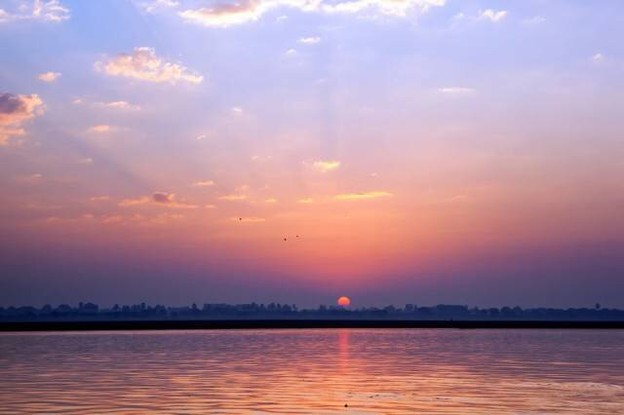
Ganges sunset in Mayapur
|