|
Tom Chavez
Mahabharata 6: Kunti and the Sun god
King Surasena had a son name Vasudeva (who became the father of Krishna) and a daughter named Pritha. He also had a cousin named Kuntibhoja (u pronounced like u in push) who had no children. King Surasena was fond of his cousin and felt sorry that he had no child, so he gave Pritha to Kuntibhoja to be brought up as his own.
Pritha was very beautiful with excellent manners.She was the most cherished possession of her foster-father. She was given the name Kunti.
Once, the sage Durvasa came to the capital of Kuntibhoja. He was famed throughout the world for his austerities and for his temper, too! If he were displeased, he could wreak havoc by his curse. Kunti was appointed by her father to attend to the sage. She discharged this difficult task admirably. Indeed, the sage was so pleased with her that he granted her a boon.
Durvasa called Kunti to his presence and told her he would teach her a mantra incantation which, if properly enunciated, would call any deva (demigod) to come to her. Kunti received this gift with the humility becoming a daughter of a king. Thereafter, Durvasa went his way.
Young Kunti did not fully understand the meaning of the mantra. One early morning, through an eastern window, she watched the sun dawning. The east was drenched the color of liquid gold. The waters of the Yamuna River lapped against the wall of the palace, reflecting the soft morning beams of the sun. The beautiful scene touched Kunti’s heart.
The sun look gorgeous. Kunti thought how wonderful it would be if the sun god could be there by her side. In a flash she remembered the mantra the great Durvasa had given her. Why, if she recited it properly, the sun god would come to her!
The innocent child held her palms together and enunciated the mantra very carefully. She opened her eyes. A miracle was happening with the sun’s rays. She was blinded by a brilliance, and suddenly the sun god stood by her side, looking at her with an amused smile.
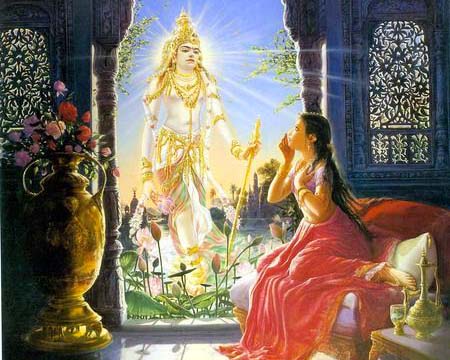
Kunti was extremely pleased with her success. She smiled happily and clapped her hands in excitement, exclaiming. “Sage Durvasa said that it would work! You looked so magnificent that I wanted you to come here. So I recited the mantra he taught me. How wonderful! You have come!”
The sun god was still smiling. He said, “Now that I am here, what do you want me to do?”
“Why, nothing,” said Kunti. “I just wanted to see you. That’s all.”
“That is not all,” said the god. “It is evident that you did not understand the deeper meaning of the mantra. Do you not understand that it means the god will embrace you and give you a son in the image of the god whom you have summoned?”
Kunti was bewildered. “I did not know it,” said the frightened child. “I had no idea that the words meant this. Please forgive my childishness. Please go away and save me from shame.”
“That is impossible,” said the sun god. “You must accept me. You cannot escape the power of the mantra which you have used unthinkingly.”
Kunti was beside herself with grief. “I am a young girl,” she said. “I am unmarried. What will the world say? What will my father say? It will break his heart to know that I am no longer a virgin. Can you not go away?”
The sun god was charmed by this girl who was barely a woman. He pacified her heart with his sweet words and reassuring smile. He said, “Do not be frightened. After our child is born, you will again become a virgin as you are now. No one will know of this incident.”
Kunti was won over by his words and his beauty. She accepted him without fear of the consequences.
Before he left, the sun god said, “Your son will be born with natural kavacha (golden armor) and kundala (earrings). He will be the image of me. He will be a great archer. In goodness of heart no one will equal him. He will be famed as the most generous of givers, unable to refuse anyone anything. His fame will live in this world as long as the sun and moon move in their orbits.” Then he vanished from her sight.
Very soon, Kunti gave birth to a beautiful child born with natural armor and earrings—golden kavacha and kundala. But her joy of motherhood was overwhelmed by a sense of shame. She looked out the window at the placid river, but in her heart a storm was brewing. She made up her mind.
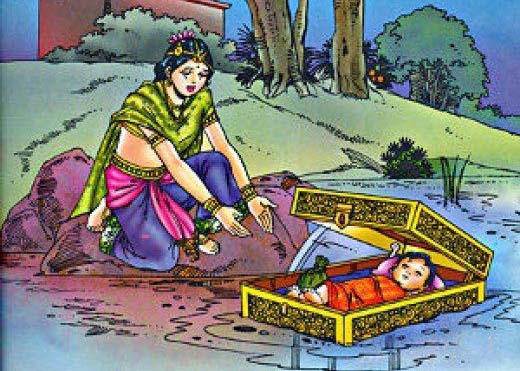
Wrapping the child in silk, she placed him in a wooden box and carried it to the bank of the river. She set the box afloat and came back to her apartments. From her window she saw the box floating away, further and further away from her. She felt that her heart was choking inside her with a great pain, an unspeakable ache for that helpless child floating on the mighty river.
Tears poured from Kunti’s eyes. Lifting her hands in supplication to the sun, she cried, “My Lord, I have done a great injustice to our beautiful child. Please guard him. Please don’t let any evil befall him.”
She spoke to her disappearing child, “May your path be auspicious. The lord of the waters will guard you. You will not die. All the gods in heaven will guard you. I will see you some day in the distant future and recognize you by your kavacha and kundala. She will be a fortunate woman who finds you and brings you up as her son. She will very happily see you grow into manhood. But I am most unfortunate. I will never have you for my son. God bless you, my child, my first born.”
The laughing girl became a woman all of a sudden. Gone were the days of carefree girlhood. Waking or sleeping, she saw just one thing: a wooden box and a length of silk; wrapped in the silk, a beautiful child with his kavaca and kundala gleaming in the light of the morning sun.
|