|
Kenneth Davis
.jpg)
 .jpg)
 .jpg)
SMALL STRAWS IN A SOFT WIND by Marsha Burns
March 19, 2024: Take stock of what has transpired so that you can perceive the breakthrough you are now experiencing. Breaking through is not necessarily a one-time event; it is the process of moving forward triumphantly and perceiving your progress, whether great or small. James 1:12 God blesses those who patiently endure testing and temptation. Afterward they will receive the crown of life that God has promised to those who love him.
T H O U G H T F O R C O N S I D E R A T I O N
TODAYS WORDS - THE PROCESS
Give light and people will find the way. You didn't see me on television, you didn't see news stories about me. The kind of role that I tried to play was to pick up pieces or put together pieces out of which I hoped organization might come. My theory is, strong people don't need strong leaders. We who believe in freedom cannot rest until it comes. Remember, we are not fighting for the freedom of the Negro alone, but for the freedom of the human spirit a larger freedom that encompasses all mankind. Until the killing of black men, black mothers' sons, becomes as important to the rest of the country as the killing of a white mother's sons, we who believe in freedom cannot rest until this happens.
I have always thought that what is needed is the development of people who are interested not in being leaders as much as in developing leadership in others. I had known, number one, that there would never be any role for me in the leadership capacity with SCLC. Why? First, I'm a woman. Also, I'm not a minister. And second, I am a person that feels that I have to maintain some degree of personal integrity and be my own barometer of what is important and what is not.
Both my parents came from North Carolina, in Warren County. My mother had a feeling that there was greater culture in North Carolina than obtained in Norfolk, Virginia, plus the fact she just didn't like the lowland-lying climate there. I was born in Norfolk, Virginia. I began school there, the first year of public school. When I was 7, the family shifted back to North Carolina. I grew up in North Carolina; had my schooling through the college level in North Carolina. I went to what is known as, and was at that time, too, Shaw University in Raleigh, North Carolina. In fact, because of the lack of public-school facilities, I began there. I began boarding school at the high school level, in fact, a year below the high school level. One of the stories that dominates our family literature was the fact that my maternal grandfather contracted for - I don't know under what terms - but, for a large section of the old slave plantation. He established himself - sisters and brothers, cousins, etc. on fifty- and sixty-acre plots.
Oppressed people, whatever their level of formal education, have the ability to understand and interpret the world around them, to see the world for what it is, and move to transform it. In order for us as poor and oppressed people to become part of a society that is meaningful, the system under which we now exist has to be radically changed... It means facing a system that does not lend itself to your needs and devising means by which you change that system. I have always felt it was a handicap for oppressed peoples to depend so largely upon a leader, because unfortunately in our culture, the charismatic leader usually becomes a leader because he has found a spot in the public limelight. I had been friendly with people who were in the Communist party and all the rest of the Left forces, which were oriented in the direction of mass action.
During the Depression years, I began to identify to some extent with the unemployed, the organization for the unemployed at that period. When I came out of the Depression, I came out of it with a different point of view as to what constituted success. And that was even just even personal success. I, perhaps, at that stage, had the kind of ambition that others may have had; you know, namely based on the concept that if you were trained the world was out there waiting for you to provide a certain kind of leadership and give you an opportunity.
But with the Depression, I began to see that there were certain social forces over which the individual had very little control. I guess the best way to describe that would be to connect with the fact that I came out of college just before the big Depression, and I came to New York. One of the things that has to be faced is the process of waiting to change the system, how much we have got to do to find out who we are, where we have come from and where we are going.
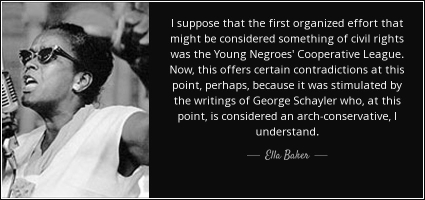
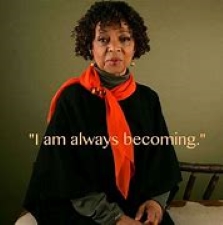
Ella Josephine Baker (December 13, 1903 – December 13, 1986) was an African American civil rights and human rights activist. She was a largely behind-the-scenes organizer whose career spanned more than five decades. In New York City and the South, she worked alongside some of the most noted civil rights leaders of the 20th century, including W. E. B. Du Bois, Thurgood Marshall, A. Philip Randolph, and Martin Luther King Jr. She also mentored many emerging activists, such as Diane Nash, Stokely Carmichael, and Bob Moses, as leaders in the Student Nonviolent Coordinating Committee (SNCC).
|



.jpg)
.jpg)
.jpg)
.jpg)







.jpg)


.jpg)

.jpg)







.jpg)

.jpg)
.jpg)


.jpg)


.jpg)

.jpg)
(12).jpg)


.jpg)


.jpg)




.jpg)




 The birthstone for March, the aquamarine gem, is a luxurious blue in color. While it is not considered a precious stone, is often associated with not only good health and hope, but a feeling of calm, trust, and fearlessness.
.jpg)
.jpg)
(4).jpg)
.jpg)
.jpg)

.jpg)
.jpg)






.jpg)

(1).jpg)
.jpg)





.jpg)


(13).jpg)