|
Gregg Wilson
DEUTERIUM
We now come to nuclear fusion. Conventional nuclear physics claims that fusion can only occur at incredibly high temperatures (millions of degrees), i.e. extremely high velocities for the nuclei. It also claims that when the nuclei fuse, there is a vast release of energy. Neither claim stands up to common sense. Various teams at universities or other government institutions have spent countless billions of dollars over the past sixty years, to create nuclear fusion reactors. They have all been spectacular failures. Fusion has not occurred and there has been no net release of energy.
The University of Wisconsin nuclear team presents a perfect example. They predicted, according to mainstream theory, that the ideal reactants for the greatest fusion release of energy would be Helium-3 nuclei. They achieved their goal of millions of degrees temperature, confinement of the Helium-3 nuclei by powerful magnets and enough time duration to get results from the countless millions of collisions. The results were no release of energy and an outward flux of 140 million protons per second. Since Helium-3 nuclei are made of three protons – not neutrons, what they achieved was fission. The colliding nuclei broke apart into singular protons.
They ignored the actual results – as did the rest of the mainstream nuclear scientists – and proclaimed that we must make a gigantic effort to go to the Moon and “mine” all of its Helium-3 for use in nuclear fusion reactors here on Earth. When one obeys dogma and stays faithful to mainstream science, there is no limit on human insanity.
Observations of newly forming stars show them surrounded by a large belt of black, opaque nebulae. Apparently, nuclear fusion can occur at “cold” temperatures!
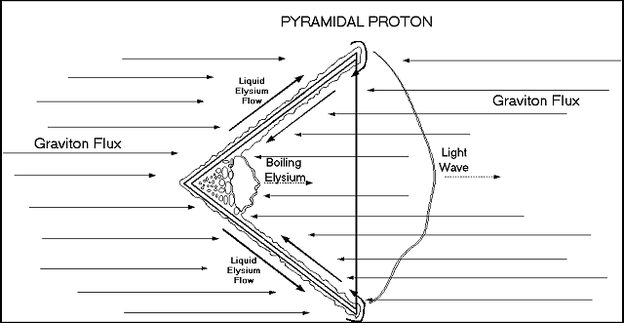
Let’s examine the figure below:
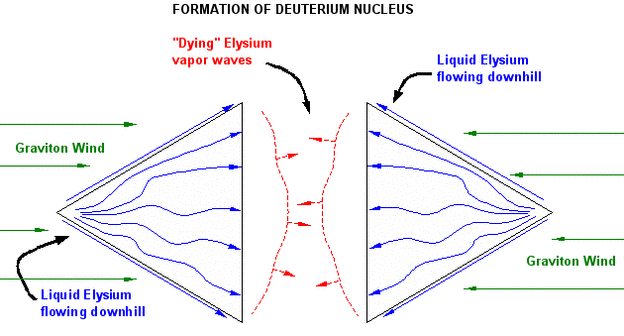
If overall gravitational pressure has compressed the molecular hydrogen nebula enough, the molecules will break apart to atomic hydrogen – due to collisions between the molecules. On rare, random occasions, when two hydrogen protons approach one another – base to base – they will once again shield one another from the gravitational “wind”. In this case, the liquid Elysium flows downhill from the cone tip to the base on each proton. Because the hollow, inner portions of the proton cones are being shielded from the graviton flux, the repulsive outflow of vaporizing Elysium will die down. But the liquid Elysium will still flow into the inside of the hollow cones. When the two cones mate – base to base – there will be a fair amount of liquid Elysium trapped inside the two cones. The graviton flux will then hold the two cones together.
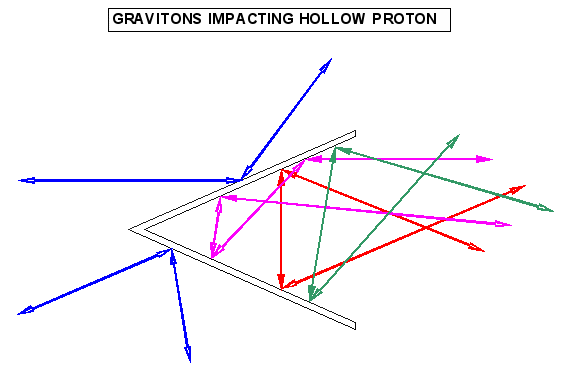
Something else gets trapped inside the two cones when they mate. One or more gravitons. Even though the velocity of the graviton is about 20 billion times the speed of light, one or more of them will be trapped. If one argues that they are fast enough to escape, then they are equally fast enough to get in. The graviton is not alive and it does not have any motivation. Its behavior is absolutely passive.
Let’s suppose that the joining of two proton hollow cones captures one graviton for every one thousand elysons. Let’s even have the elysons be at room temperature, 70oF. A plausible ratio would be for an elyson to have one millionth the mass of the proton, and a graviton have one millionth the mass of an elyson. Within the cavity, the trapped gravitons will collide with all the elysons until they all have a common temperature, i.e. a common speed. The fundamental principle here is conservation of momentum:
Mass of graviton * velocity of graviton + 1,000 * mass of elyson * velocity of elysons = a constant value.
The initial velocity of the one graviton is 20 billion times the speed of light. The initial velocity of the 1,000 elysons is “zero”. Carrying out the mathematics, the final, equilibrium velocity of each elyson is 5,996,000,000 meters per second. Or 3,726,000 miles per second. We can use the kinetic theory of gases to determine the temperature of these 1,000 elysons:
(velocity)^2 meters2 / second2 = 3 * R * T / M
Where:
R = gas constant = 8.314 kg * meter2 / second2 /mole / oK
T = absolute temperature in degrees Kelvin
M = mass of a graviton in kilograms / mole
Carrying out the computation, we get a temperature of 14.5 million oK. This temperature is right in the middle of observed temperature range of an atomic bomb detonation being from one million oK to one hundred million oK. So, the “incredible, mysterious” nuclear energy inside the nucleus is not incredible or mysterious at all. It comes from gravitons and elysons being trapped within the cavity formed by two protons joining together, base to base.
Because this deuterium molecule has no repulsive “electron” force, it is possible to form polydeuterium under pressure.
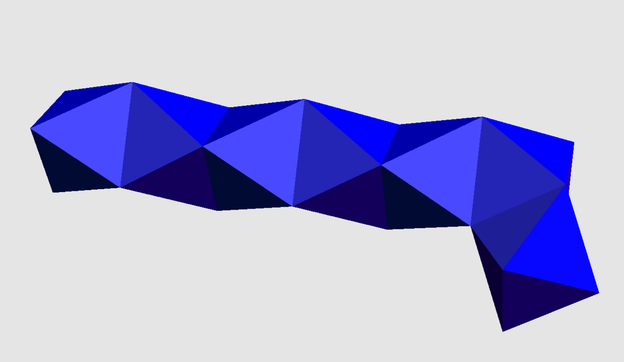
The deuterium atoms come together because they are pushed together by the gravitational flux. There is no attractive force; they are simply in each other’s way. The deuterium atoms would have a very thin layer of liquid Elysium on their pyramidal side surfaces, so this liquid Elysium probably acts as a “glue”. This nuclear fusion is the only nuclear fusion which happens. The theory that larger nuclei such as iron are formed through incredibly high velocities at temperatures of billions of degrees Kelvin is not needed. In fact, there is no evidence of stars having such temperatures at or near their surface.
There is no apparent reason or evidence that these collisions would release immense amount of energy.
|