Sea Cliff High School
Classes of 1925 -1970
User Forums
| Forum: General Discussion | |||||
|
|||||
|
Wallace Kaufman
Class Of '57
 Joined: 04/25/09 Posts: 97 View Profile |
Don Thompson Tracked Us Posted Sunday, February 14, 2010 05:20 PM
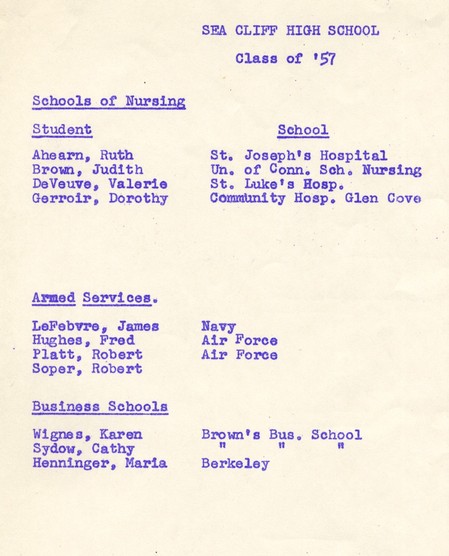
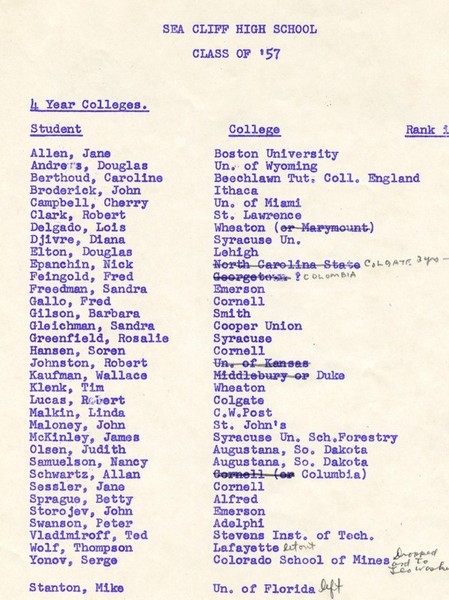
Feb. 14, 2010. This morning Don Thompson’s son Norman forwarded to me three lists that his father kept for our class. (He found nothing for other classes.) They are lists of where each of us went after high school and for each of us he lists our rank in the class academic standings. I am going to post these lists but I have cut off the class standings. (I’ll be glad to send anyone his or her rank on Don Thompson’s list.) One reason I do not post the rankings is because in many cases they do not reflect the person’s real character or achievement. I leave it to you to decide what to make, if anything, of Don Thompson’s division of futures into “4 Year Colleges,” then two other lists which include “Teachers Colleges” and “Schools of Nursing”. We know from recent studies, for instance, that both academic and athletic achievement can be highly influenced by whether a person is the oldest or youngest in the class. For instance, someone who is 11 months younger than the older class members, is often disadvantaged in athletics and the older class members advantaged because physical development is so rapid until about 18 or 20. The same is true of academic potential. For skills in reading, writing, and math and even the coordination required for penmanship, a difference of 11 or 12 months can mean the youngest are significantly behind the oldest. They often struggle. Feel stupid. A teacher might reinforce that self-image. I’m a rank amateur in child development and psychology, so I won’t carry on. I will make only a few notes as food for thought. It’s interesting to compare the rank in the class and the record of life achievements. For instance among those who ranked 80th or below in our class of 110 we have fighter pilots, decorated high ranking military officers, multi-millionare business people, accomplished fiction writers, bank presidents, Silicon Valley millionaires, and corporate executives at the Fortune 500 level. Several of the people who did not appear on Thompson’s list because they went from school directly to work also had rewarding or notable lives in business, theater, education and pursuing family and personal interests. The top 15 or so seem to have generally achieved as expected--successful careers, near Nobel Prize achievers, notable people in their professional ranks. I know enough of their personal lives, however, to tell you that at least half had very serious personal problems, including suicide. If you have thoughts about what the information signifies, post them to this forum. (note: for some reason I can't upload the other two lists, but will do it soon)
|
||||
|
|||||
.jpg)