header 1
header 2
header 3

Message Forum - GENERAL

Welcome to the Bethesda Chevy Chase High School Message Forum.

The message forum is an ongoing dialogue between classmates. There are no items, topics, subtopics, etc.

Forums work when people participate - so don't be bashful! Click the "Post Message" button to add your entry to the forum.


go to bottom 
  Post Message
  
    Prior Page
 Page  
Next Page      

11/24/23 07:15 AM #16682    


Jim Boone

I have not recieved anything since 9/22 either. Hope all is well out there.

Jim


11/26/23 12:08 PM #16683    


Joan Ruggles (Young)

Thomas and Jim, as I said, you are not being denied access. We are all getting the same posts. I've contacted Jack, Joanie, Jay, and Helen. We're all getting the same posts. The fact that people are busy over Thanksgiving may have something to do with it. 


11/27/23 08:24 PM #16684    


Jack Mallory

Guess I'll see if this still works, given all the hoorah about access. 
 

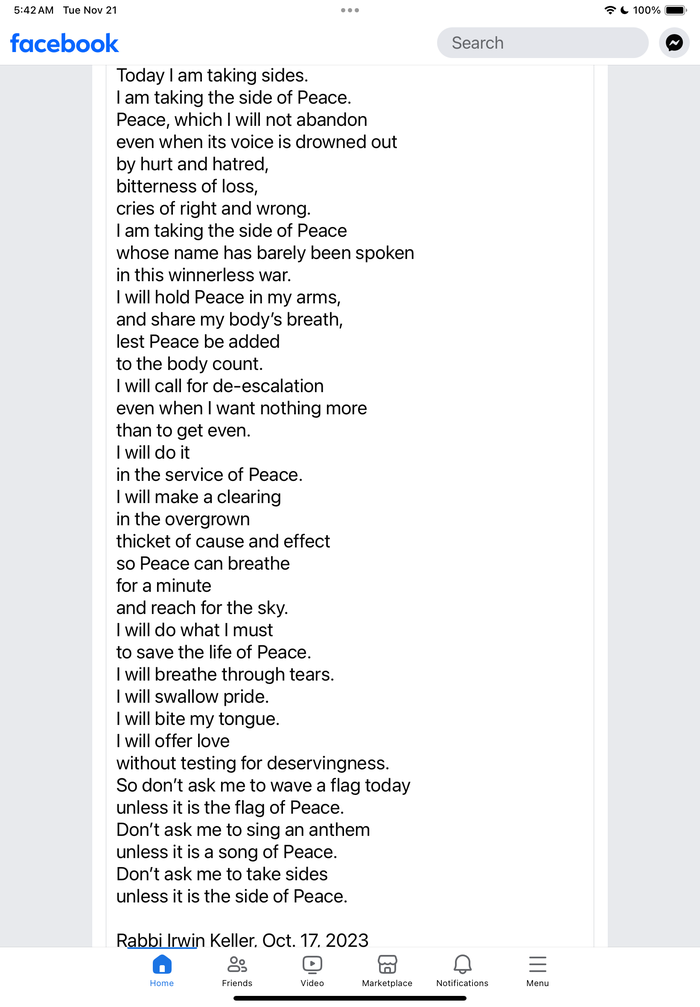
A lot of garbage on social media, but I thought this, on FB, was extraordinary:


And this!


11/28/23 07:18 AM #16685    


Jim Boone

Thanks so much, never felt I was being excluded or denied, but that there might be clitch in system. Technology is a great unknown out there. Happy thanksgivng, joy of the season to all. I work as a professional Santa and been back for a week., seven days a week, just love it. Remember going to Woodies to see Santa. Have been doing this for 18 years. 


Inline Image Not Displayed


11/29/23 08:37 AM #16686    


John Smeby

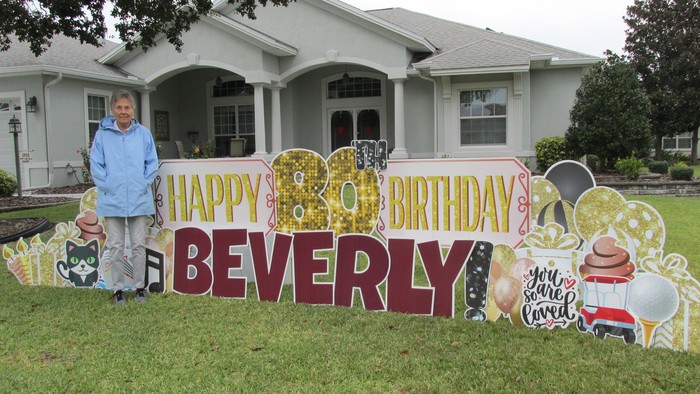
Yesterday was my wife's 80th birthday, in The Villages there is a small busines that "rents" celebration events that are placed on your yard, notice that Beverly has a substantial coat on? The northern weather pushed down into central Florida and it was 36 degrees this morning. And YES I played a tournament softball game yesterday and it was "chilly" but what else are you to do in life at our age! Our pool was in use through Nov. 21st (pool temp 84-86) using solar panels and a solar blanket on the water retaining the warmth and evaporation process. The sun will raise up from the horizon around mid to late January and the solar panel process will heat the water to a useable state by then (84-86 degress). Yes I also have a gas water heater for the pool but decide to take a break from the pool during the holiday seasons (T-Day, X-mas nd New Years). Plus natural gas is an added expense that I prefer not spending. We usually travel during that time so no enjoyment is lost. Also, there are dozens of community pools in The Villages Florida and our amenities fees fund keeping the pools heated to 84-85 degrees all winter. I also have been very traumitized since the unprovoked attack by Hamas, a barbaric terrorist organization on Oct. 7th against Israel. There has been no mention of that significant situation on our message forum, any reason for that? It is necessary for IDF to be allowed to do their job: The total destruction of Hamas, my opinion. 


11/30/23 06:34 AM #16687    


Joanie Bender (Grosfeld)

Jack the Peace posting is very moving. Also, the contrast between Trump and Carter re: who is the truely religious one. As we know its a no brainer

Happy Birthday to Beverly John. Yes, and regarding October 7, it was a day when there was no humanity...when killing was just to kill Jews and even to kill children in front of their parents and parents in front of their children... . I think Israel is in a bad situation. Any country would need and should defend themselves as they are calling for October 7ths over and over again...Its a problem as Hamas is putting people in the danger areas. Its a tragedy for everyone in that region. Love, Joanie


11/30/23 11:08 AM #16688    


Maureen Larkin (Guillot)

Happy Birthday to Beverly....looks like her day was wonderful!  I read posts from classmates,  but rarely respond. 


11/30/23 03:49 PM #16689    


Jack Mallory

John, Rabbi Keller's poem which I posted is clearly referring to the Hamas attack on innocents in Israel, just as he is referring to Israeli attacks on innocents in Gaza--and all attacks on innocents everywhere and always.


Henry Kissinger's death yesterday, and even more so his life, remind us of our own responsibility in precedents for attacks on the helpless. As he said in ordering American bombing attacks on Cambodia, “Anything that flies on anything that moves. You got that?”https://apjjf.org/-Taylor-Owen/2420/article.html

By Kissinger's own estimate, 50,000 Cambodian civilians died in our bombing. Most other estimates are far higher. 


12/01/23 09:30 AM #16690    


Jay Shackford

Here’s How Houston is Fighting Homelessness —- and Winning


By Nicholas Kristol/The New York Times


(This is the fifth in the series “How America Heals,” in which Nicholas Kristof is examining the interwoven crises devastating working-class America and exploring paths to recovery.)


Dallas and Houston are two Democratic bubbles in Texas that have long faced the familiar urban ache of homeless people slumped on sidewalks and camping in parks. Both cities tried to address the challenge.

But smart policy matters far more than good intentions. In Dallas, homelessness worsened for years, and that city now has the most unhoused people in Texas. Meanwhile, the Houston region has slashed homelessness by more than 60 percent since 2011.

Homelessness is one of those topics that leaves Americans despairing, but Houston offers hope: It demonstrates what should be obvious, that a wealthy society doesn’t have to accept as inevitable throngs of people sleeping on sidewalks. Delegations from around the country now troop to Houston to seek lessons, with the mayors of Chicago, Los Angeles and Denver traipsing through this summer.

Houston achieved its results on the cheap, spending very little of its own money even as West Coast cities like Los Angeles, San Francisco and Portland, Ore., have each poured hundreds of millions of dollars into efforts to address homelessness without much to show for them.


So what is Houston’s secret?

There were arguably three elements. First, the city had strong political leaders who herded nonprofits so that they worked in unison rather than competing. Second, Houston’s lack of regulation makes it easy, quick and cheap to build new apartments: Building a small one-bedroom can cost less than $200,000, while Los Angeles spent as much as $837,000 per apartment for people who were homeless. Third, Houston focused less on general help, such as handing out jackets or providing counseling, and more on moving people into apartments and providing ongoing care to keep them housed.


The turning point came in 2011, when Houston had the fifth-highest number of homeless people in America. That’s when the mayor at the time, Annise Parker, a numbers-driven policy wonk, introduced hardheaded new initiatives that her successor, Sylvester Turner, sustained. What unfolded wasn’t a triumph of compassion so much as one of evidence, management and impeccable execution, and in that, there are probably broader lessons for governing.

To see what Houston’s approach looked like in practice, I shadowed Molly Permenter, an outreach worker, one morning. Permenter told me she had fled an abusive home at the age of about 16, slept under park benches, used drugs and was sex trafficked. She finally escaped and entered the Coast Guard, turned her life around and eventually joined Houston’s Coalition for the Homeless to try to help others in the position she had once been in.

Permenter understands the challenges. She guesses that if an outreach worker had ever approached her when she was on the street, she might have cursed that person.


After parking her car by a small wooded area near George Bush Intercontinental Airport, Permenter cautiously entered the forest along with a colleague from the coalition. We found an encampment hidden in the trees, home to 10 people whose unofficial leader was a charismatic 31-year-old named Joe Cavazos.

Lean and muscular, Cavazos said he was a construction worker until a shard of glass fell and cut his arm six months earlier, leaving him partly disabled. He lost his job, his car and his home, but he put his skills to use building shacks; one was a two-story marvel made of wood scraps.


Clearly intelligent and industrious, Cavazos said he was expelled from high school in the 11th grade but later studied electronics at a trade school. He told me that while homeless he made a living fixing televisions and computers and reselling them. A neighboring business owner offered a different account, saying that some people in the encampment stole equipment to sell. While I was chatting with Cavazos, the business owner approached us. Cavazos angrily leaped to his feet, and for a moment I worried that they were close to a fistfight. But the business owner quickly retreated, seething.

Cavazos said he had once struggled with alcohol but had been sober for eight years. I asked about drugs and didn’t get a clear answer, but he did volunteer that he was off his mental health medication.


“It made me feel worse,” he said. I asked what his diagnosis was.

“I got A.D.H.D., bipolar personality disorder, schizo, that’s what they’re telling me,” he said. “I don’t know. I’m perfectly fine.”

Permenter asked Cavazos if he would like to get on a wait list for housing. He said yes but didn’t know where to start. When he agreed to undergo an assessment, Permenter asked him a series of standardized questions.


One of Houston’s most important innovations was to establish Coalition for the Homeless there as an independent, outside agency to coordinate 100 nonprofits, so that they could all address homelessness under the umbrella of an effort called The Way Home. In other cities, organizations are well meaning but scattered, so one homeless person may have contact with three nonprofits while another has contact with none — and these initiatives may not be tightly focused on getting a roof over someone’s head.

In a recent survey by The Oregonian, two-thirds of unsheltered people in Portland said that they had never been approached by an outreach worker offering steps to get housed. And among the one-third who had been contacted, there had been no follow-up in three-quarters of the cases.


In Houston, every sinew is pulling in sync to get people off the streets and into housing.

Permenter used a tablet to enter Cavazos’ information into a data system about homeless people shared by the nonprofits working in Houston. She quickly saw that Cavazos’ first challenge was obtaining identification.

People living on the streets frequently have lost their driver’s licenses, birth certificates and Social Security cards, making it difficult to apply for benefits. Navigating the bureaucracy to obtain IDs is a special nightmare for people whose belongings may be in shopping carts that they can’t take on a bus or into a Social Security office, and it’s worse for those like Cavazos who lack a telephone, email and a postal address.


Permenter explained that she would help Cavazos get an ID and a verification of homelessness necessary to get housing. The police, who are often distrusted by people living on the streets, have been integrated into the system in Houston and are especially helpful in getting IDs — partly because some homeless people have arrest records, so their fingerprints can prove their identities. Police officers can also often attest that someone has been homeless.

Outreach workers also try to gauge whether people have a potential income source, such as disability or veteran’s benefits, and if so, offer help in applying for it. The assessment may involve trying to locate a relative who would be willing to offer a bedroom or moral support when someone may be trying to get off drugs.


A pillar of the Houston approach is housing first: the idea that people should get housing even if they are abusing drugs or alcohol. The thinking behind this is that it may be easier for someone to overcome an addiction while safe in an apartment rather than cold on a wet sidewalk and feeling a need to self-medicate.

In Houston, people are mostly placed in apartments, not temporary shelters, and they receive case management to help with jobs, benefits, behavioral health and other needs. The system works well in getting people back on their feet but is not perfect. A year after finishing a program that provided a year’s rent in an apartment, 8 percent had returned to homelessness.

Permenter explained to Cavazos that he would soon be on the housing waiting list (in fact, she got him on the wait list within the week, after obtaining a new ID and verification of homelessness for him). She added that it would be hard to estimate a date when he would get an apartment, but that it could be a few months.

“Do your best,” Cavazos said eagerly.


In many cases, addiction does complicate homelessness, but the principal driver of high rates of homelessness is simply not enough housing. Consider that West Virginia has a huge addiction crisis yet doesn’t have much homelessness — because someone can rent a one-bedroom apartment there for less than $500 a month.

“Homelessness is a housing problem,” according to the title of an important book published last year by Gregg Colburn and Clayton Aldern. Colburn and Aldern examined nationwide data and found that high rates of homelessness didn’t correlate with high levels of addiction, poverty or mental illness but rather two related factors: high rents and low availability of rental housing.

So why is it that many who are homeless have mental health or addiction problems? It’s mostly because when there’s a shortage of housing, there’s a scramble — and the people with the lowest incomes and the least competence at managing the system are the ones left on the street.

The metaphor commonly applied is musical chairs. In a game of musical chairs, an elderly person may not be fast enough to grab a seat — but it’s not that age prevents sitting down. The solution is simply to add a chair.

California is ground zero for homelessness because it has a shortage of perhaps 3.5 million housing units, while Oregon has many people living in tents partly because it lacks some 140,000 units.


Housing trade-offs can be uncomfortable for liberals like me. We like some of the benefits of zoning that protect our neighborhoods and prevent urban sprawl, but the last couple of decades have underscored that the downside is more expensive housing and higher rates of homelessness. I was forced to reassess how I weighed the trade-offs when a school friend, Stacy, froze to death while homeless in Oregon. I wondered: If we accepted more sprawl, would she have found cheap housing and survived?

“Houston was the antithesis of how I understood land use planning should be managed,” said Kris Larson, an urban planner who moved from Los Angeles to Houston to run Central Houston, a business association. But he added that after enduring the homelessness crisis in California, he has come to believe that there are benefits to somewhat more relaxed zoning rules that make it easier and cheaper to build.


Another challenge is that it’s often difficult to persuade landlords to rent to people who need housing most desperately. Anyone with a voucher or an eviction history finds it very hard to rent, and that’s doubly so for a person with a felony record or for a sex offender.

The resistance to vouchers is partly that the federal process is bureaucratic and may mean leaving an apartment vacant for three months without income. And owners worry that if they have tenants who appear disreputable or use drugs, the value of other units in the buildings will plummet.


(A case study of the risk: I have a friend who was homeless while wrestling with addiction, and during the pandemic he was given a voucher to rent an apartment in McMinnville, Ore. When his voucher ran out, my friend was unable to pay the rent, but he stayed anyway and began selling narcotics from the apartment. Other drug users moved in as well, and one died of an overdose there. It took months for the landlord to recover his apartment, which then required substantial renovation.)

Houston has overcome this resistance by appealing to landlords to be public-spirited and help solve an urgent city problem — and also by offering a $1,600 incentive fee per unit.

Moving people from the streets into apartments may pay for itself. The coalition says that the cost in Houston of housing and supporting someone who would otherwise be homeless is about $20,000 a year (about $13,000 in housing and $7,000 in case management). The same individual on the streets could accumulate a far higher tab with a few ambulance trips, hospital stays and jailings (people who are homeless make up a disproportionate share of people arrested — half in the case of Portland, Ore., and one-quarter in Los Angeles, one investigation found).

So advocates often cite research purporting to show that housing people is cheaper than leaving them chronically homeless. In fact, much of this research has not been rigorous, and the most careful studies offer conflicting conclusions. But my guess is still that when rehousing is as efficient and inexpensive as it is in Houston, there probably are significant savings.


“People sometimes think we’re Shangri-La and we have no homelessness,” sighed Marc Eichenbaum, the Houston city government’s point person on homelessness. “No. We still have homelessness.”


He’s right, as Amy Sullivan can attest. Sullivan, 34 years old, was seven and a half months pregnant and living in a tent when I met her in a park in Houston this fall. She told me that she had been homeless for 11 years and that she was constantly on the move and had no phone. So when she gets off the wait list, outreach workers from a group aptly named SEARCH scramble to set up appointments for her — but she invariably misses meetings, can’t be found and loses her spot on the wait list.

“No progress,” she said. “I’m at a standstill.”

Sullivan is a reminder that while homelessness is mostly driven by a lack of housing units, it’s of course more than that: Some of the people I interviewed in Houston frankly were in such a haze, from mental illness or substance use, that they didn’t know where they were. One man didn’t know what year it was. One woman was naked on the street.

There’s a serious conversation to have about whether we have made it too difficult to commit people involuntarily and get them help. My friend Stacy, who froze to death, was homeless because of mental illness and alcoholism, and it’s not obvious to me that we were respecting Stacy’s autonomy by letting her suffer and die.

Houston’s challenge ahead is that its success in recent years has come from shrewd use of federal Covid relief funds that are now running out. It’s not clear how the city will finance further rehousing.


“It is a huge problem,” said Michael C. Nichols, president of Houston’s Coalition for the Homeless.

“It’s obviously going to take public funding to keep this solved,” said Ann Stern of the Houston Endowment, a local philanthropic leader.

Advocates are talking about a bond issue or a special tax, but voters may not approve. That’s part of the policy puzzle: West Coast cities have poured funding into broken models, while Houston has developed a model that has worked well but may be unwilling to finance it with its own money.


If this were a storybook, it would end with Joe Cavazos moving into a shiny new apartment and embracing the outreach workers. In the real world, alas, it’s more complicated.

While Cavazos was on the waiting list for housing, he was arrested for threatening a man with a BB gun, according to the police and court records. He pleaded guilty and is serving a 180-day sentence — so now he has housing, but it’s a jail cell.


Helping people is always harder than it looks. It’s also true that homelessness can aggravate risks and prompt a downward spiral: It may leave a man less likely to take his medications and more inclined to brandish an air gun, all of which can make rehousing more difficult than ever.

Yet if Cavazos shows that homelessness is a tough problem, Houston shows it’s not inevitable or hopeless. We may not eliminate homelessness altogether, but if we could reduce it by 60 percent, as the city has, we would be a better nation. And one sign of the success of Houston’s approach is that others are copying it.

Dallas officials were prickly when I toured their city and asked them pointedly why Houston was doing better. But over the past two years, Dallas has copied Houston’s approach, and it’s working. The number of people living on the streets in Dallas has declined 14 percent in just the last year.

What distinguishes the cities like Houston that have made a dent in homelessness is not the audacity of their vision. Between 2003 and 2005, hundreds of cities around the country — including Dallas, New York, Portland, Ore., and San Francisco — adopted 10-year plans to end chronic homelessness. Those 10-year plans accomplished little.

The lesson I take from Houston and Dallas is that success doesn’t come from repeating bromides about how housing is a human right; homelessness is indifferent to earnestness but does respond to hard work and meticulous execution. Houston has succeeded because it has strong political leadership that gathers data, follows evidence and herds nonprofits in the same direction. It is relentless.


Joe Cavazos may or may not get an apartment, but 30,000 Houstonians have been housed in the last dozen years, and other cities can learn from this success and make gains, too.


12/01/23 11:18 AM #16691    


Joanie Bender (Grosfeld)

Jack re: the poem by Rabbi Keller you paraphrased saying he is clearly referencing the Hamas attack on innocents in Israel and Israel's attacks on innocents in Gaza, there is a big difference. Hamas and Israel are not equateable as Hamas targeted innocent Israelis as their goal, to intentionally kill Jews whereas Israel distributed fliers for people to escape. That is not to say that there is not still responsibility for the tragedy of so many civilians caught in the crossfire and Israel must do everything possible to protect civilians.Unintentional deaths are still deaths.. They are in a real dilema as no country can allow a group to exist on their border with a terrorist group who says their goal is to repeat October 7ths over and over and over again but going after Hamas who puts their military in hospitals and where civilians are makes it an impossible task. Hamas uses civilians as human shields. There are other countries responsible for the carnage too as the bordering countries of Jordan and Egypt don't want the Palestinians. They didn't open their borders to them.
Jay, thank you for that very good article about homelessness . Love, Joanie

12/01/23 02:54 PM #16692    


Jack Mallory

Joanie, I've been there, seen that; first hand, hands on. Dead babies, dead innocents of any kind are dead. "But" has become an immoral word. Killing innocents, with guns, knives, bare hands, high explosives, is evil. No ifs, buts, howevers, oopsies, quibbles of any kind. Evil. 


12/01/23 03:22 PM #16693    


Joanie Bender (Grosfeld)

So Jack, Hamas for example killing a pregnant woman and throwing her fetus to the ground while rejoicing is in the same category of people caught in the crossfire when Israel warned them to flee. The result is so many dead civilians and that is heartbreaking and tragic but please realize that Hamas is in a category reserved for Hitler..Love, Joanie.

12/01/23 05:35 PM #16694    


Jack Mallory

There's that "but" word again. We see it so often. Yes, our side's violence may be unfortunate BUT the other side's violence is worse. Yes, our guys may kill the innocent BUT by mistake, and/or in a good cause. 


I don't give a damn about identifying the good guys and the bad guys. I don't give a damn about whose violence is more like Hitler's and whose blowing apart the innocent is excusable, or what the excuses are.

I've tried to revive a very dead little girl, killed "accidentally" because she was in the way when somebody was trying to kill me. I'm sure the VC who placed that booby trap was sorry for her death, but figured it was all in a good cause.

I've payed "Solatium Payments" to the families of dead Vietnamese civilians--children and adults killed by our high explosives landing at the wrong place and wrong time. BUT, as per policy, I was very careful not to admit any guilt on the part of the US, simply clarifying that the approximately $35 was a sign of our regret that a death had occurred--in a good cause. We didn't mean to kill them, BUT . . . 

Maybe I'm too morally obtuse to tell good guys from bad guys. I'll let others thrash about "in the overgrown thicket of cause and effect," as the Rabbi puts it. I've been too close to the deaths of the innocent, it's too real to me. I will call such deaths evil, though, all of them, then and now. 

Again, as the Rabbi says, "Don't ask me to take sides unless it is the side of Peace."


12/01/23 06:56 PM #16695    


Jack Mallory

I should give credit for the idea that "but" is being used in an immoral way to Israeli politician and Knesset member Mansour Abbas. In a NYT interview last week (https://www.nytimes.com/2023/11/22/opinion/israel-palestinians-arabs.html?smid=nytcore-ios-share&referringSource=articleShare) 

he argues that one should not qualify the evil of an attack on innocents by using the conjunction BUT, followed by a justification for the evil. He would seem to believe, as I do, that the evil is inherent in the act, regardless of the justification. Blowing up little girls, or boys, or innocent moms and dads and grandparents, is evil. If you must excuse, justify, or otherwise qualify the behavior, keep in mind that it's still evil. The Hamas attack, the Israeli response, Hiroshima, Dresden, bombing Cambodia . . . If our excuses clean an act of its evil, such an act becomes excused in the future and so even more likely. 


12/01/23 08:34 PM #16696    


Joanie Bender (Grosfeld)

Jack. What should Israel do then after October 7th. Shouldn't they try to free the hostages? Thank you for sharing your horrific experiences of war and trying to save a little girl:s life and so much more.. You know things of war that I have never known. Love, Joanie

12/01/23 09:43 PM #16697    


Nora Skinker (Morton)

  Am prompted to add a few thoughts:  as we see antisemitism rear its hideous head in our country, I am outraged at the numbers.  The bigger the numbers grow, the more the world should see how Israel MUST survive, MUST exist, MUST thrive.  There are many Arab states; there is but one Jewish state. Who doesn't want peace? Who doesn't want an end to wars? Who doesn't want the killing to stop?  To suggest that a ceasefire will end this crisis, is suggesting that HAMAS is not a terrorist organization, that HAMAS will not orchestrate another bloody attack, will somehow change its stripes.  Their cause is clear: to kill Jews and END Israel.  I used to instruct my school-age sons about when to fight: first rule, who started it? second rule, if it's not you, land a blow.  We call that self defense and Israel MUST defend itself or die. Golda Meir once said, "there will be no peace until Arabs love their babies more than they hate us".  I believe that. Do you?  She also said, " I'm sure that someday children will study the history of those who made war as you study an absurdity.  They'll be shocked, just as today we're shocked with cannibalism".  You may be there Jack, but the rest of the world is not. There are still ideas worth fighting for. DO you agree?  Perhaps you believe that war is only when all else has failed? History suggests all else HAS failed when it comes to HAMAS.

 But, this might bring you comfort, Jack: as an old lady, I look around and seriously doubt enough American sons and daughters will show up to fight for our democracy, if and when war comes to our shores. 

Recommendation: if anyone, who has not experienced the horrendous conditions of war as Jack has, would like to get a somber look at its cruelty, tune into the Netflix series, "All The Light We Cannot See". Four sobering episodes.


12/02/23 06:43 AM #16698    


Jack Mallory

Joanie, I am neither strategist nor diplomat. I don't claim to know what Israel should do. I'm an old fart who, 54 years ago, saw a little girl who had been gathering firewood with her little friends, dead on the ground with a hole in her heart

As I wrote years ago, her death was a refutation of any attempt to justify the killing of innocents with geopolitical bullshit or the trivia of whose fault it was. 

In ways that are difficult to understand for those not sharing my experiences, I am grateful for that war, and that little girl. They taught me the lesson I have tried to live by since--that war, all war, is evil. Because all war contains within it the death of innocents. When you go to war, regardless of motive, justification, flag or slogan, you are saying, "Killing the innocent is worth it." If you don't recognize that, you go to war, or send others to war, willingly wearing moral blinders. That, too, is evil. 

Nora asks whether I think there are ideas worth fighting for. Let's put that in more realistic and relevant language. Do I think there are ideas worth blowing up the innocent with hand grenades and 2000 lb. bombs? Sticking to what I've seen in my lifetime, America's wars have not been in support of ideas worth that cost. They certainly haven't been fought in defense of our democracy, nor in defense of our shores. 

Are wars like WWII worth fighting? Our parents certainly thought so. But, as I alluded to yesterday, the killing of hundreds of thousands of innocents at Hiroshima, Nagasaki, Dresden and elsewhere were evil acts, even if committed for "good" reasons. 

To understand war, and to appreciate the inherent evil in war, you must hold in your mind the contradiction that Hemingway expressed when he said, "Never think that war, no matter how necessary, nor how justified, is not a crime."

Go back and re-read the Rabbi, if you want someone with better moral credentials than mine, or Hemingway's. 
 

The whole story of the Little Girl at My Door, which I'm sure I've posted here before, can be found at https://vvaw.org/veteran/article/?id=3841.


12/02/23 07:44 AM #16699    


Joanie Bender (Grosfeld)

Jack, thank you for reposting your writing about the little girl. It is moving and honest and I am going to save it. Thank you. I'm glad you can go into the woods now for itself and not just to escape. I'm drawn to the outdoors to capture beauty with painting. We get to enjoy your gift at the camera. Thank you. Love, Joanie
Nora, I have always felt safe as a Jewish woman in America but now I wonder if the Jewish star I continue to wear will make me a target for someone. Love Joanie and love to all our classmates♥️

12/02/23 11:26 AM #16700    


Joan Ruggles (Young)

Thomas and Jim, I trust that you are again receiving the latest flurry of posts? If so please let me know so I don't have to look into the matter any further.


12/02/23 02:11 PM #16701    


Joanie Bender (Grosfeld)

Jack, I felt the heartbreak expressed in your writing of the little perished girl. You kept her memory alive.
Love, Joanie

12/02/23 02:15 PM #16702    


Joanie Bender (Grosfeld)

Nora, thanks for understanding and caring about Israel who has no friends in the region and since her inception has been under attack, in 1948, 1967, 1973, and Oct 7 and many times in between. Love, Joanie

12/05/23 09:24 PM #16703    

Clifford Elgin

It's Kip.  I apologize, my computer was hacked and I basicaly had to start over.  That combined with family travels, health issues (not mine), etc. have kept me off of the forum.  I missed it.  I have been reading to catch up.  I, like many people, am distressed over the war in Gaza and all the horrors involved.The Jews vs. the Palistinians is truly terrible, but something that horrifies me even more is that the world is ignoring what was going on in the Middle East when Hamas initiated its attack.  The world was on the verge of a treaty between Isreal and Saudi Arabia which would have further normalized relations in the Middle East when Hammas attacked.  This is something that Hammas has done before when Israel was on the verge of signing a treaty with one of its neighbors.

Changing to a different subject, I appreciate the many posts from Jay  --- always informative and thought provoking especially in this era of so many news and non-news stories.  Thank you Jay.

Switching subjects, I have enjoyed the many nature pictures posted and have some I'd like to share.  I refer to my pictures as nature "portraits" and, unfortunately, they have been taken overe many, many years with different cameras, some before the digital age, so I don't know how to share them other than via email.  If you have any suggestions on how to do this, please let me know.

Finally, I got the `64 year book out the other night -- brought back a lot of memories.

I hope all is well with all of you and best wishes for a wonderful and safe holidays,

Kip


12/05/23 10:16 PM #16704    


Nora Skinker (Morton)

I believe that Israel's largest source of bitter anger is being put in a position to HAVE to kill innocents, in order to survive. As most of us, I am acutely aware (from eyewitness reports and even film footage) of the evil HAMAS attackers have displayed in its TARGETING of innocents...raping of women, barbaric slaughters of babies, use of human shields. Jack seems to be indicating that militarily campaigning against THAT kind of evil is equally AS evil?  Matter of fact, I believe it is Israel's downright responsibility to Jews and Palestinians alike, who are living within its borders, to protect them from HAMAS by eradicating HAMAS.

As an American, I am horrified at the fact that many students attending (supposedly) stellar US colleges and universities are not only feeling unsafe....but ARE unsafe. Some are grandchildren of Holocaust victims! And the harrassment is evident not only among fellow students but professors, administrators!  Where is the outrage? To quote Jack, WTF??? 

(I noticed that Jack has decided that Jimmy Carter is a better (real?) Christian than (unreal?) Donald Trump.  Thank God I've learned long ago that we are all God's children and sinners, to boot!  Am happy to leave those kinds of judgement calls up to God). 


12/05/23 10:31 PM #16705    


Joanie Bender (Grosfeld)

Thanks for your nice note Kip. I agree too that Hamas was extremely motivated to attack because of the possibility of Israel making a pact with Saudi Arabia. Glad you wrote in and hope we can see your pictures sometime. Love, Joanie

12/06/23 05:58 AM #16706    


Jack Mallory

Nora, go back and read my last post. "Military campaigning" is a euphemism for war and the atrocities of war. It is a euphemism used to allow us to close our eyes and put our fingers in our ears and not experience the evils of war, which I regard as evil in itself. An easy way out, perhaps, for those fortunate enough only to have sent their tax dollars and their fellow citizens to war without seeing it themselves. Lucky you, Nora, and the hundreds of millions of others who can think of wars as consisting of vague "military campaigns" between the good guys, us, and the bad guys, them.
 

But lucky me, too. I saw it, I deal with it, I know it. I can say I've done my tiny little bit to condemn wars ever since. At the very least, I open my eyes and ears to understand that the deaths of the innocent are evil, even when masked by euphemism and regardless of the flag carried by those who kill them. Appreciate your euphemisms, Nora. Ignorance makes life much easier, even as it makes the killling of innocents easier. 


go to top 
  Post Message
  
    Prior Page
 Page  
Next Page      

agape