header 1
header 2
header 3

Message Forum - GENERAL

Welcome to the Bethesda Chevy Chase High School Message Forum.

The message forum is an ongoing dialogue between classmates. There are no items, topics, subtopics, etc.

Forums work when people participate - so don't be bashful! Click the "Post Message" button to add your entry to the forum.


go to bottom 
  Post Message
  
    Prior Page
 Page  
Next Page      

09/16/24 06:39 PM #17489    


Joanie Bender (Grosfeld)

Stephen, I can't wait to check it out.  I'm so proud of you and love how accepting the overall messages is.  Yay to you Stephen and your daughter.  Wonderful to hear of this.  Love, Joanie❤️


09/16/24 09:25 PM #17490    


Joanie Bender (Grosfeld)

Stephen, a friend of mine asked if your movie will be able to be seen on regular tv as she doesn't have streaming or amazon.??  .  Thanks.  Love, Joanie❤️


09/17/24 09:24 AM #17491    


Jay Shackford

Excerpts from Peter Baker’s 

Report in the New York Times

September 17, 2024

One of Mr. Trump’s most prominent and vocal supporters went so far as to question why Mr. Biden and Ms. Harris have not been targeted for murder. “And no one is even trying to assassinate Biden/Kamala,” Elon Musk, the billionaire social media owner, wrote online.

Mr. Musk later deleted the post and called it a joke, but the White House pushed back. “Violence should only be condemned, never encouraged or joked about,” said Andrew Bates, a White House spokesman. “This rhetoric is irresponsible.”

American history has been marked by periods of political violence before. Four sitting presidents have been killed in office, and another was shot and seriously wounded. A former president likewise was shot and survived, and plenty of others who lived in the White House have been targets. But two attempts on the life of a former president within two months still stands out, especially in the heat of an election in which he is a leading candidate for his old job.

Perhaps the closest analogy might be President Gerald R. Ford, who survived two assassination attempts in a little over two weeks in 1975. More hauntingly, though, the efforts to kill Mr. Trump recalled for many 1968, when the Rev. Dr. Martin Luther King Jr. and Robert F. Kennedy were gunned down two months apart. Those assassinations came during a moment of broader violence in American streets amid a sense of fraying societal bonds, something that worries many leaders today too.

At the heart of today’s eruption of political violence is Mr. Trump, a figure who seems to inspire people to make threats or take actions both for him and against him. He has long favored the language of violence in his political discourse, encouraging supporters to beat up hecklers, threatening to shoot looters and undocumented migrants, mocking a near-fatal attack on the husband of the Democratic House speaker and suggesting that a general he deemed disloyal be executed.


While Mr. Trump insists his fiery speech to supporters on Jan. 6, 2021, was not responsible for the subsequent ransacking of the Capitol, he resisted pleas from advisers and his own daughter that day to do more to stop the assault. He even suggested that the mob might be right to want to hang his vice president and has since embraced the attackers as patriots whom he may pardon if elected again.

Mr. Trump does not pause to reflect on the impact of his own words. Just last week, his false pet-eating accusations against Haitian migrants during his debate with Ms. Harris were quickly followed by bomb threats that turned life upside-down in Springfield, Ohio, and he did nothing to discourage them. After 33 bomb threats, Ohio’s governor said Monday that law enforcement would conduct daily sweeps of schools in the town.

Asked by a reporter if he denounced the bomb threats, he demurred. “I don’t know what happened with the bomb threats,” he said. “I know that it’s been taken over by illegal migrants, and that’s a terrible thing that happened.”

Mr. Trump’s critics have at times employed the language of violence as well, though not as extensively and repeatedly at the highest levels. The former president’s allies distributed a video compilation online of various Trump opponents saying they would like to punch him in the face or the like. Some of the more extreme voices on social media in the past day have mocked or minimized the close call at the Florida golf course. Mr. Trump’s allies often decry what they call Trump Derangement Syndrome, the notion that his critics despise him so much they have lost their minds.

Anger, of course, has long been the animating force of Mr. Trump’s time in politics — both the anger he stirs among supporters against his rivals and the anger that he generates among opponents who come to loathe him. Predictions that he might rethink that after he narrowly escaped death in Butler proved ephemeral. By halfway through his acceptance speech at the Republican National Convention five days later, he was back to himself.

But it is a measure of how much political violence has become a part of modern American culture — not accepted, perhaps, but more and more expected — that the latest incident may make no more difference than the first. The shock from the shooting in Butler wore off relatively quickly as attention turned to other developments. The shock from this one may not last any longer.


09/17/24 03:39 PM #17492    


Nora Skinker (Morton)


It's hard to keep up with the current events and topics in today's world, let alone the diverse forum opinions but here are a few thoughts:

First off, let me echo major kudos to Steve and Jodi.  Their unwavering perseverence to jump hurdles, financially and otherwise, with a realized quest to reach the finish line, should prove to us that truly anything IS possible.  Our pride in knowing you includes us all.

Next, a few thoughts to Jay (& others?), regarding the much heralded debate on Oct. 10th: hard to believe we both saw the same debate.  Yes, Kamala Harris held her own with many appealing words and therefore, exceeded expectations (which were far to low a bar, after having served with Biden for years as VP).  That said, for someone who was looking for her to better define herself, I was hugely disappointed - not only in her refusal to detail how she would go about improving our lives but disappointed too, because of the unvarnished bias which ruined so many opportunities for good debate.  The debate seemed for me to be between Trump and the media anchors, which unbelievably fact checked him repeatedly but never fact checked her!  She could skate freely, unscathed because of that bias. And she never provided details as to what brought on her evolution of change. Disappointing.  Do you and others for a minute think she was not relaying misinformation, right along with him?  As a moderate member of the electorate, let me list a few of her missteps and misrepresentations from my  viewpoint:  (1)  Unlike her assessment that Trump intends to follow the 2025 Project, Trump has distanced and downright disavowed himself from the far Right-leaning 2025 Project, (2) though she said he would bring about a Federal ban on abortion, he has never indicated he would promote or sign legislation to legalize a federal abortion ban of any kind and is proud of giving that decision to the people of each state to decide, (3) his reference last year of a 'blood bath' was in a rally speech which was referencing the auto industry and never threatened a 'blood bath' if there was an election outcome that was not to his liking (her words), (4) her statement "I made it clear in 2020 that I would not ban fracking" and that is not true -- she did, in fact, say that Biden would not ban fracking, (5) she said police were killed in the Jan. 6th altercation (not true), (6) she said there were no American soldiers in combat zones over her tenure. In addition, the first question of the debate asked whether we were better 4 years ago than we are today.  She never answered the question and just filled the airtime with platitudes ie., 'I will build an opportunity-for-all economy', 'I was raised in the middle class', blah blah. Where's the meat? Nothing of substance for those looking for depth or distinguishing herself by defining her economic policies.  He, unfortunately, did not take the opportunity to mention that his border was more secure, mortgages were below 3%, that on his watch, Arabs and Israelis agreed to a historic agreement (the Abraham Accords); that he had fast-tracked Covid vaccines across the land, that prices today are up 25% and skyrocketing, and more of which he could boast. Stephen may only care about personal values and character, but I want to know what will affect MY life and those of MY children and grandchildren. Who slept with who? What his wife is like? Whether Kamala's hubby is Atheist or Jewish or whether she is purple or Asian or woman are all so unimportant to me. 

Even The New York Times published that "ABC built guardrails around Trump". I couldn't have said it better. Embarrassing. When Trump declared that crime was rising, Muir knee-jerked with "crime is coming down". Do we really want debate commentators to argue with the candidates? If so, we got what we wanted: a three against one.  Instead of legit questions like 'how are you going to pay for it?' or "how will you curb spending?", it turned into another black eye against the biased, ever Trump bashing media. Now I count at least 4 attempted assassination attempts against Trump: Mar-a-lago, PA rooftop, Iraqi attempt  and Oct. 10th. His base would add the impeachments and courtroom dramas as well. Being poor in math, that's too many for me to count. But never fear, my liberal friends, someone's gonna get him sooner or later. 

As a brief footnote to Jack:  if we are chatting politics, "rethinking" is fine.  When if comes to a potential POTUS, i want definitive answers and clear cut positions.  Rethnking police numbers, really? If she has an idea, spit the damn thing out.  Don't play with our curiosities. Just makes us that much more in wonderment of what a puppet she is to her handlers.  She's not going to have time to decide things when Putin is sitting across from her, when riots are going on, when bombs are dropping.  Get REAL. Leadership is different.  It's our lives.


09/17/24 03:42 PM #17493    


Jack Mallory

Thanks for posting Baker's column, Jay. Sad but not surprising that "it is a measure of how much political violence has become a part of modern American culture - not accepted, perhaps, but more and more expected." The second assasination attempt was, like the first, somehow shocking but not surprising.


Right-wing spin is trying to lay blame for current political violence at the feet of the left; whatever one might care to make of comments from the left, only the deliberately unconscious could fail to see and remark on the violently accusatory language coming from Vance and Trump.


We as a generation came to political maturity in an era of violent rhetoric, and actions, often but certainly not always from the left: Weather Underground, Black Panther Party, the KKK, American Nazis. It would be difficult, I think, to accuse any ideology of greater responsibility for political violence--rhetorical or actual--in our history.


I just ran across reference to American Violence, by Hofstadter and Wallace; a documentary history of domestic political violence since our beginning. Published in 1970, it may provide interesting historical perspective on our apparent propensity for tearing at each other's throats, politically and literally. 
 

The authors categorize the varieties of violence described in the included documents as

  • Political
  • Economic
  • Racial
  • Religious and Ethnic
  • Anti-radical and Police
  • Personal
  • Assassinations, Terrorism, and Political Murders
  • Violence in the Name of Law, Order, and Morality 

Documents describe violent events such as:

  • The Stamp Act Riots
  • Harpers Ferry
  • The 1894 Pullman Strike 
  • The 1965 Watts Riots
  • 1891 Anti-Italian Riots in New Orleans
  • Chicago 1968
  • The Gunfight at the OK Corral
  • The assassination of Malcolm X

​And, curiously:

  • The Portland Whorehouse Riots of 1825

​Starting to read it this afternoon! The entire book, not just the chapter on the Portland Whorehouse Riots. Mr. Bryant covered that in US History, didn't he? I never skipped it when I taught history. 


*********

Congratulations, Steven! Sounds much more wholesome than the NYT these days. 


09/17/24 05:21 PM #17494    


Jack Mallory

Thanks for clarifying your position on rethinking, Nori. Had you said that earlier, I wouldn't have questioned it. 

While clarifying, could you clear up your take on Trump's evil? Is it evil to spread unevidenced racist rumors for political advantage? I certainly think so. 


The expression on my face when reading about contenders for the highest offices in the land emulating Monty Python's Monster Raving Loony Party, with the humor replaced by bigotry.


09/18/24 09:28 AM #17495    


Patricia Geiger (Bensetler)

Steve Cutler - I am so proud of you and Jodie and all the work you have done. You have shown such love and kindness and yes excitement for the movie and its cause.


09/19/24 09:36 AM #17496    


Jack Mallory

Miss Sassy and her owner shine a little light of truth and human (and feline) decency into the dark corner of MAGA lies, bigotry, and politics. 


JD Vance is factually challenged – and morally deficient

The vice-presidential candidate seems to feel no remorse about spreading dangerous misinformation that has put lives at risk

There was a moment when JD Vance could have turned back from the story.

After the vice-presidential candidate posted on social media about Haitian immigrants in Springfield, Ohio, eating pets – based on the flimsiest of supposed evidence – a Vance staffer checked it out.

“His staff member asked Springfield’s city manager if the claim was true,” according to new Wall Street Journal reporting. The city manager responded clearly: “I told him no … I told him these claims were baseless.”

Then and there, Vance could have deleted the post, which had already done damage. He could have disavowed it and tried to limit the harm.

Nothing doing. He left the post up and Donald Trump immediately took it from there. As nearly 70 million people watched, the former president blasted the lie out to the world at the presidential debate.

We know what followed: not just viral memes and hip-hop songs that feature the words: “They’re eating the dogs, they’re eating the cats, they’re eating the pets of the people that live there.”

It was far worse. Bomb threats plagued Springfield’s hospitals, and officials closed schools. Racist rhetoric circulated, harming the lives of Vance’s own constituents – he is, after all, an Ohio senator.

Innocent people were portrayed as villains. Despite all the Trump campaign’s trashing of “illegals”, the Haitian immigrants in Springfield are largely there legally, through a temporary protected status, as the Guardian recently reported. Local business owners say they have been a welcome addition to the city’s workforce.

But Vance is fine – more than fine – with having turned rumors into real damage.

He told CNN that he is willing “to create stories” to focus the media’s attention on his and Trump’s relentless, though often false, message about the harm that immigrants are doing to American society – and of course to blame Trump’s Democratic rival, Kamala Harris, at every turn.

Vance’s rejection of the chance to take down his original post speaks volumes about how he and Trump operate. And his doubling down by asserting that making up lies is acceptable should be a red-alarm warning – yet another – about a second Trump term. There are so many.

The ugly episode reminds me of Trump aide Kellyanne Conway’s remark to NBC News’s Chuck Todd soon after the 2016 election. As Trump spread ego-driven nonsense about the unprecedented size of his inaugural crowd – and insisted that his press secretary Sean Spicer do the same – Conway offered a blithe defense.

Spicer, she said, was merely providing “alternative facts”.

“Look, alternative facts are not facts,” Todd pointed out. “They’re falsehoods.” Or, as the mainstream media has finally brought itself to say: they are lies.

Nearly eight years later, the Trump team is even bolder about lying, expressing that practice not just as defensible but a necessity. It spreads hatred so efficiently.

This chapter is sad – even tragic – for many reasons. The continual rejection of truth by some of the most prominent people in public life does real damage, not only to innocent people’s lives and to a community’s safety, but more broadly to our society and democracy.

One bit of heartening news emerged amid all this ugliness. As the Wall Street Journal reporters explored the original rumor about pets in Springfield, a Vance spokesperson came up with a police report in which a resident had claimed her pet might have been taken by her Haitian neighbors.

But when a reporter checked it out by going to Anna Kilgore’s house, she told him that her cat, Miss Sassy, had returned a few days after having gone missing.

Imagine that: not stolen, not eaten, Miss Sassy was found safe – in Kilgore’s own basement.

Afterwards, with the help of a translation app, Kilgore did the right thing: she apologized to her Haitian neighbor. That apology was a touch of human decency amid the ugliness.

Don’t look for any such thing from Vance or Trump. They have no regrets, and – on the contrary – take all of this as proof that their methods are working very well indeed.


09/19/24 06:12 PM #17497    


Nora Skinker (Morton)

Yes, sad there are never (seldom?) apologies from politicians when his or her lies are revealed as such.  Perhaps because a certain number of Americans still take them at their word, politicians refuse to face accountability because it many connote weakness.  After listing 5 distressing (and un-factchecked!) fabrications (via Ms. Harris) in my previous post, I scratch my head at her failure to correct herself, too. Her blatant debate statement claiming there have been zero American troops serving in combat areas must be particularly disheartening to the 900 who are.  Not to mention their families who live in fear of losing loved ones. (I guess The Teamsters didn't like her lie much either).

Saw the flick "Reagan" today.  Among the lessons it bears, "clarity is power", resonated when several audience members laughed outright.  I, however,  just rolled my eyes in the darkened theatre. If we can't always get truth. ler's at least shoot for clarity. Anyway, excellent flick.  Let me also recommend an excellent read, "The Women" by Kristen Hannah - a hauntingly gripping account, and according to the Viet Nam war vets in my sphere, a realistic story of sacrifices made and told by the unsung nurses who served in Nam during the war.  I literally could not put it down.


09/19/24 07:42 PM #17498    


Joanie Bender (Grosfeld)

Nori you are right that there are still Americans in combat zones but none actively engaged in war.  However Kamala's comments pale in comparison to the evil that Trump and Vance are doing by falsely claiming that Haitian immigrants are eating peoples dogs and cats.  As you must have heard there are bomb threats, school shut downs etc. in Springfield, Ohio since these false attacks on Haitian immigrants. By the way the Haitians have temporary LEGAL status and are now fearing for their lives. They should not have Trump threaten if he becomes President to round them up and throw them out.  Vance had this fact checked and was told it was totally false but he went on to push the lie. Trump pushed the lie to 69 million people during the debate.  Also Trump calling immigrants vermin and said they poison America. He threatens if President to round them up for mass deportation. That would be our loss as immigrants for the most part work hard and contribute to our economy.  Reagan praised Immigrants. He would be horrified by Trump and Vance. Nori, I know you are focused on Harris but I would think you would be alarmed by the racism and hate toward Haitians who have temporary legal status. Someone could get killed.  Love, Joanie


09/20/24 02:36 AM #17499    


Joan Ruggles (Young)

I agree with Nori. She was watching a different debate than the one I saw. I guess she missed Trump's discussion of his policy issues. You see what you want to see. Nori says, "Joanie, must I really reiterate Trump's issue positions?" Actually yes, you do. Can you reiterate/explain what "a concept of an plan" means regarding improving health care? And where did he get the idea that Democrats support "abortions after birth"??? How would that work?

Meanwhile, another piece by Peter Baker is worth quoting in its entirety.

111 Former G.O.P. Officials Back Harris, Calling Trump ‘Unfit to Serve’

Peter Baker

By Peter Baker

Reporting from Washington

Leer en español

More than 100 former national security officials from Republican administrations and former Republican members of Congress endorsed Vice President Kamala Harris on Wednesday after concluding that their party’s nominee, Donald J. Trump, is “unfit to serve again as president.”

In a letter to the public, the Republicans, including both vocal longtime Trump opponents and others who had not endorsed Joseph R. Biden Jr. in 2020, argued that while they might “disagree with Kamala Harris” on many issues, Mr. Trump had demonstrated “dangerous qualities.” Those include, they said, “unusual affinity” for dictators like President Vladimir V. Putin of Russia and “contempt for the norms of decent, ethical and lawful behavior.”

“As president,” the letter said, “he promoted daily chaos in government, praised our enemies and undermined our allies, politicized the military and disparaged our veterans, prioritized his personal interest above American interests and betrayed our values, democracy and this country’s founding documents.”

READ THE LETTER

More than 100 former Republican officials endorsed Vice President Kamala Harris.

The letter condemned Mr. Trump’s incitement of the mob attack on the Capitol on Jan. 6, 2021, aimed at allowing him to hold onto power after losing an election, saying that “he has violated his oath of office and brought danger to our country.” It quoted Mr. Trump’s own former vice president, Mike Pence, who has said that “anyone who puts himself over the Constitution should never be president of the United States.”

The letter came not long after former Vice President Dick Cheney and his daughter, former Representative Liz Cheney of Wyoming, both said they would vote for Ms. Harris. Democrats featured a number of anti-Trump Republicans at their nominating convention last month, including former Representative Adam Kinzinger of Illinois. Mr. Pence has said he will not endorse Mr. Trump but has not endorsed Ms. Harris.

The 111 signatories included former officials who served under Ronald Reagan, George H.W. Bush or George W. Bush. Many of them had previously broken with Mr. Trump, including two former defense secretaries, Chuck Hagel and William S. Cohen; Robert B. Zoellick, a former president of the World Bank; the former C.I.A. directors Michael V. Hayden and William H. Webster; a former director of national intelligence, John D. Negroponte; and former Gov. William F. Weld of Massachusetts. Miles Taylor and Olivia Troye, two Trump administration officials who became vocal critics, also signed.

But a number of Republicans who did not sign a similar letter on behalf of Mr. Biden in 2020 signed the one for Ms. Harris this time, including several former House members, like Charles W. Boustany Jr. of Louisiana, Barbara Comstock of Virginia, Dan Miller of Florida and Bill Paxon of New York.

In their letter, the Republicans acknowledged concerns about “some of the positions advocated by the left wing of the Democratic Party,” and some of them have been quite critical of the Biden-Harris administration. Just last year, Mr. Zoellick wrote a newspaper essay eviscerating Democratic economic policies. But the letter said that “any potential concerns” about Ms. Harris “pale in comparison to” those over Mr. Trump.


09/20/24 10:26 AM #17500    

Carole Meininger (Moore)

Hi all  It is nice to see everyone still hard at work both sending enjoyable posts and enlightening ones!  I'm still holding down the fort here in good old Silver Spring. Mostly, my husband and I still work daily in our vegetable - and fruit - garden, and my Quaker Meeting keeps me otherwise really busy. 
As a psychologist, I have to conclude that persuasion using facts rarely works for many because they believe what they want to believe - just as I still believe that kind and compassionate people are so important in this world, and that getting what you want in any way possible is a form of evil.  Still I try hard to understand and love the person behind the "evil".  In the end, it possibly matters most. 
   There are some days, though - Lol!!
Best to all,
Carole (Meininger) Moore


09/20/24 11:22 AM #17501    


Jack Mallory

I see the self-described "Family Values" party is running a self-described "Black Nazi" for governor of North Carolina! Trolling for the transgender porn fan vote?

*********
Thank you, Carole, for your kindly and reasonable comments! 


Joan, and Nori, even if Trump were to elucidate a detailed policy position on whatever, why would anyone put any credence in it? Why would we trust a man who lies as regularly as he does about things as minor as crowd sizes and as important as immigration and crime? References easily available to anyone with access to Google search. 

The Women is an interesting, though tritely written, novel about nurses in the Vietnam War. Hannah herself is not a Vietnam vet. I wouldn't begin to evaluate how realistic the depiction of nurses' experiences were--I seriously doubt that anyone who didn't serve as a nurse in Vietnam could, even other veterans. I can only evaluate her accuracy by reading her imagined description of Vietnam Veterans Against the War's returning of medals during our April 1971 demonstrations, which includes major misstatements concerning the event. She even invents a police attack on the demonstrating vets, which never happened. Her exaggerated emphasis on the supposed mistreatment of returning vets does a disservice to our real experiences. I can only hope she's more accurate in her imaginings of nurses' experiences in-country. 

Anyone truly interested in those actual experiences, and on their post-war experiences, would benefit by reading Winnie Smith's American Daughter Gone to War. Smith IS a Vietnam vet and writes with first hand knowledge of nurses in the war. She has no need to create incidents which never occurred. I met her at an anti-Iraq war demonstration in San Francisco decades ago. She was with a veterans' anti-war contingent. I stepped solidly on my dick by asking her if she was there because her husband was a veteran. She didn't kill me. 
 

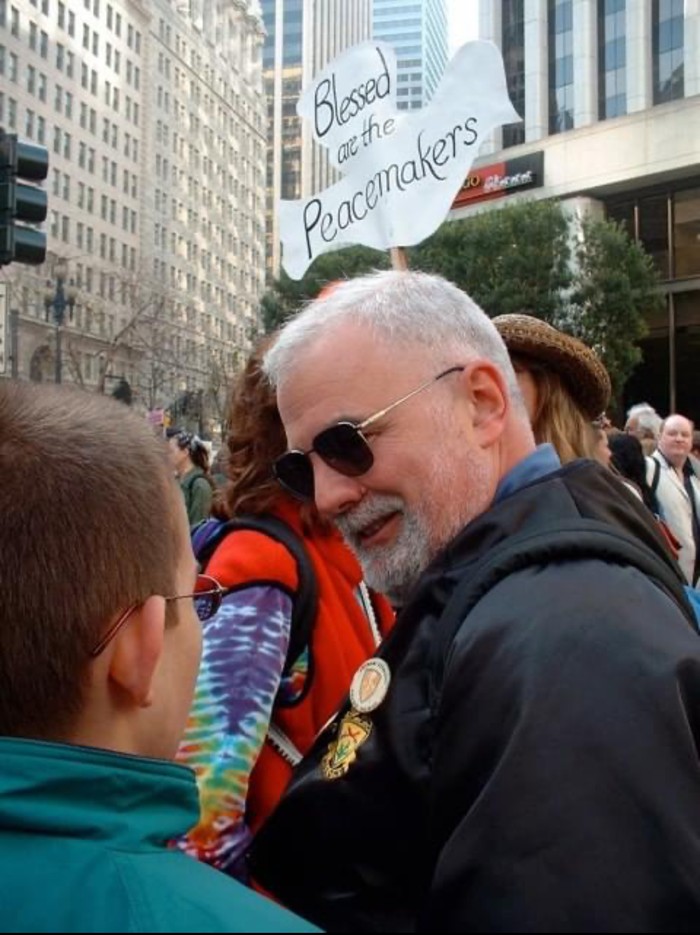
Not sure this was that demonstration, but a similar time period. My son Devlin in foreground--brought my kids up right, going to anti-war demonstrations from an early age! 


NB: when taking pix of people, always check to make sure there's nothing in the background that then appears to be growing out of their head. 


09/22/24 07:28 AM #17502    


Jay Shackford

Freedom Is Not What We Think It Is

The New York Times

Sept. 21, 2024


By Timothy Snyder

Dr. Snyder is a professor of history at Yale University and the author of “On Freedom.”


I know a town in southern Ukraine where every single house has been destroyed by shelling or bombing. Even the ruins are riddled by bullet holes. Posad-Pokrovske, in the Kherson region, was occupied by Russians for most of 2022, before they were driven out by the Ukrainian army.

I visited there a year ago and met Mariia. She was living in a corrugated-metal hut behind the rubble of her house, her possessions arranged neatly, water bottles in a line, extension cords from the generator well hidden. She was proud of her Ukrainian government and cried in sympathy with her president, Volodymyr Zelensky. He seemed so young to her. Mariia is 86.

When we spoke, in Ukrainian, she used the word “de-occupation” rather than the expected “liberation.” I had a draft of a book about freedom in my backpack. I got it out and made a note.

We like to think that people are free when the correct army arrives: a liberation. But removing evil is not enough. Mariia would be less free without her temporary dwelling, provided by an international organization. She will be more free when the lane through the rubble is wide enough for her walker, and when the buses are running again.


The Ukrainians don’t expect us to bring them freedom. One soldier told me to remind Americans that they don’t need our troops. They do need our weapons, as one tool of many to keep their futures open. No one can bring anyone else freedom. But freedom can arise from cooperation.


Ukrainians have to keep fighting because they know what Russian occupation means. They have every reason to think of freedom as negative, as just the removal of what is wrong. But in the hundreds of conversations I have now had with Ukrainians about freedom, including soldiers on the front this month, I have never heard anyone say that. Freedom is about moral commitments and multiple possibilities. The Ukrainians driving vans to the front and rebuilding houses also speak of their actions in terms of freedom.

In the ruins of the Kharkiv suburbs recently, and in the rubble of the Kherson region last year, I was reminded of a nurse who arrived at a Nazi concentration camp in 1945 after “liberation.” She wrote in her diary that this was not the correct word. Inmates could not be regarded as free, she thought, until they had been restored to health and their trauma was addressed.

To be sure, it matters when Russian power is removed from Ukraine. And of course it mattered when the SS fled the camps. No one is free behind barbed wire or under bombing, whether we are talking about the past or the present, about Xinjiang or Gaza or anywhere else.

But freedom is not just an absence of evil. Freedom is a presence of good. It is the value of values, the condition in which we choose and combine the good things, bringing them into the world, leaving our own unique trace. It is positive.


So long as Americans imagine freedom as negative, as a matter of getting rid of power, we will have no land of the free. We will have to listen to one another about how power can create the conditions of freedom. As conservatives say, virtue is real. As liberals believe, there are many virtues, which we have to consider and combine. And as social democrats maintain, we need to work together to create structures that allow us to do that work.

Freedom helps us know how to govern. Freedom, in my view, takes five forms, connecting philosophy to politics. The first, sovereignty, means the capacity of children to understand themselves and the world. We think of states as sovereign, but a politics that begins with freedom requires a government that helps make people so. The second, unpredictability, makes us unruly and lively. The third, mobility, is the multiplicity of paths across space and time that opens before us. The fourth, factuality, is the grip on the world that allows us to change it. And the fifth, solidarity, is the recognition that freedom must be for us all.

And the home of the brave? It is cowardly to believe that freedom is just negative, just an absence. When we think of freedom that way, we leave all the hard questions open: Who are we? What do we care about? For what will we take a risk? What we are really saying is that someone or something else will fill the void and do the work for us. A leader will tell us what to think. Or a market or a machine will do the thinking for us. Or it will be the founders who somehow did all the thinking long ago.

We need government to solve certain problems so that we can be free. Only a government will stop an invader or break up a monopoly. But that is just the beginning. When people have health care, they are less worried about the future and free to change jobs. When children have access to school, adults are more free to organize life. Children who learn can defend themselves against the lies of aspiring tyrants.

Freedom is national work. It takes a cooperative nation to create free individuals. That cooperation is called government. And freedom is generational work. For children to grow up free, the necessary institutions and policies must already be in place. Infants cannot create the conditions of their own upbringing. No young person can build the roads and the universities needed for the American dream. We have to always be looking ahead. It is this prospect, this sense of a better future enabled by present decisions, that makes a land of the free.


When we believe freedom is negative, we believe that we are always right. We separate ourselves from the outside world, believing that this is liberation. We end up in a safe space with other Americans who think the same way. Some outside force is supposed to make us free, and when it does not, we call our condition freedom anyway. We have an answer for everything: Whatever happens, the government is to blame. And so we live inside a story.

A free person knows that there is no one answer to everything and no single story for everybody. As I finished my book about freedom, I tried to listen to people whose predicaments were different from mine. Mariia was one of them. She got me thinking about de-occupation, about how we get from the negative to the positive. She smiled when she spoke to me, and offered me the one beautiful object she had rescued from her ruined house as a gift. I looked at her walker and thought about what more she needed to be free.

To be free, we have to see other people, not least to be able to see ourselves. If we understand freedom correctly, if we draw the right lessons from extreme situations, we can connect freedom to government. Then that better future awaits us: a beautiful range of possibilities for unpredictable, unruly people.


09/22/24 07:36 AM #17503    


Joanie Bender (Grosfeld)

Thanks for your Posts folks. Jay, I enjoyed the post re: Stephen Snyder. I have heard him talk on TV and he is very impressive to listen to...I agree with a lot of what was just written by others too.. As Joan said, where are the policies that are not based on lies for Trump and thanks Jack for mentioning the book that is about true life accounts of the Vietnam war regarding nurses and for your other points...Carole, nice to see your post and Stephen, nice you and Nori have such a special connection. I'm worried the way Republicans are trying to tamper with the election by things like pushing through hand counting ballots in Georgia and in Nebraska trying to make it winner take all when now one of the electors could go to the Democrat, etc. Trump is really planning to mess things up if he loses. We have to pray, even athiests that Trump doesn't win. (meant as a joke but with serious undertones). Love, Joanie


09/22/24 10:48 AM #17504    


Jack Mallory

Metaphorically praying daily, Joanie! Looks like we're not the only ones!


LiVE

"Election Live Updates: Harris Picks Up Backing of National Security Officials

"More than 700 members of the national security and military communities endorsed Vice President Kamala Harris . . . "

https://www.nytimes.com/live/2024/09/22/us/trump-harris-election?smid=nytcore-ios-share&referringSource=articleShare&sgrp=c-cb&ngrp=mnp&pvid=82A7493B-ECCD-4BB2-A2C8-0E821530D759


Probably all deep state commie vermin, as the First Felon might say.


09/23/24 11:59 AM #17505    


Jack Mallory

When Fall Comes to New England . . . (https://youtu.be/f9_Fij0mW48?si=0p_R8rJFPCobookp)


09/23/24 12:02 PM #17506    


Jay Shackford

(Editor's Note:  In recent months, Donald Trump has gone off the deep end claiming that a migrant crime wave and uptick in violent crimes generally are turning the U.S. into a third world nation.  Below is the first of two articles published by the Brennan Center for Justice and the PEW Research Center debunking  that political crazy talk by Old Bone Spurs.)


Brennan Center for Justice

Debunking the Myth of the ‘Migrant Crime Wave

Data does not support claims that the United States is experiencing a surge in crime caused by immigrants.

By Brianna Seid,
RosemaryNdiry, and
Ram Subramanian

May 29, 2024


In the past few months, politicians and certain media outlets have latched on to a narrative that recent immigrants, especially undocumented ones, are causing spikes in crime. Instead of gathering data and examining the issue empirically, they are making this broad assertion based on highly publicized individual incidents of crime by undocumented immigrants. All acts of violence must be taken seriously. But policymakers should not attribute blame to entire classes of people when individuals commit crimes.

The research does not support the view that immigrants commit crime or are incarcerated at higher rates than native-born Americans. In fact, immigrants might have less law enforcement contact compared to nonimmigrants. Focusing on the facts is imperative, especially given that immigration has become a top issue for voters ahead of the election.

Substantial research has assessed the relationship between immigration and crime. Numerous studies show that immigration is not linked to higher levels of crime, but rather the opposite. Studies have also examined the impact of the concentration of immigrants in a community on crime patterns, finding that immigration is associated with lower crime rates and an increase in structural factors — such as social connection and economic opportunity — that are linked to neighborhood safety.

When looking specifically at the relationship between undocumented immigrants and crime, researchers come to similar conclusions. Numerous studies show that undocumented immigration does not increase violent crime; research examining crime rates in so-called sanctuary cities also found no discernable difference when compared to similarly situated cities without sanctuary policies. One study that focused on drug crimes and driving under the influence found that unauthorized immigration status was associated with reductions in arrests for those offenses.

The research also shows that overall, immigrants have a similar or even lower likelihood of incarceration compared to native-born Americans, a trend that holds for immigrants from various source countries. For example, one study found that undocumented immigrants are 33 percent less likely to be incarcerated than people born in the United States. Indications of a negative relationship between immigration and crime also emerge when looking at conviction rates. In a Texas study, undocumented immigrants were found to be 47 percent less likely to be convicted of a crime in 2017 than native-born Americans. More recently, a study looked at census data over a 150-year period; since 1870, incarceration rates of immigrants are actually slightly lower than U.S.-born people and that gap widens in recent years with immigrants 60 percent less likely to be incarcerated than U.S.-born citizens.

Despite claims from conservative media and campaign rhetoric pointing to immigration as the cause of crime increases, there is no evidence that immigration — and in particular the recent influx of immigrants to Democratic-run cities — is causing a “crime wave.” For one, direct data on the causes behind recent increases in crime is limited, especially as it relates to undocumented immigrants. Crime is complicated – attempting to isolate single factors to explain crime trends, especially when the full impact of the Covid-19 pandemic is still being born out, would be misguided. However, some factors to consider are the socioeconomic instability largely caused by the pandemic, gun violence and an increased prevalence of guns in communities, and disruptions to community life and increased social isolation. Although some policymakers and media pundits readily assume a correlation, research does not substantiate the assumption that any increase in crime is caused by the recent influx of immigrants.

What’s more, the arrival of record numbers of immigrants at the United States–Mexico border over the past two years has not corresponded with an overall increase in crime in so-called “blue” cities where many of the recent arrivals have settled. In most places, the opposite has happened — crime, including violent crime, has trended downward (other than larceny and a small increase in robbery) after peaking across the country in 2020. This has been true since the spring of 2022, the year Republican governors, including those in Arizona, Florida, and Texas, began transporting undocumented immigrants to cities with more immigrant-friendly policies, including BostonChicagoNew York, and Washington.

As a recent NBC News analysis shows, crime overall was down in most of the cities targeted by Texas from April 2022 through 2023, though Washington is a notable exception. According to an analysis by the Council on Criminal Justice, crime has dropped since April 2022 across many categories, such as aggravated assault (including assault committed with a firearm) and carjackings, in most of the cities where information was reported. Where increases did occur, including in the categories of robbery and shoplifting, those trends began in 2021, before the current upsurge in undocumented immigrants. Nor has there been a surge in violent crime in states and counties along the U.S-Mexico border corresponding to larger immigration flows. 

In New York, a sanctuary city that has received the most immigrants from Republican-run border states, crime decreased in most major categories in 2023 compared to the year before, as confirmed by a January report from the New York City Police Department. This follows reductions in most crime categories in the city in 2022. New York City remains one of the safest big cities in the country despite sensational claims that it is being overwhelmed by crime.

Although some have tried to portray the areas of New York City where immigrants are temporarily being housed as crime-ridden, the existing data does not support that contention. In four precincts that have large migrant sheltersdata shows no unifying trend in crime rates. One precinct saw a drop in crime rates, two saw a rise, and one remained static.

Narratives equating immigrants with danger and criminality are nothing new. They gain prominence in public discourse in a cyclical fashion, typically after surges in immigration. Waves of immigration by new groups — historically, Irish, Catholic, Jewish, Italian, Mexican, Japanese, Chinese, and German people — were often followed by backlashes linking them with crime and disorder. This is centuries-old discourse aimed primarily at boosting a contemporaneous politics of exclusion, not one seriously concerned about the true causes of crime.

A 1931 report by the National Commission of Law and Enforcement acknowledged this: “The theory that immigration is responsible for crime, that the most recent ‘wave of immigration,’ whatever the nationality, is less desirable than the old ones, that all newcomers should be regarded with an attitude of suspicion, is a theory that is almost as old as the colonies planted by Englishmen on the New England coast.”

Perpetuating this myth today may be counterproductive to public safety, particularly when decision-makers adopt policies that target whole communities. Such policies can potentially fracture communities — for example, by breaking up millions of mixed-status households. They may also harm police-community relationships by increasing the risk that punitive immigration enforcement could increase immigrants’ fear of law enforcement and reluctance to report crime.

Painting all immigrants with a broad brush can perpetuate harmful stereotypes that help foster hostility toward their communities. This in turn can have a detrimental impact on law enforcement’s ability to conduct investigations and eventually hold perpetrators accountable; many people may not report crimes to police or cooperate with an investigation or prosecution due to distrust and fear of retaliation based on their immigration status. It can also detract from efforts to address the reasons why some people commit crime, be it economic conditions, behavioral health issues, or poverty.

All told, the factors that drive crime rates are extraordinarily complex and can rarely be reduced to one cause. Policymakers should refrain from blaming immigrants as a group for increased crime where data does not substantiate those claims. Doing otherwise will hinder the development of effective crime prevention policies that can help make communities safer for everyone.


09/23/24 12:05 PM #17507    


Jay Shackford

What the data says about crime in the U.S.

April 24, 2024

JOHN GRAMLICH/PEW Research Center


A growing share of Americans say reducing crime should be a top priority for the president and Congress to address this year. Around six-in-ten U.S. adults (58%) hold that view today, up from 47% at the beginning of Joe Biden’s presidency in 2021.


With the issue likely to come up in this year’s presidential election, here’s what we know about crime in the United States, based on the latest available data from the federal government and other sources.


How much crime is there in the U.S.?


It’s difficult to say for certain. The two primary sources of government crime statistics – the Federal Bureau of Investigation (FBI) and the Bureau of Justice Statistics (BJS) – paint an incomplete picture.


The FBI publishes annual data on crimes that have been reported to law enforcement, but not crimes that haven’t been reported. Historically, the FBI has also only published statistics about a handful of specific violent and property crimes, but not many other types of crime, such as drug crime. And while the FBI’s data is based on information from thousands of federal, state, county, city and other police departments, not all law enforcement agencies participate every year. In 2022, the most recent full year with available statistics, the FBI received data from 83% of participating agencies.


BJS, for its part, tracks crime by fielding a large annual survey of Americans ages 12 and older and asking them whether they were the victim of certain types of crime in the past six months. One advantage of this approach is that it captures both reported and unreported crimes. But the BJS survey has limitations of its own. Like the FBI, it focuses mainly on a handful of violent and property crimes. And since the BJS data is based on after-the-fact interviews with crime victims, it cannot provide information about one especially high-profile type of offense: murder.


All those caveats aside, looking at the FBI and BJS statistics side-by-side does give researchers a good picture of U.S. violent and property crime rates and how they have changed over time. In addition, the FBI is transitioning to a new data collection system – known as the National Incident-Based Reporting System – that eventually will provide national information on a much larger set of crimes, as well as details such as the time and place they occur and the types of weapons involved, if applicable.


Which kinds of crime are most and least common?


Property crime in the U.S. is much more common than violent crime. In 2022, the FBI reported a total of 1,954.4 property crimes per 100,000 people, compared with 380.7 violent crimes per 100,000 people.  


By far the most common form of property crime in 2022 was larceny/theft, followed by motor vehicle theft and burglary. Among violent crimes, aggravated assault was the most common offense, followed by robbery, rape, and murder/nonnegligent manslaughter.


BJS tracks a slightly different set of offenses from the FBI, but it finds the same overall patterns, with theft the most common form of property crime in 2022 and assault the most common form of violent crime.


How have crime rates in the U.S. changed over time?


Both the FBI and BJS data show dramatic declines in U.S. violent and property crime rates since the early 1990s, when crime spiked across much of the nation.


Using the FBI data, the violent crime rate fell 49% between 1993 and 2022, with large decreases in the rates of robbery (-74%), aggravated assault (-39%) and murder/nonnegligent manslaughter (-34%). It’s not possible to calculate the change in the rape rate during this period because the FBI revised its definition of the offense in 2013.


pastedGraphic.png

The FBI data also shows a 59% reduction in the U.S. property crime rate between 1993 and 2022, with big declines in the rates of burglary (-75%), larceny/theft (-54%) and motor vehicle theft (-53%).


Using the BJS statistics, the declines in the violent and property crime rates are even steeper than those captured in the FBI data. Per BJS, the U.S. violent and property crime rates each fell 71% between 1993 and 2022.


While crime rates have fallen sharply over the long term, the decline hasn’t always been steady. There have been notable increases in certain kinds of crime in some years, including recently.

In 2020, for example, the U.S. murder rate saw its largest single-year increase on record – and by 2022, it remained considerably higher than before the coronavirus pandemic. Preliminary data for 2023, however, suggests that the murder rate fell substantially last year.


How do Americans perceive crime in their country?


Americans tend to believe crime is up, even when official data shows it is down.


In 23 of 27 Gallup surveys conducted since 1993, at least 60% of U.S. adults have said there is more crime nationally than there was the year before, despite the downward trend in crime rates during most of that period.

pastedGraphic_1.png

While perceptions of rising crime at the national level are common, fewer Americans believe crime is up in their own communities. In every Gallup crime survey since the 1990s, Americans have been much less likely to say crime is up in their area than to say the same about crime nationally.


Public attitudes about crime differ widely by Americans’ party affiliation, race and ethnicity, and other factors. For example, Republicans and Republican-leaning independents are much more likely than Democrats and Democratic leaners to say reducing crime should be a top priority for the president and Congress this year (68% vs. 47%), according to a recent Pew Research Center survey.


09/23/24 04:59 PM #17508    


Jack Mallory

​There you go again, Jay, all those facts! Encouraging people to confuse their honest opinions with evidence! Opinions don' need no steenkin' evidence! "Preliminary data" (eeek, the data word!) and "%"s and "per 100,000"s! Flagrant use of the obscenity "research" in a family forum! Eeew!

We know your type. After the election, people like you will pay. "Sometimes revenge can be justified."


09/23/24 05:34 PM #17509    


Jay Shackford

The MAGA Movement Has 

Become a Problem for Trump


By Ezra Klein

Opinion Columnist/The New York Times

Sept. 22, 2024


In 2024, the deep state that defeats Donald Trump might be his own.

That, after all, is what Project 2025 was actually meant to be. The 900-page tome that Democrats hoist in front of the cameras is a festival of policy options, detailed down to the sub-agency level. But options for whom? Not for Trump himself. Even the most wonkish of presidents can only engage on a small fraction of what the executive branch does. And Donald Trump was not the most wonkish of presidents. When he said, during his debate with Kamala Harris, that he hadn’t read Project 2025 and has no intention of doing so, I believed him.

But Project 2025 — and much else like it that has gotten less press — is more than a compendium of policy proposals: It is an effort to build a deep state of Trump’s own. The presidency is not one man, Diet Coke in hand, Fox & Friends on TV, barking orders. It’s 4,000-or-so political appointees — nearer to 50,000 if Trump again uses Schedule F powers to strip civil-service protections from vast swaths of the federal government — trying to do what they think the president wants them to do or what they think needs to be done. They do that by setting policy for the more than two million civilian employees of the federal government and by writing regulations that the rest of society must follow.

Veterans of Trump’s administration believe personnel was their biggest problem. They could not act ambitiously or swiftly enough because they were at constant war with the government they, in theory, controlled. Part of this reflected Trump’s erratic leadership style and the constant conflict between the warring factions inside his White House: the traditional Republicans clustered around Mike Pence and Reince Priebus; the MAGA types led by Steve Bannon and Stephen Miller; the foreign policy establishment that spoke through H.R. McMaster and Nikki Haley; the corporatists led by Jared Kushner and Gary Cohn. Read any book on the Trump presidency, and you will be buried in examples of Trump’s top appointees trying to foil each other — and him.

But some of it reflected a federal bureaucracy that resisted Trump and the people he appointed. In a presentation at the 2024 National Conservatism conference in Washington, Katy Talento, who oversaw health care policy on Trump’s Domestic Policy Council, described the obstacles she faced:

There’s like a handful of political appointees at an agency with hundreds of thousands of employees and maybe one or two of those appointees is sufficiently experienced to write regulations. They can’t seek any help from experienced but hostile bureaucrats that surround them, or those drafts get leaked, or bad advice gets provided, and poison pills get put into regs, drafts get slowed down or scuttled all together. So this dramatically limits the productivity potential of a Republican administration.


This is the problem groups like Project 2025 set out to solve. Behind the policy playbook sits a database of around 20,000 applicants ready to be part of the next Trump administration. And that database is still growing. There is an online portal that, even now, invites applicants to apply for inclusion in “the Presidential Personnel Database.” It goes on to say that “with the right conservative policy recommendations and properly vetted and trained personnel to implement them, we will take back our government.”


To do that, the next Trump administration must first clear out or conquer the federal government that currently exists. Project 2025 is obsessed with this task and many of its 900-some pages are dedicated to plans and theories for how this might be done.


“The great challenge confronting a conservative President is the existential need for aggressive use of the vast powers of the executive branch to return power — including power currently held by the executive branch — to the American people,” writes Russ Vought, Trump’s former director of the Office of Management and Budget, in one of its chapters. Victory will require the “boldness to bend or break the bureaucracy to the presidential will.”

This, I would say, is the unifying theory of a second Trump term. Purge or break the federal bureaucracy. Fill it with vetted loyalists. Then use its power to pass policy, yes, but also to break or conquer the other institutions in American life that so vex Trump and his supporters. “We are in the process of the second American Revolution, which will remain bloodless if the left allows it to be,” Kevin Roberts, the president of the Heritage Foundation, which oversaw Project 2025, said in July.

By all accounts, Trump and his campaign are furious that Project 2025 has been hung like a millstone around his neck. But there are two reasons their disavowals have counted for little. The first is that the campaign has treated Trump’s policy plans like a secret the public can only be let in on after his victory. His issues page is a joke, his official platform a Delphic collection of all-caps aphorisms backed up by the occasional bullet point.

The next Trump administration will do far more than the Trump campaign is describing, and Project 2025 — which was produced with input from more than 100 conservative organizations that see themselves as part of the MAGA-governing coalition — filled the void that Trump himself has left. He did not tell us what he was going to do, so Project 2025 did.


The second is that Trump’s 2024 campaign differs from his 2016 campaign in a fundamental way. In 2016, Trump ran as the destroyer of the existing Republican coalition. He won by humiliating the politicians who had held power before him, but he did not, during that campaign, attempt to replace them. And so Trump presided over a kind of uneasy coalition government with the Republican Party of Paul Ryan and Mitch McConnell. His major domestic policy projects reflected that coalition: Repeal of Obamacare was what united congressional Republicans in 2016, so that’s what the Trump administration attempted in 2017. Cutting corporate taxes is what got Speaker Ryan out of bed in the morning, so that is what the Trump administration turned to next.

But now Trump is the leader of the Republican coalition. He cannot credibly divorce himself from the groups working day and night to secure his victory and staff his presidency. There is no competing power center that the media or the public can assume will do the governing that so bores Trump. But Trump is not temperamentally suited to the work of managing a coalition and he has not elevated a trusted ideological consigliere to do it for him. He is a diffident, distracted ruler, and the result is dozens of groups competing for his favor and unsure of how to win it.

The Heritage Foundation was one of these groups and Project 2025 their signature effort. In 2021, Roberts took over Heritage and retooled it into an organization dedicated to “institutionalizing Trumpism.” He sought centrality through both scale and publicity: Project 2025 was a vast undertaking, and Roberts promoted it relentlessly. This is now seen as folly, but it is easy enough to follow the original logic: Heritage has experience putting together governing documents for insurgent candidates, going back to the Mandate for Leadership that Ronald Reagan relied on in 1981, and Trump often rewards the loyalists he notices fighting for him in public. But Roberts went too far.

“The problem, which I had always suspected, was that very few plans survive contact with Donald Trump,” said Matthew Continetti, the author of “The Right: The Hundred-Year War for American Conservatism.” “He always wants to maintain maximum flexibility and maximum maneuverability in order to improve his position at any given moment. So he was not just going to turn around and say, yes, Project 2025 is exactly what my program will be, and it’s exactly who I plan to have in my administration.”

But if Trump wins, he will need plans and he will need people. And so the problems that Project 2025 has caused for Trump in the campaign would also bedevil his presidency.


The MAGA coalition — particularly its elected officials and Washington staffer class — has grown beyond Trump. It has more views on more issues than he does. It has absorbed more specific and unusual ideologies than he has. It is more hostile to abortion than he is, or than he wants to appear to be. It is more committed to deregulating health insurance than he is, or than he wants to appear to be. There is a great gap between the MAGA leader who slept with a porn star and the factions in the MAGA movement that want to outlaw pornography, as Roberts proposed on Project 2025’s first page.

Trumpism is whatever Trump says it is, but MAGA is whatever his movement becomes. This is why JD Vance has been a political liability to Trump’s campaign: Vance represents MAGA as it has evolved — esoterically ideological, deeply resentful, terminally online — unleavened by Trump’s instincts for showmanship and the winds of public sentiment. It is telling that it is Vance, not Trump, who wrote a glowing foreword to Roberts’s forthcoming book. Trump is where MAGA started, but Vance and Roberts is where it is going.

Trump’s problem in the 2024 election is that he can no longer run as if he is a man alone. Everyone knew Mike Pence did not represent Trumpism. But Trump chose Vance to be the heir of the MAGA movement. A Trump administration would be full of people like Vance pursuing the agendas they believe in. In the Talento presentation I mentioned, she describes the Biden administration as “a federal leviathan that is killing our babies” and argues that “every cabinet secretary who comes into a new, hopefully Republican administration will have a pro-life agenda that they must enact.” This is not Trump’s election-year message but it would be his administration’s reality.

Another Trump administration would be filled with people pursuing agendas like this at every level, and properly so: That is what coalitions do when they win elections. But this is why Trump’s disavowals ring so false: He is denying a reality of his second term that everyone else can plainly see. Project 2025 is not a perfect guide to that second term, but it’s the closest thing we have to one. It was all so much easier when the deep state was something Trump could complain about, rather than something he had to manage and own.


09/23/24 10:18 PM #17510    


Joanie Bender (Grosfeld)

This sign shows Donald Trumps reaction to another debate.After scrolling down you will see the Trump Chicken sign!!!   Love, Joanie

https://news.yahoo.com/news/dnc-trolls-trump-photos-him-192508317.html


09/24/24 09:50 AM #17511    


Jay Shackford

Donald Trump’s imaginary and frightening world


Analysis by Ashley Parker/The Washington Post

September 23, 2024


In Donald Trump’s imaginary world, Americans can’t venture out to buy a loaf of bread without getting shot, mugged or raped. Immigrants in a small Ohio town eat their neighbors’ cats and dogs. World War III and economic collapse are just around the corner. And kids head off to school only to return at day’s end having undergone gender confirming surgery.


The former president’s imaginary world is a dark, dystopian place, described by Trump in his rallies, interviews, social media posts and debate appearances to paint an alarming picture of America under the Biden-Harris administration.


It is a distorted, warped and, at times, absurdist portrait of a nation where the insurrectionists who stormed the U.S. Capitol on Jan. 6, 2021, to deadly effect were merely peaceful protesters, and where unlucky boaters are faced with the unappealing choice between electrocution or a shark attack. His extreme caricatures also serve as another way for Trump to traffic in lies and misinformation, using an alternate reality of his own making to create an often terrifying — and, he seems to hope — politically devastating landscape for his political opponents.


Trump, for instance, regularly claims that Democrats favor abortions up until the day of birth — and, in some cases, even after birth.


Speaking at the Sept. 10 presidential debate with Vice President Kamala Harris in Philadelphia, Trump falsely claimed that Harris’s running mate, Minnesota Gov. Tim Walz, has said “abortion in the ninth month is absolutely fine.


“He also says, ‘execution after birth’ — execution, no longer abortion because the baby is born — is okay, Trump continued.


In fact, Walz has not said this, The Washington Post Fact Checker found, and “execution after birth” — or infanticide — is illegal in all states. According to the Centers for Disease Control and Prevention, in 2021, nearly all abortions — 93.5 percent — occur at or before 13 weeks, and fewer than 1 percent were performed after 21 weeks.


World War III, too, is another all-but-certainty should Trump not be elected in November, the former president frequently claims. In July, before a meeting with Israeli Prime Minister Benjamin Netanyahu at his private Mar-a-Lago Club, Trump told reporters that only his electoral victory could stave off another global conflagration.


“If we win, it’ll be very simple. It’s all going to work out and very quickly,” Trump said. “If we don’t, you’re going to end up with major wars in the Middle East and maybe a Third World War. You are closer to a Third World War right now than at any time since the Second World War. You’ve never been so close, because we have incompetent people running our country.”


And this month, shortly after news that former Republican vice president Dick Cheney and his daughter, Liz Cheney, a former Republican congresswoman from Wyoming, planned to vote for Harris, Trump took to his Truth Social site to attack them. “I am the Peace President, and only I will stop World War III!” he claimed.


“He’s not the same candidate he was in 2016 or 2020,” said Simon Rosenberg, a Democratic strategist who took note of Trump’s “imaginary world” in a post on X this month. “He’s far more diminished and untethered.”


“The percentage of time he’s spending in the real world versus his dystopian world is decreasing. He’s just not speaking about things that are true in this world that we all live in,” Rosenberg said.


“It is true that economic hardships, border tragedies, and two new wars have broken out under Vice President Kamala Harris and four more years of her policies will only make the pain and suffering worse,” said Karoline Leavitt, the Trump campaign’s national press secretary, in a statement. “President Trump speaks the hard truth about this reality and has an optimistic vision for the future to make America strong, safe, and prosperous again by securing the border, cutting taxes, bringing down inflation, and restoring peace around the world, like there was during his first term.”


Asked to provide specific examples of all of the claims Trump has alleged, Leavitt sent over a list that in some cases — like schools performing sex reassignment surgery — did not provide any evidence of the assertions. In other cases — such as not being able to buy groceries without getting accosted — Leavitt offered several examples of such crimes, but not the mass phenomena justifying Trump’s claim that “you can’t walk across the street to get a loaf of bread; you get shot, you get mugged, you get raped.”


Among Trump’s supporters, some seem to accept his false claims as unassailable truths, while others say he sometimes exaggerates — but in doing so accurately captures their fears about real issues facing the nation.


“I don’t think he does stretch the truth,” said Trump supporter Marelee Ernestberg, 59, as she defended some of his more extreme falsehoods, including his baseless claim about Haitian migrants eating pets, which she called “an absolute truth” that did not surprise her. “Trump is not a liar.”


Speaking at her first Trump rally in Las Vegas earlier this month, Ernestberg pivoted when discussing Trump’s claim that children are being given gender confirming surgeries in school — and said that she does not care about the list of falsehoods.


“Now, of course, everybody exaggerates. … Trump’s not perfect, and when I’m looking at a candidate, I’m not looking for perfection. I’m not going to marry the guy,” she said. “I’m not looking for a spouse. I’m looking for someone who’s going to bring this country to a safer, more secure place.”


Immigration is another topic ripe for Trump’s land of make-believe. For example, the former president repeatedly references Hannibal Lecter, the fictional serial killer from “The Silence of the Lambs,” as a way of conflating migrants seeking asylum with people in mental institutions to suggest without evidence — but with dehumanizing language — that those crossing the U.S.-Mexico border are migrants from insane asylums.


We have people that are being released into our country that we don’t want in our country,” Trump told a Wildwood, N.J., crowd in May, after mentioning “the late, great Hannibal Lecter.”

Trump also regularly claims that the government is putting up undocumented immigrants in “luxury hotels.” In Manhattan, for instance, the city has spent millions converting motels, office buildings and even some upscale hotels into housing for thousands of migrants, but the accommodations are shelter operations, not five-star opulence.


“You have soldiers right now laying on the streets of different cities, all Democrat-run. They’re laying on the streets in front of hotels, in some cases luxury hotels, and you have illegal immigrants coming in and living in those hotels and laughing at our soldiers, as they walk by into a luxury lobby,” Trump said during an economic speech in New York this month. “Is there something wrong with that thinking? Is there something wrong with our country?”


And recently Trump has also begun falsely claiming that a Venezuelan gang has overtaken an apartment complex in Aurora, Colo. — prompting the local police department to release a video statement explaining that after talking to the residents, they are seeing a “different picture.” Yes, the police chief continued, some gang members do live in the Aurora community, but “gang members have not taken over this complex.”


Trump, however, was undaunted.


“You saw in Aurora, Colorado, a group of very tough young thugs from Venezuela taking over big areas, including buildings,” Trump told a podcast, despite the police statement to the contrary. “They’re taking over buildings. They have their big rifles. But they’re taking over buildings. We’re not going to let this happen.”


At the presidential debate, an agitated Trump repeated the baseless claim that Haitian immigrants in Springfield, Ohio, are eating the town’s pets.


“In Springfield, they’re eating the dogs,” Trump said. “The people that came in — they’re eating the cats. They’re eating — they’re eating the pets of the people that live there.”


It is also a continuation of Trump’s perpetual lying and obfuscating; in Trump’s presidency alone, an analysis by The Post’s Fact Checker found that he made more than 30,000 false or misleading claims — an average of about 21 untruths per day.


Another favorite claim Trump offers is that tourists come to the nation’s capital hoping to see the sights — and end up traveling home in body bags. 


Accepting his party’s nomination in Milwaukee in July, Trump lambasted the nation’s capital, calling it “a horrible killing field.”


Crime in D.C. did increase between 2022 and 2023, when all crime went up 26 percent — and violent crime increased by 39 percent, according to the D.C. police. But so far this year, both crimes are down from the 2023 numbers.


Recently, there have been several high profile instances of out-of-towners being killed while in D.C. — including a woman visiting the city for a concert and a teacher visiting for a conference — but Trump’s rhetoric is deeply overstated.


“They leave from Wisconsin, they go to look at the Washington Monument, they end up getting stabbed, killed or shot,” Trump said in Milwaukee.

The former president has also seized on gender confirming surgery as another area in which to embellish.


“Can you imagine you’re a parent and your son leaves the house and you say, ‘Jimmy, I love you so much. Go have a good day in school’ — and your son comes back with a brutal operation,” Trump said at a rally in Wisconsin this month.


Then, speaking in Arizona last Thursday, Trump spun a similar fictional tale.


“Can you imagine?” the former president asked. “Your child goes to school and they don’t even call you, and they change the sex of your child.”


Many of Trump’s imaginary scenarios go unchecked in real time, in part because he delivers them to adoring crowds or favorable news outlets. But at this month’s debate, the moderators were primed for his fictitious world.


After Trump made his claim about immigrants eating cats and dogs, ABC News’s David Muir interjected: “You bring up Springfield, Ohio, and ABC News did reach out to the city manager there. He told us there have been no credible reports of specific claims of pets being harmed, injured or abused by individuals within the immigrant community.”


But Trump persisted.


“The people on television say my dog was taken and used for food!” Trump insisted, turning to the often make-believe world of television to buttress his own imagined fantasy.


Abbie Cheeseman in Las Vegas contributed to this report.


09/24/24 11:59 AM #17512    


Joanie Bender (Grosfeld)

Thanks Jay. I like Ashley Parker and this article she wrote really sums up the Trump lies. I know someone I've debated some about politics who is a Trump supporter and he made a big deal about the so called numerous lies he said Kamala made during the debate and said nothing about the Trump lies. The most I could find from his complaints was that there wasn't obvious evidence she worked at McDonalds.  Wow that would be so egregious and cause such suffering to the country if she didn't really work at McDonalds. Compare that to Trump calling immigrants vermin and saying they poison America and take Black and Latino jobs. (talk about fostering devisiveness) Then recently he targeted Haitians in Springfield, Ohio saying they eat peoples pets. Also, he set the Jews up to be blamed if he loses the election.  There already is antisemitism in the US without Trump pointing the finger at Jewish folks. Love, Joanie


09/24/24 03:01 PM #17513    


Jack Mallory

Taking a break from election season on Grafton Pond. This is the third Trump election fall--I've never seen a Trump or MAGA sticker on a vehicle at a put-in. All at the golf course, I guess. 


go to top 
  Post Message
  
    Prior Page
 Page  
Next Page      

agape