|
Jay Shackford
CAN DONALD TRUMP WIN A WAR WITH
IRAN IF HE CAN’T EXPLAIN WHY HE STARTED IT?
So far, explanations are few and the goals—from regime change to ending a nuclear program the President already claimed to have “obliterated”—are many.
By Susan B. Glasser
March 2, 2026
In the two and a half days since Donald Trump unleashed a new war in the Middle East, the President and his Administration have come up with an astonishing array of different, even contradictory, rationales for the American military attack on Iran. By my count, and I’m sure I’ve missed a few, these include outright regime change, assistance to the oppressed peoples of the Islamic Republic, stripping Iran of “the ability to project power outside its borders,” stopping future Iranian-sponsored terrorist attacks while exacting revenge for past ones, preëmptive action against an imminent Iranian threat to attack U.S. forces, preëmptive action to block Iran from building ballistic missiles that could hit the U.S. mainland, and preëmptive action to stop the Iranian nuclear program that Trump had, as recently as last week, claimed was “obliterated.” Many of these explanations are based on false premises; some already seem to have been abandoned.
All of which raises perhaps the most urgent question thus far about the most dramatic military action undertaken by the United States since the 2003 invasion of Iraq: Can the U.S. win a war of its choosing when it cannot explain why it chose to fight or what, exactly, victory would mean?
Trump himself has been the author of most of the confusion. In an eight-minute video, which was released in the predawn hours of Saturday morning, soon after the strikes began, the President vaguely warned of “imminent threats,” while offering a litany of decades-old complaints about Iran’s long and deadly campaign of terror against the U.S. and its allies. His call for regime change was explicit, though the level of American assistance to achieve that was notably ambiguous: he told Iranians that “the hour of your freedom is at hand” and “now you have a President who is giving you what you want,” and he called on them to help topple “this very wicked, radical dictatorship.”
But in several quick phone interviews that he conducted with various news outlets over the weekend Trump offered a different vision for victory, suggesting to the Times that “the perfect scenario” would be a repeat of his recent intervention in Venezuela, where, after removing Nicolás Maduro from power, he abandoned the U.S.’s long-standing support for the democratic opposition and endorsed Maduro’s Vice-President to run the country. As for Iranians choosing who would rule them, our democratically elected President seemed to rule that out, all but announcing that he and he alone would pick who would run the country next.
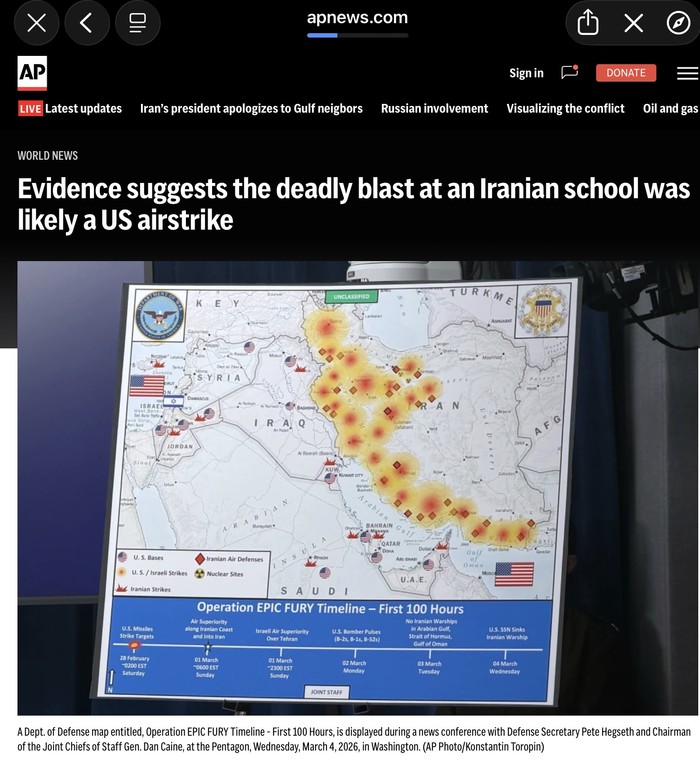
On Monday morning, the Pentagon leadership held its first press conference since the start of the attacks, and the Defense Secretary, Pete Hegseth, responded to the increasingly loud concerns about what the U.S. hoped to achieve by saying that the goal of Operation Epic Fury was to “destroy” Iran’s Navy, its missiles, and its nuclear ambitions. “This is not a so-called regime-change war,” he insisted, “but the regime did change.” Like much of what we’ve heard from the Trump Administration over the past few days, this was both confusing and misleading—Iran’s Supreme Leader, Ayatollah Ali Khamenei, was killed in the first wave of strikes, but his repressive government, at least for now, remains. The Secretary of State, Marco Rubio, hardly cleared things up when he announced, a few hours later, that the focus of the operation was “destruction of their ballistic-missile capabilities,” with regime change downgraded to a “hope,” not an “objective.”
When the President, in his first public remarks about the military campaign, appeared at the White House on Monday, he didn’t say a word about regime change, aspirational or otherwise, or even nod to the brave protesters whom he had so recently urged to rise up against their leaders. He also did not discuss the consequences—from oil-price spikes to possible terrorist reprisals in the U.S.—that Americans can expect as the war unfolds. Nor did he so much as mention America’s partner in the war, Israel, or the conflict’s rapid spread—Iran has already launched retaliatory strikes on Bahrain, Jordan, Kuwait, Iraq, Israel, Oman, Qatar, Saudi Arabia, and the United Arab Emirates, which have made this the widest-ranging war in the Middle East in decades.
But you wouldn’t have known that from Trump’s few sentences of bluster. He offered no evidence beyond bald assertion that Iran posed an “intolerable threat” to the region and the American people. Nor did he explain why he had initiated this war without permission from Congress or a more robust effort to seek the approval of the public, who, according to polls since the strikes began, are not in favor of Trump’s action. Perhaps most remarkably, as a politician who has spent years promising his followers “no new wars” and an end to the folly of endless U.S. military engagement in the quagmire of the Middle East, he did not even bother to address his epic flip-flop from war-hater to warmonger.
He did, however, promise to remain intensely focussed on defeating Iran for however long it takes, even if that turned out to be “far longer” than four to five weeks, which is how long he said he expected the war to last. “I don’t get bored,” he insisted. “There’s nothing boring about this.” Forty-six seconds later, he began waxing about the “very, very beautiful” new White House ballroom he’s building, which he thinks will be “the most beautiful ballroom anywhere in the world.”
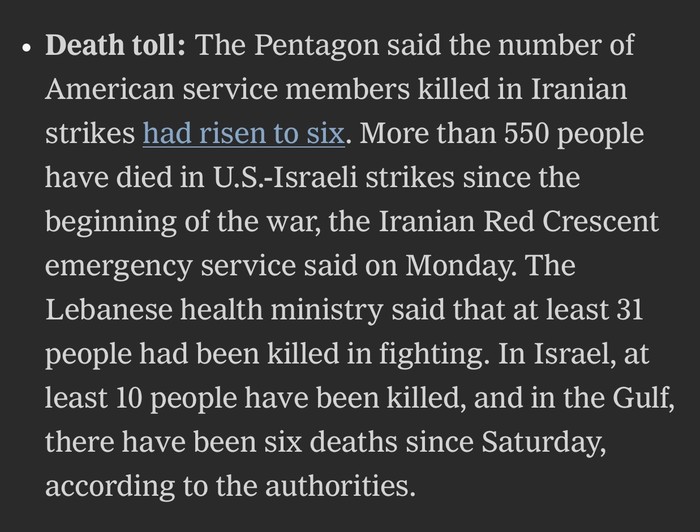
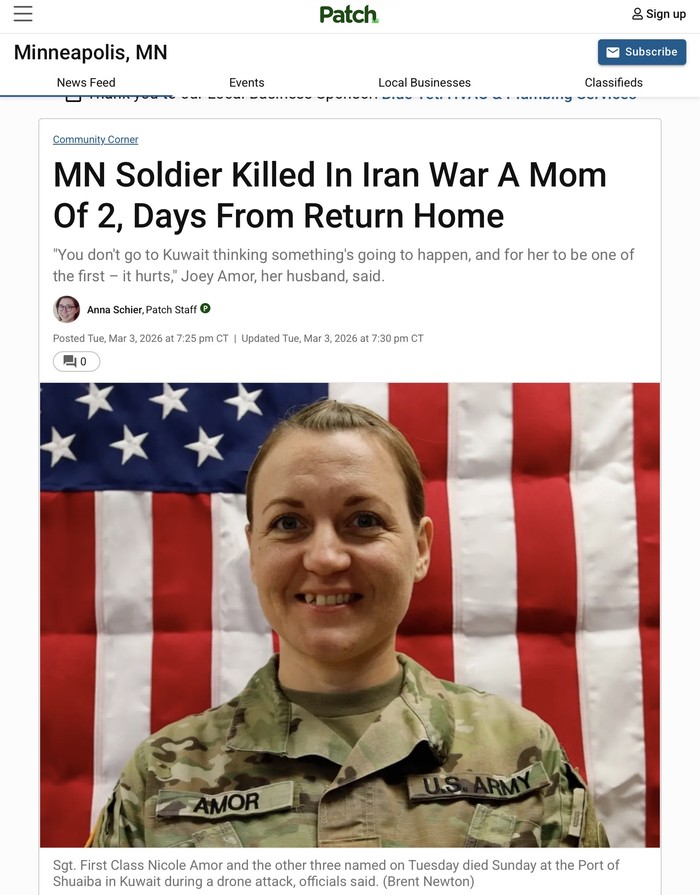
If there has ever been a more politically tone-deaf pivot from an American President, I can’t think of one. In fact, until Trump came along, I am pretty sure there has never been a White House speech that veered from sombre matters of war and peace to our Commander-in-Chief’s brilliant interior-design decisions. Six U.S. service members have so far died in this war, and Trump has acknowledged that there will “likely” be more. But what he really seems to care about is the color of the White House drapes.
There is a certain method to this madness, of course. As Robert Satloff, director of the Washington Institute for Near East Policy, observed to me on Monday, Trump, by presenting a “Chinese menu of possible objectives,” spanning “everything from total regime change to getting rid of the nuclear program and all variations in between,” is leaving open the possibility to claim victory no matter what happens. In the end, “it will be what Trump says in retrospect was the objective.”
The question of why Trump did this might be almost as hard to answer as what he hopes to achieve. During his first term, Trump repeatedly confronted the possibility of large-scale action against Iran, but pulled back, siding with military advisers who counselled caution, such as his first-term Defense Secretary, Jim Mattis, over his more hawkish aides, including the national-security adviser John Bolton and Secretary of State Mike Pompeo, who were longtime advocates of striking Iran. “His risk tolerance was lower then,” one of Trump’s senior national-security officials from his first term recalled. “More of his notion was to get out of things rather than to get into them.”
Part of the difference can be explained by personnel: Trump, in his second term, is advised by a collection of sycophants purposely selected to say yes to whatever he wants. Another crucial difference is the facts on the ground in the Middle East, which has been transformed since the terrorist attack on Israel by the Iranian-funded proxy group Hamas on October 7, 2023. Israel’s response has been not only to wage war on Hamas in Gaza but to effectively destroy much of Iran’s regional capabilities and, acting in concert with Trump last June, to knock out key facilities associated with its nuclear program. Despite Trump’s loud claims of imminent attack, the most rational case for his decision to launch the war now is to take advantage of Iran’s weakness, not its strength.
To a legacy-obsessed leader who is seeking opportunities to write his name in the history books, the chance to topple a regime that has tormented American Presidents since 1979 may have been simply too tantalizing to turn down. All the more so because Trump has gotten used to the sheer rush from his repeated, relatively low-risk, high-reward deployments of American force around the world. America’s most performatively macho President has always been attracted to spectacular displays of military power; in his first year back in office, he ordered attacks on seven different nations—more than any other modern President.
Last year, when Trump insisted on renaming the Department of Defense as the Department of War, despite not having the legal authority to do so, it might have seemed a discordant note from a draft dodger who was, at the time, insistent upon styling himself the “President of PEACE.” But, to me, it was the moment when this conflict took on a certain inevitability: when he created a War Department, sooner or later he was always going to have to have a real war. ♦︎
Susan B. Glasser, a staff writer at The New Yorker, has a weekly column on life in Washington and is a host of the Political Scene podcast. She is also a co-author of “The Divider: Trump in the White House, 2017-2021.”
|