|
Jay Shackford
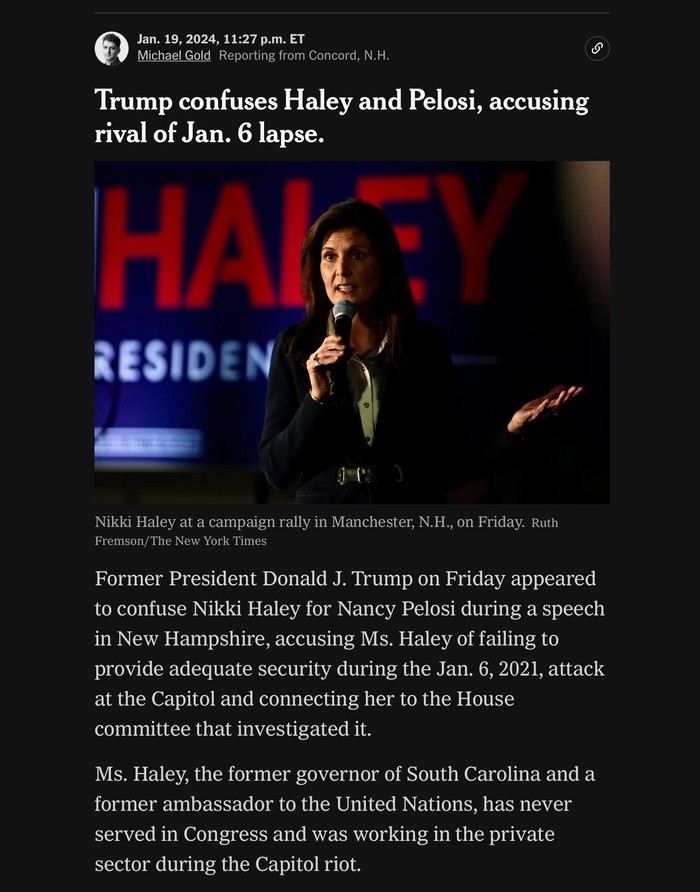
Jay -- Cleaning out my files, I found this post from more than two years ago that I believe is worth recirculating. It's amazing how little things have changed regarding our bat-shit crazy, twice impeached, four-times indicted ex-President who still faces 91 felony counts and who gets Nikki Haley mixed up with Nancy Pelosi and believes he ran against Barack Obama in the 2016 election. Even so, he's the favorite in tomorrow's New Hampshire primary. With that said, I'm not giving up that Nikki might pull off the upset of the century. Bests, everyone.
October 30, 2021
(Editor’s note: Below is a passage from Lawrence Wright’s “The Plague Year,” which was published earlier this year. In chapter 20, titled The Hedgehog and the Fox, he makes an insightful comparison between the personalities of Anthony Fauci and President Trump – one that really sums up Trump’s inability to fight the pandemic. Wright is best known for his book about Osama bin Laden titled “The Looming Tower.” Besides being a gifted writer, he’s a kind of historian/journalist who sees trends in world events and undercurrents of history long before his fellow journalists.) Enjoy….
The Play-doh Truth
There was an erudite parlor game that Oxford undergraduates used to play in the 1930s. It derived from a fragment of Greek poetry which said, “The fox knows many things, but the hedgehog knows one big thing.” Depending on their understanding of this Delphic verse, the undergraduates would divide personalities into hedgehogs or foxes. Hedgehogs are dogged and concentrated; they live their lives believing that the world is organized by universal laws, even if those laws are not entirely graspable. Foxes are scattered and contradictory, taking what they need for their journey without a real destination in mind. The game is a bit like casting a horoscope with only two astrological signs.
Isaiah Berlin took the hedgehog/fox dichotomy as a starting point for his famous lecture on Tolstoy. He later admitted he never meant it seriously. He insisted that he didn’t intend the fox to be superior to the hedgehog, or vice versa, and he acknowledged that a single person could encompass both qualities. Tolstoy, for instance, confounded the distinction.
Anthony Fauci and Donald Trump, however, thoroughly embodied these opposing archetypes. They were in some glancing ways very much alike: New Yorkers, both in their seventies, immensely confident, optimistic, neither requiring more than five hours of sleep at night. In other respects, they were almost comically opposite. “We had this interesting relationship,” Fauci later recalled, “a New York City camaraderie thing.” That wouldn’t last.
Fauci is small, trim, dapper, an “unflappable bullet of a man,” as Natalie Angier once memorably described him. He has the hedgehog’s intensity, working sixteen to seventeen hours a day, taking only Sundays off to be with his family. He used to run seven miles at lunchtime, no matter what the weather, but he switched to power-walking with his wife at night. He has led the National Institute of Allergy and Infectious Diseases (NIAID) through six administrations, rejecting promotions or the prosperous lure of private industry. His idea of fun is “being with my wife and children and eating fried calamari, drinking a glass of wine.”
Trump has led a life marked by chaos and full of great wealth, spectacular bankruptcies, three marriages, two divorces, Playboy models and porn stars, cheated workers, showy skyscrapers, failed casinos, television stardom, tabloid fame—a life spent surfing the wave of popular culture without ever probing deeply into any defining pursuit. Even his run for the presidency was whimsical, as much for brand promotion as it was for revenge against what he perceived as Barack Obama’s slights.
Whimsy and grievance—what he termed his gut feelings—drove him and the nation that he dragged behind him, but it was never clear where he was taking us, nor perhaps did he know or especially care.
The relationship between Trump and Fauci was wary. They were handcuffed to each other, Fauci needing the president to allow him to do his job, Trump needing to keep the one person America trusted most in his camp. From Trump’s perspective, Fauci was dangerous because he didn’t have enough to lose and could not be relied upon to bend to the president’s will, as had nearly everyone who remained in his administration. Unlike the CDC, HHS, and the FDA, Fauci’s institution had not been bullied into submission by political appointees. Fauci and his colleagues at NIAID were outliers in the Trump-era medical research establishment, but they were also the best hope for a workable, effective, and politically timely vaccine.
To trim Fauci’s vast constituency, the president pushed him off the Sunday morning news shows and onto talk radio and webinars. But Fauci’s influence remained unsquashable, an ever- present reminder of the peril the country was in, honestly admitting the blunders committed by the most powerful nation in the world, the one ostensibly best prepared to face such a catastrophe, but now pitied, feckless, and beaten.
Trump belittled Fauci while also envying his appeal. He retweeted that there was a conspiracy “by Fauci & the Democrats to perpetuate Covid deaths to hurt Trump.” The president told Sean Hannity that Fauci was “a nice man, but he’s made a lot of mistakes.” He accused Fauci of misleading the country about hydroxychloroquine, which Trump continued to cling to as a miracle cure even after the FDA withdrew its emergency authorization. “He’s got this high approval rating, so why don’t I have a high approval rating, and the administration, with respect to the virus?” Trump wondered aloud at a press briefing. “It can only be my personality.” A recent poll had showed that for information about the coronavirus, 67 percent of voters trusted Fauci, compared with 26 percent for Trump.
Fauci, a devout fan of the Washington Nationals, was invited to throw out the first pitch for the World Series champions, who were playing in an empty stadium like all teams in this spectatorless year. As Fauci was preparing to walk to the mound, wearing a Nats mask, Trump told the press that he had been invited to throw out a first pitch as well. “I think I’m doing that on August 15 at Yankee Stadium.” No one had told the Yankees. Later Trump tweeted that his own busy schedule made it impossible to accommodate the August date. “We will make it later in the season!”
Covid-19 told us more about these two men than any other individuals in the country. For Fauci, science was a self-correcting compass, always pointed at the truth. For Trump, the truth was Play-doh, and he could twist it to fit the shape of his desire.
|