|
Jack Mallory
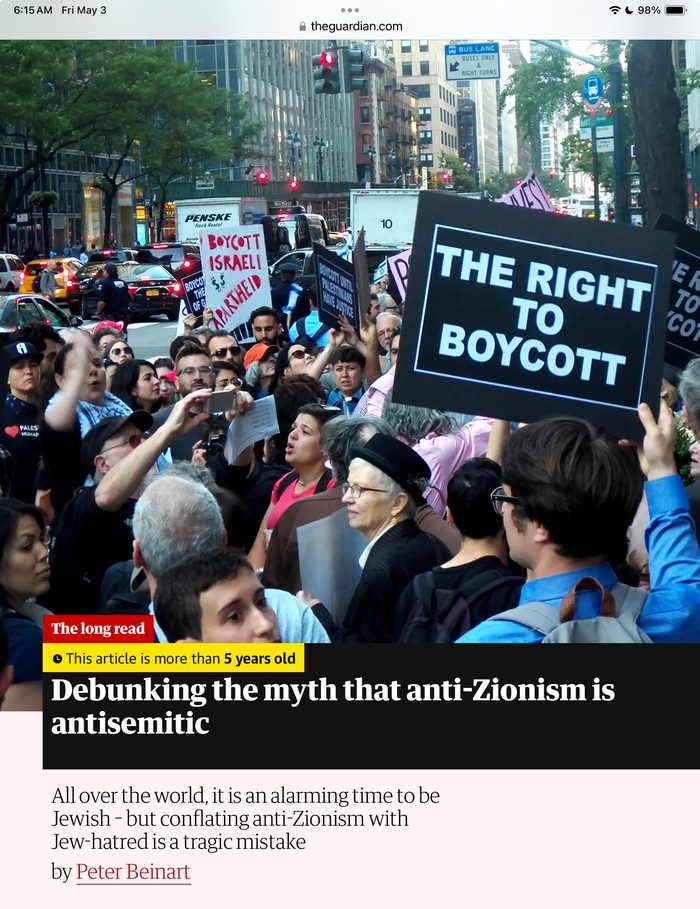
If we're going to suggest, without evidence, that anyone seeing advantage in the protests against the war in Gaza may be complicit in those protests, perhaps the Republican Party is behind them, along with the Russians, Chinese, North Koreans, etc.
". . . the parallels between 2024 and 1968 are ominous, especially as protests spread across university campuses like they did back then. The turmoil of ’68 not only helped propel Richard Nixon to victory in November but also marked the long-term transformation of national politics. The images of disorder on campuses and in the streets helped break the New Deal coalition apart and drive conservative and centrist voters away from the Democratic Party; they hastened the realignment of much of the American electorate. Republicans would hold the White House for 16 of the next 20 years. Indeed, the politics of the past six decades have been shaped by the divisions that sharpened that year. In 2024, we are still suffering from the hangover of 1968.
"And a particular risk has emerged from the campus chaos of today: Even as the nation faces the clear and present danger of right-wing illiberalism, the next few months could be dominated by the far less existential threat of left-wing activists cosplaying their version of 1968. Tuesday night’s dramatic police action to clear an administration building at Columbia University that had been seized by anti-Israel activists took place 56 years to the day from one of the most violent clashes between police and protesters on that same campus. In 1968, activists occupied half a dozen university buildings during protests against the university’s affiliation with military research and its plans to build a segregated gym in a predominantly Black neighborhood. That occupation ended violently after New York police officers clashed with protesters and cleared the buildings. Hundreds of students were arrested, dozens injured, and an NYPD officer was left permanently disabled.
"A “fact-finding commission” headed by the future Watergate special prosecutor Archibald Cox found that “the revolt enjoyed both wide and deep support among the students and junior faculty.” But the protests generated a backlash from the American public. The political fallout from 1968—a year that saw riots in cities, assassinations, campus upheavals, and the DNC riots—was immensely consequential. In 1968, both Nixon and Alabama Governor George Wallace (who was running as a third-party candidate) made the disorder in the streets and on campuses the centerpiece of their campaigns. In November, the two men received a combined 56.2 percent of the popular vote—just four years after Lyndon Johnson’s Democratic landslide over Barry Goldwater.
"But many campus activists, who were beginning the decades-long project of romanticizing 1968, felt emboldened. In 1970, after the killing of four anti-war student demonstrators by the Ohio National Guard at Kent State University, protesters across the country tried to shut down universities, including the University of Wisconsin at Milwaukee, where my father taught journalism. Despite his opposition to the Vietnam War—and his role supporting McCarthy’s insurgent anti-war candidacy—he was appalled by the tactics of the protesters who occupied the university library, leading to its closure, which my father regarded as “a new version of book burning,” according to his unpublished manuscript. A Jewish World War II veteran, he refused to shut down his classes, and when he ordered occupiers to leave the office of the student newspaper, he wrote, he was denounced as a “fascist pig.”
"Two years later, in 1972, despite the brewing Watergate scandal, Nixon won reelection with 60.7 percent of the popular vote and 520 electoral votes.
"And here we are again. Now, George Packer wrote in The Atlantic, elite colleges are reaping what they have been sowing for decades. This month’s turmoil on campuses like Columbia’s “brings a strong sense of déjà vu: the chants, the teach-ins, the nonnegotiable demands, the self-conscious building of separate communities, the revolutionary costumes, the embrace of oppressed identities by elite students, the tactic of escalating to incite a reaction that mobilizes a critical mass of students.”
"Donald Trump obviously hopes that history will repeat itself, and that the left-wing theatrics of the anti-Israel protests, on college campuses and beyond, will have an outsize effect on the 2024 election. Like Nixon and Wallace before him, Trump (and the congressional GOP) will seize on the protests’ methodology and rhetoric—this time to further polarize an already deeply polarized electorate. The irony, of course, is rich: Even as Trump stands trial for multiple felonies, he is trying to cast himself as the candidate of law and order. Even as he lashes out about the campus protesters, he is pledging pardons for the rioters who attacked the Capitol.
"But Trump would be right to think that every banner calling for “intifada,”every chant of “From the river to the sea,” every random protester who shouts “Death to America,” and every attempt to turn this year’s DNC into a repeat of 1968 brings him closer to a return to the Oval Office."
https://www.theatlantic.com/newsletters/archive/2024/05/the-1968-hangover/678263/
|