header 1
header 2
header 3

Message Forum - GENERAL

Welcome to the Bethesda Chevy Chase High School Message Forum.

The message forum is an ongoing dialogue between classmates. There are no items, topics, subtopics, etc.

Forums work when people participate - so don't be bashful! Click the "Post Message" button to add your entry to the forum.


go to bottom 
  Post Message
  
    Prior Page
 Page  
Next Page      

10/10/24 02:26 PM #17566    


Jack Mallory

Google search and I have a special relationship, Joan. 

*********

Never, ever, ever let your dog up on your bed. 


10/10/24 04:13 PM #17567    


Glen Hirose

Jack,

Once a dog knows that they're Cute, like humans, they can become extra sassy.

      mastiff tibetan mastiff attack | Awesome | Pinterest | Tibetan mastiff ...

     Even as full grown adults, somehow the puppy still shines through.


10/10/24 08:20 PM #17568    


Jack Mallory

Those 30,000 years or so of canine domestication did encourage the survival and reproduction of the not-too-sassy pups, while the overly sassy ones ended up in the cooking pot! I remind my dogs of that if they get out of line, tell them PETA isn't always watching, put a nice Cabernet out around dinner time. 


10/11/24 08:10 AM #17569    


Jay Shackford

Do You Think Donald Trump Ever Changed a Diaper?

Take a momemt to watch Barack Obama's speech last night in Pittsburgh. It was a classic -- insightful, funny, powerful and delivered with the magic of a gifted and once-in-a-lifetime American statesman.  Gotta love Obama!


10/12/24 07:54 AM #17570    


Joanie Bender (Grosfeld)

Yes Jay, Heard Obama's speech.  There is no one like him.  Love, Joanie


10/12/24 09:15 AM #17571    


Jack Mallory

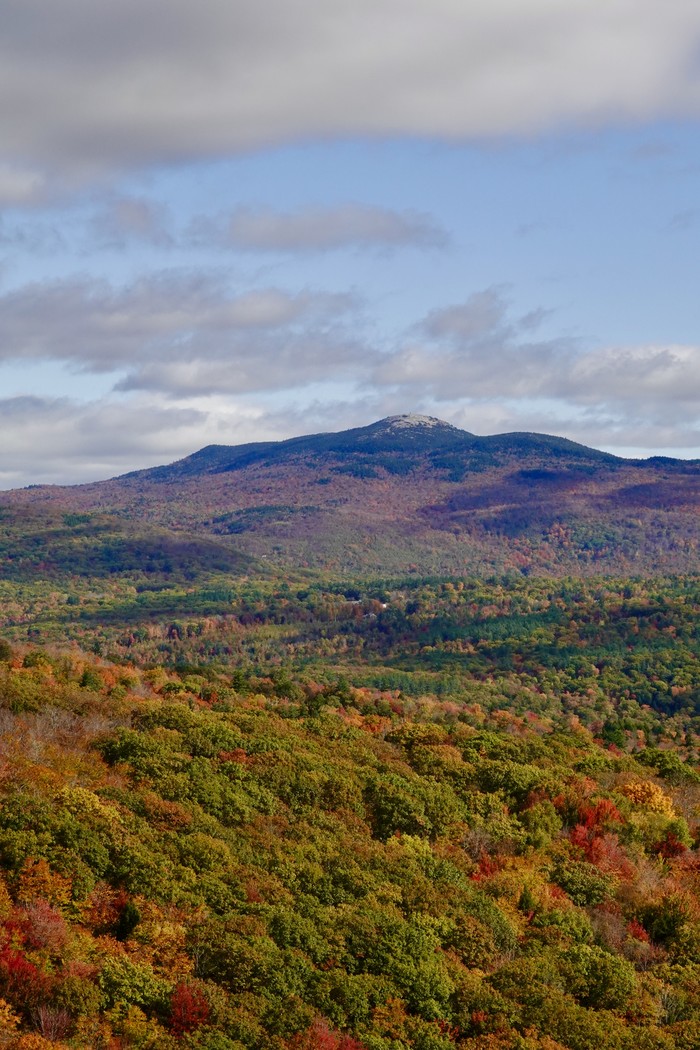
Indigenous Peoples'/Columbus Day is often taken as peak color day in much of New England. And the geese are on the move.


The beavers are always busy. 


10/12/24 11:20 AM #17572    


Joanie Bender (Grosfeld)

Jack, those shots are all beauties. You could be mistaken for a top National Geographic photograher...well better yet, you are a great Jack Mallory photographer...I would be inspired to paint those scenes but since I paint best on location, I won't get to unless I come to New Hamshire..By the way, though I love them all, the blue heron one is exquisite..It has the beautiful blues of the herons and the bright yellows nearby....Love, Joanie


10/12/24 02:19 PM #17573    


Glen Hirose


I'll bet there are some Chain-pickerel, Brook trout, or maybe even Northern pike in that beaver pond.

Pike Fishing Guide: How To Find, Catch ...


10/12/24 04:25 PM #17574    


Jack Mallory

Are those some kinda fish, Glen? Only fish I know live at the sea food counter at the market! Well, maybe live isn't the isn't word.


That rocky-topped mountain is Cardigan, often seen much farther in the distance in my pix from Grafton Pond. 
 

Again, thank you for the compliments, Joanie. I think those are the Canada Geese you're looking at. These guys?


10/12/24 08:49 PM #17575    


Joanie Bender (Grosfeld)

OOPS, yes they were not the blue heron...I think I was just thinkiing of the beautiful blues of both birds but forgot about the different shapes and hence the different birds... Love, Joanie


10/13/24 12:26 PM #17576    


Jack Mallory

I know it sounds like one of those goopy pieces of "wellness" advice, but sometimes a cloudy day is your friend. 


10/13/24 01:07 PM #17577    


Jack Mallory


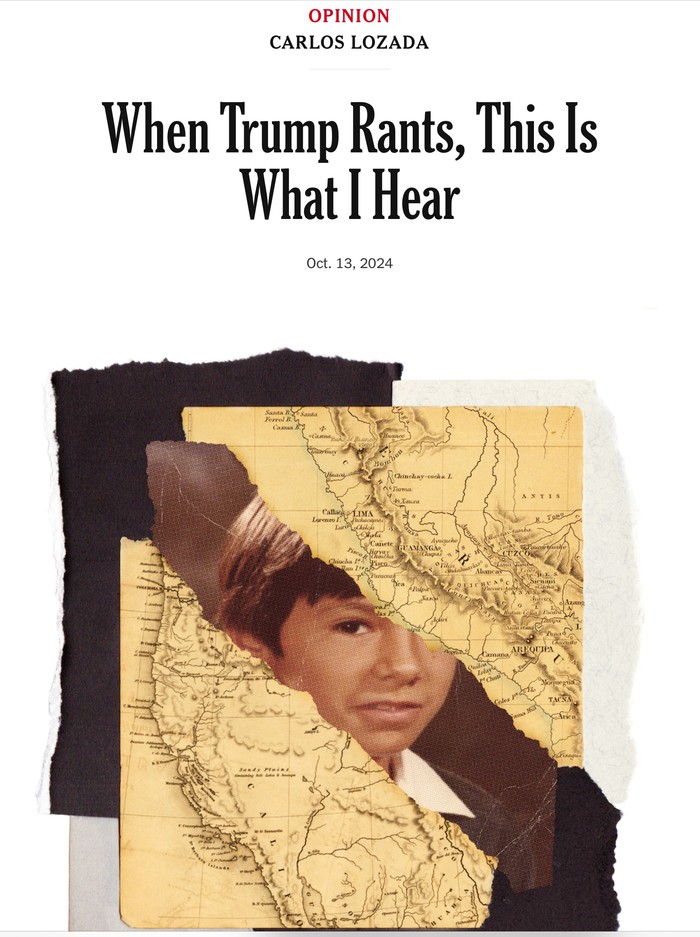
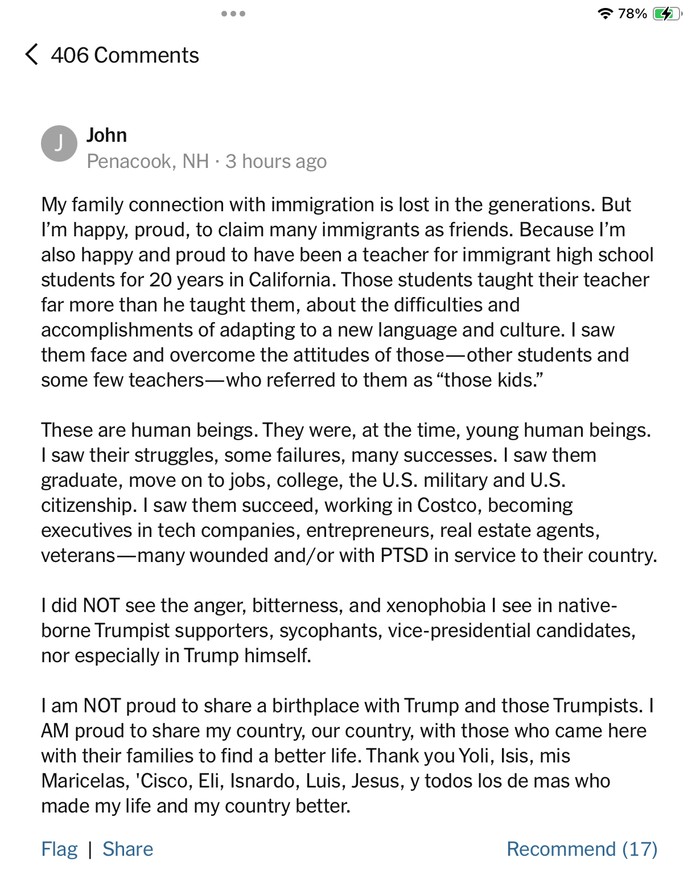
I made it into The New York Times this morning! In a letter to the editor commenting on this wonderfully written, insightful opinion piece written by an NYT columnist. My comment is printed here following his article. Lozada has never lain bleeding on a battlefield, but I strongly recommend his opinion nonetheless.

Opinion Columnist

I’ve never considered “immigrant” my calling card, even though it’s one I’ve always carried.

I arrived here first as a 3-year-old boy in the mid-1970s, settling with my family in Northern California, in a small town with trees so thick that their branches mingled high over the roads. My mother introduced us around the neighborhood not just as a new family, but as a Peruvian family (she signed cards, “from your Peruvian friends”). It mattered to her that people knew, whether to convey her pride or pre-empt their questions. Even when you’re trying to fit in, you can’t help standing out.

She connected with other women in the area from Spanish-speaking countries, forming a group they called the Lovely Latin Ladies. The food, music, laughter and nostalgia infusing those Triple L gatherings remain among my most vivid childhood memories. It’s taken me this long to realize that in Spanish the verb for “longing” and the noun for “stranger” — “extraño” — are the same word.

I am older today than the lovely ladies were then. After some back and forth between Lima and California in my childhood, I’ve made my home in the United States for decades now — going to college and graduate school, passing the citizenship test, marrying a native-born American, even seeing our children born in the nation’s capital. I’m an immigrant, but over the years the label has moved lower on my drop-down menu.

Is immigration something you do or something you are? Is it a step on the way to becoming something else or does the passage itself forever define you?


The longer I’m here, the more it’s become a memory, an evocation of a long ago that I share with my children, much as we might construct a family tree.

In recent years, though, the distance has narrowed between memory and identity, between immigration as a once upon a time versus a here and now. In our politics, the presence of immigrants is again a contested campaign issue. But even that word — “issue” — is too convenient, a buffer between policy and humanity. It’s one thing to ponder and debate issues, as I do in my work. It’s another to be one.

When Donald Trump cried out in last month’s debate with Kamala Harris that immigrants were “eating the dogs” in Springfield, Ohio, I was struck by an overwhelming sadness. Sadness at the cruelty of the unfounded accusation and at the damage it would inflict on the people in that one town, but also at the relentless diminishing of an American aspiration, an aspiration I still refuse to dismiss as naïve. I’ve long regarded Trump as a challenge for America — for democratic institutions, for honesty and, yes, for its immigrant tradition — but this xenophobic cacophony, building so relentlessly over the past decade, now feels overpowering. It also feels directed my way, at who I am and the choices I’ve made.

It would be wildly ahistoric to say that Trump, on his own, has eroded the ideal of America as a nation of immigrants. His opponents love to say that “this is not who we are,” even if, in truth, it is who we have often been. For all of Trump’s particular efforts — the wall, the travel ban, the family separations and now the pledge of mass deportation — he is part of a long tradition. You don’t have to go back to the expulsion of Mexicans and Mexican Americans during the Great Depression, or the passage of the Chinese Exclusion Act in the late 19th century, or Benjamin Franklin’s musings on those inassimilable Germans. But you could.


Ronald Reagan invoked America’s immigrant tradition in his 1989 farewell address, when he reminded the world that if his shining city needed walls, “the walls had doors and the doors were open to anyone with the will and the heart to get here.” When Trump rejects this parallel heritage — promising bigger walls and locked doors — his words strike at the hopes and insecurities that I always bear. Even when Trump’s words are false, their aim is true.

I do not speak for immigrants, for Hispanics or for my family; I take on neither the burden nor the arrogance of representation. No doubt, Trump’s various statements attacking immigrants strike different people, including other newcomers, in different ways. To me, they show that the man who accuses immigrants of poisoning the blood of America is administering his own brand of venom, one whose cumulative effect is to disfigure a nation rather than exalt it.

‘They’re not sending their best’

“When Mexico sends its people,” Trump declared on June 16, 2015, announcing his first presidential campaign, “they’re not sending their best. They’re not sending you. They’re not sending you.” He went on to brand immigrants as drug traffickers and rapists, then added the most casually dismissive of caveats, “and some, I assume, are good people.”

That assumption of criminality became the first of many transgressions that, while seemingly disqualifying, merely anticipated core elements of Trump’s appeal. Yet those words were not the ones that struck me hardest. Listen to his case again, and you’ll find so much more to choose from.


When Trump twice stressed “they’re not sending you,” he physically pointed at his audience, at you,emphasizing the gap he finds between those who belong and those who never will. And when he could only “assume” that some immigrants were good people, he tacitly acknowledged the remove at which he holds them. Trump does not say that he knows any good immigrants; he must imagine their existence.

But to me, Trump’s starkest message in that moment was the passivity he implied with one word. “They’re not sending their best.” Sending.

Nobody sent me. No government shipped me, my parents or my sisters to LAX, our official port of entry. We chose to leave, and we chose this place. Obsessed with our education, my father believed his children would receive better schooling in the United States, that we would learn to speak English well. I have few strong memories of those earliest days — I do recall how distasteful it was to drink my milk cold for the first time — but I know the story of our choice, because I heard it so often. No one forced us aboard that plane. I’ll forever wonder if it was the right choice, but I’ll never doubt that it was ours to make.

“Little is more extraordinary than the decision to migrate, little more extraordinary than the accumulation of emotions and thoughts which finally leads a family to say farewell to a community where it has lived for centuries, to abandon old ties and familiar landmarks,” John F. Kennedy wrote in “A Nation of Immigrants.” He called it a “highly individual decision” and “an enormous intellectual and emotional commitment.”


“Sending” reflects not just how Trump views immigration but how he sees the world: all-powerful leaders making decisions, unquestioned and unreviewable, over people’s lives. But “sending” robs me of agency over my own fate. After seven years in California, we moved back to Lima, and I lived there for another seven years until I finished high school. Then I decided to return to the United States for college, to make this my home. These were choices, not orders. “Sending” renders the immigrant not just unwanted but submissive.

Whether I am the best or worst of immigrants is a matter of opinion. That I chose to come here is not.

‘Go back’

In 2019, Trump told four members of Congress to “go back” to the countries “from which they came.”

“So interesting to see ‘Progressive’ Democrat Congresswomen, who originally came from countries whose governments are a complete and total catastrophe,” the president posted on social media, “now loudly and viciously telling the people of the United States, the greatest and most powerful Nation on earth, how our government is to be run. Why don’t they go back and help fix the totally broken and crime infested places from which they came. Then come back and show us how it is done.”


Disregard for the moment that Alexandria Ocasio-Cortez, Ayanna Pressley and Rashida Tlaib were born in the United States and that Ilhan Omar migrated here from Somalia as a child. To me, Trump’s most egregious error was his blithe assumption that going back, that returning and belonging to an ancestral home, is truly possible.

You’re lucky to be here, Trump’s post suggests, so make no demands. And remember: Whatever conditions prompted you or your ancestors to leave the old place will forever be used against you in the new one.

The irony is that I’ve often thought about going back. Not about returning to live in Peru, necessarily, but about going back in time, to the moment my family decided to leave, or later when I chose to come here myself. What alternate life, what pains and joys and regrets, might I have known had the choice been different? There is a parallel existence always shadowing me, a version I glimpse in the cousins and friends who remained. What if I’d stayed?

I’ve always been jealous of those Americans who claim one unmistakable hometown, the place whose streets and rhythms they instantly recognize, a singular setting that anchors their memory. I ache for that, but I lost it. When I visit Lima, I feel out of place. My cultural references are dated, my mental maps fragmented, my friendships treasured but fragile. I don’t quite get the jokes. My longing is for a place that no longer exists, just like that other person I might have been.

“I will never be American enough for many Americans,” the journalist Jorge Ramos writes in “Stranger,” a 2018 memoir. “Just as I will never be Mexican enough for many Mexicans.” The plight of living in between makes Trump’s “go back” admonition especially harsh. The old place is gone, so I cling to the new with the zeal of the convert; I read and write about U.S. politics, history and ideals for a living in part because I’m still trying to stake my claim, to make this place the home to which I can always return.

‘Shithole countries’

Six years before Trump and his running mate, JD Vance, began spreading rumors about Haitian immigrants in Springfield, Trump complained in an Oval Office meeting that he didn’t like admitting immigrants from Haiti, El Salvador or African countries. “Why are we having all these people from shithole countries come here?” the president asked, as he rejected a bipartisan immigration proposal. With little subtlety, he said he’d rather draw from Norway. “Why do we need more Haitians?” he reiterated. “Take them out.”

Why does Trump think people leave their homelands, often at such risk and uncertainty? Some quarter of a billion people live in countries other than those they were born in, and many more wish to join the exile. “When migrants move, it’s not out of idle fancy, or because they hate their homelands, or to plunder the countries they come to, or even (most often) to strike it rich,” Suketu Mehta writes in “This Land Is Our Land,” a 2019 manifesto. They move, he explains, “because the accumulated burdens of history have rendered their homelands less and less habitable.”

For Haiti, those accumulated burdens include political turmoil, repression and foreign interventions, and today, gangs brutalize its citizens. The accumulated burdens of history have not made Haiti a shithole; they have made it a tragedy.

My parents enjoyed a comfortable life in Peru; neither poverty nor oppression compelled our departure. But that life was not enough. My father’s American dream was less for himself than for me and my sisters, and we came here to find it. I chose to return to the United States for college because the Peru of my youth was mired in hyperinflation and terrorism; because I missed the sisters who had made that choice already; because the taste I’d had of America, even as a child, was impossible to forget.

That does not make the departure simple or unambiguous. Hoping that the new home will be better than the old one does not diminish the pain of truncating the life you have known, leaving a hole so gaping that even a land of opportunity has trouble filling it.

If they were shitholes, they’d be easy to leave.

‘They can’t even speak English’

In the presidential debate last month, Trump suggested that Democrats were importing immigrants to vote illegally. “They can’t even speak English,” he said.

I owe my existence to an aspiring immigrant’s desire to learn English. At a beach party in Peru some six decades ago, my father, who did not speak English well, approached other guests with a question: ¿Quién aquí habla inglés? He wanted to practice it. My mother, who had learned the language from the American nuns who taught at her school in Lima, answered affirmatively. That’s how they met — and there’s my origin story.

It must be hard for native speakers to understand the constant tension — the constrained opportunity and heightened self-awareness — that comes from inhabiting a country whose dominant language you don’t quite grasp, full of phrases moving too quickly and words spelled too weirdly. Try to imagine it, and then add politicians who declare you unworthy for those very linguistic shortcomings you are striving to overcome.

As a child, I watched my father pore over books in English with a pen in hand and a dictionary at his side, underlining and looking up the difficult words. His canon included novels by James Clavell, John Jakes and Leon Uris — yes, even immigrant dads read dad books — as well as a nonfiction work, “All the President’s Men,” by Carl Bernstein and Bob Woodward. I still have his movie-edition paperback, the one with Dustin Hoffman and Robert Redford on the cover, and his underlining still visible:

“Woodward fumbled for the receiver.”

“Five men had been arrested earlier that morning in a burglary at Democratic headquarters.”

There’s also “shrugged,” “sprawling” and “byline.”

I won’t say that watching him read “All the President’s Men” inspired my career in journalism. Life isn’t so cinematic. But the book did inspire him — my father loved the idea that we now lived in a country where what happened in that book could, in fact, happen. He never mastered the language, but he spoke it loudly, as though daring anyone to correct him. (His mash-up version of “kangaroo” as “can-GU-ru” sticks in my mind.)

I underline my books, too, but my struggle is not about unfamiliar words or idioms. It’s about staying true to the two languages that still compete for my attention, about reconciling their power over my thoughts.

I came here so young that I don’t remember not knowing both languages. During my childhood in California, we spoke Spanish at home but English everywhere else, so much so that when we returned to Peru a few years later, my Spanish featured a slight American tinge. The contrast between my mastery of English and my accented Spanish prompted my new fifth-grade classmates in Lima to call me “gringo” — a nickname some of them still use with me now. I never minded it, but it told me, even then, that I almost, but didn’t quite, belong.

In Peru, the emphasis flipped: English at home and Spanish everywhere else. By the time I finished high school and returned here for college, Spanish had become dominant, whereas my English was packed with words I could define and spell but not easily pronounce. (I still remember mistakenly sounding out the “p” in “coup” in a freshman writing seminar, and even now I have difficulty with “iron,” often pronouncing it as “eye-run” rather than “eye-earn.”)

Today, my Spanish is alive, and English is my living. I feel as though I have two strong second languages rather than a single native one; they’re still trading punches. When talking or writing, I mentally scroll through both vocabularies, searching for the best term. I’m a better writer and speaker in English, yet I default to Spanish in moments of stress, and my wife says I speak in Spanish in my sleep. When I am speaking in one language, a part of me is always offering criticism in the other.

Trump’s “they can’t even speak English” critique misunderstands the challenge of language and assimilation. In 2015, the National Academy of Sciences reported that “language integration” for immigrants to the United States is taking place “as rapidly or faster now than it did for the earlier waves of mainly European immigrants in the 20th century.” And while the study suggested that Spanish-speaking immigrants and their descendants may learn English and relinquish their native language more slowly than other immigrant groups, by the third generation the transition to English is close to universal. ¿Quién aquí habla inglés? Lots of us.

A few months ago, a Times reader emailed me feedback about an essay of mine — he did not focus on what I’d said but on how I had said it: “Sentí al idioma español en tu uso del inglés, y no como una falla, sino como una fuente de amplitud tonal. Ahora quiero leer otras cosas tuyas.” (Translation: “I felt the Spanish language in your use of English, not as a failing, but as a source of tonal range. Now I want to read other things of yours.”)

Perhaps my Spanish and English have reached a truce, enhancing each other, adding range to what I can write and imagine. To demand purity in language is as self-defeating as seeking purity in people; in America, the overlap is everything.

‘Poisoning the blood'

Today, the immigrant’s offense is not just how you sound, what you do or where you come from, but who and what you are.

“We’ve got a lot of work to do. They’re poisoning the blood of our country,” Trump said at a New Hampshire rally in December. “That’s what they’ve done — they poison — mental institutions and prisons all over the world. Not just in South America, not just the three or four countries that we think about, but all over the world they’re coming into our country.”

Should Trump win the election next month, I no longer must wonder if America regards immigration as something I did or something I am. He has provided the answer, and his audience has validated it: Immigration is a chronic condition, and the only cure, Trump tells us, is a “bloody story” of mass deportation.

But there is no American race or blood that outsiders can pollute. How can immigrants poison the blood of the nation when we have always been its lifeblood? “Once I thought to write a history of the immigrants in America,” Oscar Handlin wrote in “The Uprooted,” his 1952 work. “Then I discovered that the immigrants were American history.”

Many politicians and citizens distinguish between those who entered the country legally and those who arrived or stayed through unlawful means. It’s a meaningful difference, but it is obliterated the moment a party or a president asserts that immigrants poison the blood of the nation. Do American-born children taint the country if they have an immigrant parent like me, one with “bad genes,” as Trump might put it? What is my citizenship certificate worth once my very presence contaminates? Disease does not respond to documentation, only eradication.

Erika Lee, a historian at Harvard, writes that Trump’s policies are the “logical evolution” of xenophobic pressures in American life. “Xenophobia has been neither an aberration nor a contradiction to the United States’ history of immigration,” Lee writes in “America for Americans,” published in 2019. “Rather, it has existed alongside and constrained America’s immigration tradition.”

That evolution continues. Trump’s pledge to build the wall was his essential promise in 2016; the call for mass deportation is his crucial commitment today. The immigrant threat has been redefined from those who are coming — remember the caravan arriving just before the 2018 midterm elections? — to those who are here. The wall purported to protect America; deportations are meant to purify it.

The pretenses are growing less tenable. Politicians can say they are pro-family and pro-child, but when I form a family, I am befouling the nation. They can say immigrants should not take advantage of social services, but if I work, then I am stealing someone’s job. They say that homeownership is key to the American dream, but if I secure a home, then I am distorting housing prices for the native born. The argument is not just about keeping immigrants out or kicking them out, but about denying the full American experience even to the ones who remain.

‘We welcome you’

Almost 10 years ago, I stood in a Baltimore federal building with dozens of other immigrants and swore the oath of U.S. citizenship. Two memories stand out. During the ceremony, there was a pause to list, alphabetically, all the countries from which the new citizens hailed. But one country was inadvertently skipped, and the new citizens and their families protested. Even when promising to “bear true faith and allegiance” to the Constitution of the United States, they wanted to make certain that the home they’d left behind would not be forgotten.

Not only did I “renounce and abjure all allegiance and fidelity to any foreign prince, potentate, state or sovereignty”; I also had to give up my green card. It was a document that, in different iterations, I’d had since age 3, a wallet-size golden ticket that protected and justified my presence here. I was always scared of losing it, so I rarely carried it with me, but I did keep a copy in my wallet, just in case I ever had to prove, as it declared on the back, that “Person Identified by this Card Is Entitled to Reside Permanently and Work in the United States.”

I remember its laminated feel, and I can still recite the alien registration number it bore. So, when I handed it to an official who casually tossed it in a box with many others, I panicked. How would I now prove that I belonged?

The citizenship packet included a letter from President Barack Obama (“we welcome you to the American family”), a flier with the Oath of Allegiance on one side and the Pledge of Allegiance and “The Star-Spangled Banner” on the other, a listing of my rights (including the freedom to express myself) and responsibilities (including to defend America “if the need should arise”), a guide to federal elections and a brochure describing a lengthy “Guide for New Immigrants,” which I could obtain online in 14 languages (among them, Spanish and Haitian Creole).

But with citizenship, there’s no red-white-and-blue card to replace the green one. You’re just supposed to know, to start cutting through the world with that land-of-the-free swagger. I think my temporary panic was a reminder: There’s a difference between lawful and included, between needed and welcomed, between tolerated and accepted.

Trump began the first of his three presidential campaigns warning that immigrants were not the best. I would never presume to be the best of my old country, nor the best of my adopted one. I don’t have to be, and I don’t apologize for that.

If Trump’s attacks render me even more of an immigrant in the eyes of this nation, I’ll accept that outcome, even embrace it. It’s a reminder that so much of how I think and write and act and feel— so much of who I am — flows from that status, that the pang of living in between is a classic American condition, one that both enriches and complicates. I am grateful to live that life here, with the same opportunity as anyone else to help perfect this union.

I don’t have to go home to do that. I’m already here.


10/14/24 06:24 AM #17578    


Jack Mallory

A couple of cold, dreary, rainy days; no paddling or walking. HCR this morning. She starts out by quoting one of those who Trump has referred to as the best and most serious. https://www.msnbc.com/rachel-maddow-show/maddowblog/has-trump-surrounded-himself-only-best-people-n1245495

October 13, 2024 

“He is the most dangerous person ever. I had suspicions when I talked to you about his mental decline and so forth, but now I realize he’s a total fascist. He is now the most dangerous person to this country…a fascist to the core.” 

This is how former chairman of the Joint Chiefs of Staff Mark Milley, the nation’s highest-ranking military officer and the primary military advisor to the president, the secretary of defense, and the National Security Council, described former president Donald Trump to veteran journalist Bob Woodward. Trump appointed Milley to that position. 

Since he announced his presidential candidacy in June 2015 by calling Mexican immigrants rapists and criminals, Trump has trafficked in racist anti-immigrant stories. But since the September 10 presidential debate when he drew ridicule for his outburst regurgitating the lie that legal Haitian migrants in Springfield, Ohio, were eating their white neighbors’ pets, Trump has used increasingly fascist rhetoric. By this weekend, he had fully embraced the idea that the United States is being overrun by Black and Brown criminals and that they, along with their Democratic accomplices, must be rounded up, deported, or executed, with the help of the military. 

Myah Ward of Politico noted on October 12 that Trump’s speeches have escalated to the point that he now promises that he alone can save the country from those people he calls “animals,” “stone cold killers,” the “worst people,” and the “enemy from within.” He falsely claims Vice President Kamala Harris “has imported an army of illegal alien gang members and migrant criminals from the dungeons of the third world…from prisons and jails and insane asylums and mental institutions, and she has had them resettled beautifully into your community to prey upon innocent American citizens.” 

Trump’s behavior is Authoritarianism 101. In a 1951 book called The True Believer, political philosopher Eric Hoffer noted that demagogues appeal to a disaffected population whose members feel they have lost the power they previously held, that they have been displaced either religiously, economically, culturally, or politically. Such people are willing to follow a leader who promises to return them to their former positions of prominence and thus to make the nation great again. 

But to cement their loyalty, the leader has to give them someone to hate. Who that is doesn't really matter: the group simply has to be blamed for all the troubles the leader’s supporters are suffering. Trump has kept his base firmly behind him by demonizing immigrants, the media, and, increasingly, Democrats, deflecting his own shortcomings by blaming these groups for undermining him. 

According to Hoffer, there’s a psychological trick to the way this rhetoric works that makes loyalty to such a leader get stronger as that leader's behavior deteriorates. People who sign on to the idea that they are standing with their leader against an enemy begin to attack their opponents, and in order to justify their attacks, they have to convince themselves that that enemy is not good-intentioned, as they are, but evil. And the worse they behave, the more they have to believe their enemies deserve to be treated badly.

According to Hoffer, so long as they are unified against an enemy, true believers will support their leader no matter how outrageous his behavior gets. Indeed, their loyalty will only grow stronger as his behavior becomes more and more extreme. Turning against him would force them to own their own part in his attacks on those former enemies they would now have to recognize as ordinary human beings like themselves.

At a MAGA rally in Aurora, Colorado, on October 11, Trump added to this formula his determination to use the federal government to attack those he calls enemies. Standing on a stage with a backdrop that read, “DEPORT ILLEGALS NOW” and “END MIGRANT CRIME,” he insisted that the city had been taken over by Venezuelan gangs and proposed a federal program he called “Operation Aurora” to remove those immigrants he insists are members of “savage gangs.” When Trump said, “We have to live with these animals, but we won’t live with them for long,” a person in the crowd shouted: “Kill them!”

Officials in Aurora emphatically deny Trump’s claim that the city is a “war zone.” Republican mayor Mike Coffman said that Aurora is “not a city overrun by Venezuelan gangs” and that such statements are “grossly exaggerated.” While there have been incidents, they “were limited to several apartment complexes in this city of more than 400,000 residents.” The chief of the Aurora police agreed that the city is “not by any means overtaken by Venezuelan gangs.”

In Aurora, Trump also promised to “invoke the Alien Enemies Act of 1798.” As legal analyst Asha Rangappa explains, the Alien Enemies Act authorizes the government to round up, detain, and deport foreign nationals of a country with which the U.S. is at war. But it is virtually certain Trump didn’t come up with the idea to use that law on his own, raising the question of who really will be in charge of policy in a second Trump administration.

Trump aide Stephen Miller seems the likely candidate to run immigration policy. He has promised to begin a project of “denaturalization,” that is, stripping naturalized citizens of their citizenship. He, too, spoke at Aurora, leading the audience in booing photos that were allegedly of migrant criminals. 

Before Miller spoke, a host from Right Side Broadcasting used the dehumanizing language associated with genocide, saying of migrants: “These people, they are so evil. They are not your run-of-the-mill criminal. They are people that are Satanic. They are involved in human sacrifice. They are raping men, women, and children—especially underaged children." Trump added the old trope of a population carrying disease, saying that immigrants are “very very very sick with highly contagious disease, and they’re let into our country to infect our country.” 

Trump promised the audience in Aurora that he would “liberate Colorado. I will give you back your freedom and your life.”

On Saturday, October 12, Trump held a rally in Coachella, California, where temperatures near 100 degrees Fahrenheit (38 degrees Celsius) sparked heat-related illnesses in his audience as he spoke for about 80 minutes in the apocalyptic vein he has adopted lately. After the rally, shuttle buses failed to arrive to take attendees back to their cars, leaving them stranded.  

And on Sunday, October 13, Trump made the full leap to authoritarianism, calling for using the federal government not only against immigrants, but also against his political opponents. After weeks of complaining about the “enemy within,” Trump suggested that those who oppose him in the 2024 election are the nation’s most serious problem. 

He told Fox News Channel host Maria Bartiromo that even more troubling for the forthcoming election than immigrants "is the enemy from within…we have some very bad people, we have some sick people, radical left lunatics…. And it should be easily handled by, if necessary, by National Guard, or if really necessary, by the military."

Trump’s campaign seems to be deliberately pushing the comparisons to historic American fascism by announcing that Trump will hold a rally at New York City’s Madison Square Garden on October 27, an echo of a February 1939 rally held there by American Nazis in honor of President George Washington’s birthday. More than 20,000 people showed up for the “true Americanism” event, held on a stage that featured a huge portrait of Washington in his Continental Army uniform flanked by swastikas.

Trump’s full-throated embrace of Nazi “race science” and fascism is deadly dangerous, but there is something notable about Trump’s recent rallies that undermines his claims that he is winning the 2024 election. Trump is not holding these rallies in the swing states he needs to win but rather is holding them in states—Colorado, California, New York—that he is almost certain to lose by a lot.

Longtime Republican operative Matthew Bartlett told Matt Dixon and Allan Smith of NBC News: “This does not seem like a campaign putting their candidate in critical vote-rich or swing vote locations—it seems more like a candidate who wants his campaign to put on rallies for optics and vibes.” 

Trump seems eager to demonstrate that he is a strongman, a dominant candidate, when in fact he has refused another debate with Democratic presidential candidate Kamala Harris and backed out of an interview with 60 Minutes. He has refused to release a medical report although his mental acuity is a topic of concern as he rambles through speeches and seems entirely untethered from reality. And as Harris turns out larger numbers for her rallies in swing states than he does, he appears to be turning bloodthirsty in Democratic areas. 

Today, Harris told a rally of her own in North Carolina: “[Trump] is not being transparent…. He refuses to release his medical records. I've done it. Every other presidential candidate in the modern era has done it. He is unwilling to do a 60 Minutes interview like every other major party candidate has done for more than half a century. He is unwilling to meet for a second debate…. It makes you wonder, why does his staff want him to hide away?... Are they afraid that people will see that he is too weak and unstable to lead America? Is that what’s going on?” 

“For these reasons and so many more,” she said, “it is time to turn the page.”

Notes:

https://www.independent.co.uk/news/world/americas/us-politics/trump-fascist-general-woodward-book-b2627972.html

https://www.politico.com/news/2024/10/12/trump-racist-rhetoric-immigrants-00183537

“22,000 Nazis Hold Rally in Garden,” The New York Times, February 21, 1939; Ryan Bort, “When Nazis Took Over Madison Square Garden,” Rolling Stone, February 19, 2019.

https://www.theguardian.com/us-news/2024/oct/10/trump-madison-square-garden-rally-nazi-comparison

https://www.nytimes.com/2024/10/12/us/politics/trump-rally-coachella-california.html

https://timesofsandiego.com/politics/2024/10/13/heat-exhaustion-violent-speech-reports-of-missing-shuttles-trump-campaigns-in-coachella/

https://www.nbcnews.com/politics/2024-election/trump-rallies-solidly-democratic-states-unorthodox-strategy-rcna174674

https://newrepublic.com/post/187115/donald-trump-rally-nazi-bloodthirsty-immigration-threat

https://www.cbsnews.com/news/trump-aurora-colorado-venezuelan-gang-claims/

Eric Hoffer, The True Believer: Thoughts on the Nature of Mass Movements(Harper & Brothers, 1951).

https://www.npr.org/2024/10/11/nx-s1-5147400/donald-trump-aurora-colorado-rally

https://www.yahoo.com/news/trump-coachella-rally-attendees-were-010925587.html

X:

AshaRangappa_/status/1844871286863823153

atrupar/status/1844810445036679669

prchovanec/status/1835024827817582719

atrupar/status/1845469638768972272

KamalaHQ/status/1845571369439731872

AmoneyResists/status/1845117197082898806


10/17/24 12:06 AM #17579    


Helen Lambie (Goldstein)

I highly recommend watching this video once a day (or more) until election day. A very talented family from the UK!

https://youtu.be/se-didBGn8A?si=j6WdNFqAIrG5jKrW


10/18/24 06:23 AM #17580    


Jack Mallory

Helen, how about if I just take a walk in the woods or paddle on the water every day from now through the elections (pausing briefly to vote)? And then walk or paddle through the recounts, Trump raving, Vance lying, court cases, Trump lying, attacks on poll workers, appeals, Trump whining, SCOTUS decisions, Trump threatening . . . 


10/18/24 11:19 AM #17581    


Jack Mallory

Honoring decent Republicans, and human beings generally:


An extract from Chasing Hope: a Journalist's Life, the new memoir by multiple Pulitzer prize-winning journalist Nicholas Kristof:


"One of the finest moments in American politics in my lifetime came in August 2008 when McCain held a campaign rally at a high school in Lakeville, Minnesota . . . 

"' Frankly, we’re scared,' the man told McCain. 'We’re scared of an Obama presidency.'

"McCain took the microphone and responded as seriously as I’ve ever seen him.

'“First of all, I want to be president of the United States,' he said. 'And obviously I do not want Obama to be. But I have to tell you, I have to tell you, he is a decent person, and a person that you don’t have to be scared of as president of the United States.'

"The McCain crowd booed McCain. An elderly woman named Gayle Quinnell took the microphone. 'I can’t trust Obama,' she said. 'I have read about him and he’s…he’s an Arab.' 

"McCain stopped her, took the microphone and shook his head. 'No, ma’am,' McCain said. 'He’s a decent family man, citizen, that I just happen to have disagreements with on fundamental issues. And that’s what this campaign is all about.'

“'I will fight, but we will be respectful,' McCain told his supporters, adding: 'I admire Senator Obama.' At this, the crowd booed more loudly. McCain’s rebuke of his followers was a high-water mark in American politics.​"

***********

Yes. McCain, the man of whom Donald Trump said, "I like people who weren't captured, OK?" Donald Trump, whose idea of democracy entails unevidenced labeling of his political opponents as enemies of the people, Marxists, criminals, fascists, thugs, vermin, and radical left maniacs. 


10/18/24 01:27 PM #17582    


Jay Shackford

“Kamala’s Banning the Cows”


By Dana Milbank/The Washington Post

October 18, 2024


They’re eating the dogs. They’re eating the cats. And now, they’re banning the cows.


Or so says Donald Trump. No bull!


“Kamala even wants to pass laws to outlaw red meat to stop climate change,” Donald Trump told supporters in North Carolina. “That means no more cows. You know, this is serious.”


Ruminate on that.


“She wants to get rid of your cows. No more cows,” Trump warned an audience in Georgia.


The steaks could not be higher in this election.


If you are alarmed by Trump’s portrait of bovine abolition under a President Kamala Harris, the good news is you probably won’t have to look at it much if it happens. This is because, according to Trump, Harris is also planning to ban windows.


“They want buildings taken down and new buildings built without windows,” Trump informed his followers in Wisconsin.


He explained at another stop that Harris will see to it that “new buildings are built without windows because, you see, a window is environmentally unfriendly, having to do with the heat, the gases and the sunlight.”


On Saturday in Nevada, Trump put the two grave menaces together in a single, apocalyptic sentence: “They want to do things like no more cows and no windows in buildings.”


Under the stress of the final weeks of the campaign, Trump has somehow become ever more bonkers than he already was. Over the past week, he proposed using the National Guard or the military against “radical left lunatics” on Election Day, and he called the United States an “occupied country.” He stood onstage at what was supposed to be a “town hall meeting” and swayed and danced to his campaign playlist for 39 minutes. He bickered with an interviewer at the Economic Club of Chicago and slurred words at a rally in Georgia. He threatened to impose 2,000 percent tariffs on cars. He called his opponents the “enemy from within” and made up stories about migrant gangs taking over buildings in Colorado. He held a Fox News event with women and proclaimed himself “the father of IVF,” then acknowledged he asked a female Republican senator to “explain IVF” to him.


And his doomsaying has gotten even more outlandish. Under Harris, “America will be condemned to a fate of decline, desperation and despair,” Trump said at one stop. “Your family finances will be permanently destroyed. Your borders will be gone forever. Tens of millions more illegal aliens will invade our cities and towns. ... Medicare and Social Security will buckle and collapse.” He went on to say that businesses would be “worthless” and that Harris “would crash the stock market like in 1929, annihilate the pensions, 401(k)s and all of the retirement accounts” and cause “your income to plummet, your net worth to collapse, your tax bills to soar and your jobs to totally disappear.” But none of this will matter, because, in Trump’s telling, she’ll also start World War III.


Perhaps the weirdest part of these prophesies of doom is that they aren’t even original. In the closing weeks of the 2020 campaign, Trump issued similarly cataclysmic visions — in some cases, word for word the same — about a Joe Biden presidency. They apparently didn’t come true. (We’re still here, after all, and so are the cows and windows.) Yet Trump is repeating the same loony forecasts this time around, as if 2020 didn’t happen. Not for the first time, he seems to think Americans have very short memories and don’t know how to Google stuff.

“Cows are out,” Trump said in September 2020. “They don’t want cattle.” Also: “We’re not going to have windows anymore.” And one month later: “You, too, can have no windows in your buildings.”


Four years later, there are still 87 million head of cattle on U.S. farms. And the multibillion-dollar U.S. window market is growing steadily. Yet it didn’t occur to Trump to defenestrate these wacky claims.


Over and over, Trump has predicted that “Kamala will deliver a 1929-style depression” and crash the stock market, thus eviscerating retirement savings. Back in 2020, Trump predicted that “on the chance that Biden got in, you will have a stock market go down like you wouldn’t believe.” He warned that “if Biden and Harris and the radical left gain power, they will collapse our economy and send our nation into a very steep depression.” It would be “a crippling depression, the likes of which you’ve never seen.”


Instead, Biden has presided over a three-year bull market, with stocks gaining more than 50 percent overall and setting records dozens of times this year. The economy grew at a substantially higher clip under Biden than under Trump and added more than 16 million jobs — compared with the 2.7 million lost under Trump.


Trump is claiming on the trail that “if I’m not elected, you will have no auto industry” and that, under Harris, “the auto industry would be nonexistent or dead. It will be dead. It will never be able to survive.”

Sound familiar? In 2020, Trump said that “a vote for Biden is a vote to eradicate your auto industry” — and that Biden would “close down manufacturing” in general.


Yet, miraculously, the United States continues to produce about 10 million new cars per year, second only to China in the world. Manufacturing output overall is up more than 20 percent since Biden took office, and American manufacturers have added more than 700,000 jobs.


Trump is lately calling Harris “the tax queen” who will increase your tax burden by varying amounts. Sometimes he claims “they want to raise your taxes by five times.” Other times, “she’s going to double and quadruple your taxes.” Yet other times she will hike taxes by only 72 percent. “I’ve never seen somebody that openly campaigns on the fact that they’re going to raise taxes,” he said this month.


Trump likewise claimed in 2020 that “Biden will raise your taxes $4 trillion” and was “the only guy I’ve ever seen who runs by saying ... ‘We will raise your taxes.’”


But his crystal ball failed him again. Federal tax revenue as a percentage of gross domestic product have remained largely unchanged under Biden.


In the current campaign, Trump warns that Harris “wants to ban fracking. ... She wants to ban anything having to do with fossil fuel.” Furthermore, “Kamala will crush the electrical grid of the United States of America,” and “your costs will go up and your lights will go out.”


And here is a Trump tweet from 2020: “Sleepy Joe Biden has vowed to ABOLISH the American oil and natural gas industries, and BAN fracking.”


For the record, the United States produced more crude oil than any nation in history over the past several years and is on course to do so again this year. It has also been producing natural gas at record levels.


On crime, Trump claims that Harris “was one of the founders of ‘Defund the Police,’ and she still believes that.” In his telling, she “supports abolishing cash bail” so that murder suspects can be released without posting bond. Harris “destroyed San Francisco” with crime, “then she destroyed California, and now she wants to destroy the United States.”


And back in 2020? “Biden wants to defund the police,” Trump alleged. “He’s going to defund the police. He’s going to cut it way down,” he said at another point. Biden, too, would “end cash bail, releasing dangerous criminals onto our streets.” Because of Biden’s policies that would “destroy America,” Trump said: “If Joe Biden is elected president, the chaos and bloodshed will spread to every community in our land.”


Biden did not end cash bail. Funds for police have generally risen. And violent crime, after increasing during the pandemic, has been falling for three years and is now below where it was during Trump’s final year in office.


Trump now prophesies the entire nation coming to resemble a “migrant camp” under Harris, in which borders are “gone forever.” He explains: “She wants mass amnesty for people that have literally looked to destroy our country. ... It’s going to bankrupt your Medicare, bankrupt your Social Security.”


In 2020, Trump similarly alleged that Biden would “dissolve your borders.” Biden’s “plan to provide government health care to illegal immigrants would bankrupt our health-care system, collapse our hospitals and destroy Medicare.” Seniors would “lose the benefits they paid into” so that Biden could finance “open borders.”


After a big post-pandemic surge, illegal crossings are down sharply on the supposedly “open” border. And the latest solvency reports for Social Security and Medicare show improvement.


Trump’s prediction that World War III “is going to happen” if he isn’t returned to the White House is better understood in the context of his statement that there “would have been a nuclear war” if he were not elected in 2016. His claim that Harris “wants to confiscate your guns” should be seen alongside his 2020 claim that Biden would “shred your Second Amendment, confiscate your guns.” (There were nearly 17 million guns sold in the United States last year alone.) 


His nonsensical idea that Harris “wants to abolish the suburbs” (when she’s finished with the cows and windows?) has to be seen alongside Trump’s 2020 prediction that Biden would “destroy our suburbs.” He says Harris “wants to take away your private health care.” In 2020, Biden wanted to “eliminate private health care.” And yet, the percentage of Americans with private health insurance has somehow remained stable at about 65 percent.


He can’t even bring himself to trot a new metaphor out of the stable. In 2020, Biden was a “Trojan horse for socialism,” as NBC’s Alex Seitz-Wald pointed out. Now “Kamala Harris is a Trojan horse for nation-destroying spending, communist price controls and open borders.”


The Oracle at Mar-a-Lago prophesied with all-caps confidence in 2020 that if Biden won, “Our Country would COLLAPSE!” He foretold that, “Under Biden, there will be no school, no graduations, no weddings, no Thanksgivings, no Easters, no Christmases, and no Fourth of July. Other than that, you’re going to have a wonderful life.” If Biden won, Trump said, “China will own the United States. You’re going to have to learn to speak Chinese.”


Bet you a banned beefsteak that you won’t be sitting in your windowless home this Thanksgiving practicing Mandarin. But, by all means, let’s take him seriously when he says that, if Harris wins, “you won’t have a country left” and “our country is finished.”


The problem with this particular false prophet is that he tries to prove his auguries true even when they invariably fail to materialize. In 2020, he predicted that “the only way we’re going to lose this election is if the election is rigged” — then fomented an insurrection in support of his lie. Now he’s saying that his opponents are “professional thieves” and that cheating is “the only way they’re going to win.”


You don’t need to be clairvoyant to see where this is going.


10/18/24 01:53 PM #17583    


Jay Shackford

Helen -- Great post.  Everyone needs to open Helen's  Utube post --and play it repeatedly.  BTW, Trump should be disquallified for his choice of songs played at his rallies.  And don't tempt me on commenting on his dance moves.  Bests everyone.  


10/18/24 05:50 PM #17584    


Jack Mallory

Thanks for posting that, Jay. The WaPo is strict with me about its paywall! 

*********

Early morning reflections in the river, scarcely 50' behind the house:


10/19/24 03:41 AM #17585    


Joan Ruggles (Young)

Helen, I can't get the catchy rif "Gimme Hope Kamala" from the song you posted out of my head. It really is a charming song!


10/19/24 05:49 AM #17586    


Jack Mallory

Trump comparing the jailed Jan. 6 rioters to Japanese Americans in our WWII concentration camps--can it get any crazier than that?

https://www.nytimes.com/2024/10/18/us/politics/trump-jan-6.html?smid=nytcore-ios-share&referringSource=articleShare

*********

Guess we radical left maniacal vermin don't all think alike--that Brit family singalong drives me nuts!

*********

Getting to be late Fall. 37 just now when I took the pup out. Looking a lot more like a small dog now than a pup. 


10/19/24 08:59 AM #17587    


Jay Shackford

Trump’s Charity Toward None


By Maureen Dowd/ New York Times Opinion Columnist, reporting from Washington

October 19, 2024

The cardinal should go to confession.

Timothy Dolan let a white-tie charity dinner in New York showcase that most uncharitable of men, Donald Trump.

At the annual Al Smith dinner, Dolan suffused the impious Trump in the pious glow of Catholic charities. Dolan looked on with a doting expression as Trump made his usual degrading, scatological comments about his foils, this time cloaked as humor.

“We have someone in the White House who can barely talk, barely put together two coherent sentences, who seems to have mental faculties of a child,” Trump told the New York fat cats. “It’s a person who has nothing going, no intelligence whatsoever. But enough about Kamala Harris.”

Trump also offered this beauty: “I used to think the Democrats were crazy for saying that men have periods. But then I met Tim Walz.” When Trump joked about keeping Doug Emhoff away from nannies, even he admitted it was “too tough.”


As he did in 2016 when he crudely attacked Hillary Clinton as she sat on the dais, Trump added a rancid cloud to what used to be a good-tempered bipartisan roast.

Dolan could have stood up and told Trump “Enough!” We have been longing for that voice of authority who could deliver the Joseph Welch line — “Have you no sense of decency, sir, at long last?” — to our modern Joe McCarthy. It is the church’s job, after all, to teach right from wrong.

Instead of telling Trump he was over the line, Dolan enabled him in his blasphemous effort to cast his campaign as a quasi-religious crusade and himself as a saintly martyr saved by God. The conservative cardinal didn’t care about soiling the legacy of the great Democratic patriot Al Smith.

Like Trump, Smith, the “Happy Warrior,” was a native New Yorker — half Irish and half Italian. His track was the reverse of Trump’s, starting in politics and ending in skyscrapers. Smith was born into an Irish community nestled under the Brooklyn Bridge and left school at 14, after his father died, to help his family by working at the Fulton Fish Market. When his political career ended, he became the president of the corporation that built the Empire State Building. From his office in the sky, he could see the street he grew up on.

The gregarious four-term governor of New York believed deeply in lifting up the less fortunate, and in America’s founding principles. Emotionally devastated after helping investigate the Triangle Shirtwaist Factory fire that killed scores of women and girls in 1911, he crusaded to create laws for safer working conditions.


Anti-Catholic bigotry destroyed his presidential bid in 1928, and he hated bigotry of all kinds. He early on decried lynching, racial violence, the Ku Klux Klan and Naziism. He would have detested Trump, a bigot cynically stoking racial fears and bloodthirsty impulses to get elected.

Unlike Trump, Smith was a man of faith. He died with a prayer on his lips, next to his parish priest. He had no patience for bickering and was praised in his obits as “warmhearted” and “honest as the noonday sun.”

Despite Trump’s contention this past week that he has a “good heart” and his father had a “big, big heart,” both Trumps’ hearts were cold. Young Donald helped his dad, Fred, refuse Black tenants.

Trump is proudly amoral. He disdains the Christian values I was taught by nuns and priests. His only values are self-interest and self-gratification. He has replaced a code of ethics with the Narcissus pool.

Certainly, Dolan is happy with Trump’s abortion crackdown. But can’t he see that Trump is corroding our country’s moral core? Trying to steal an election violates the Eighth Commandment. And Trump has broken the commandments about cheating and lying and coveting.


As Anne Applebaum points out in The Atlantic, Trump uses the language of Stalin, Hitler and Mussolini to rouse hate and violence. This, while sacrilegiously calling Jan. 6 a “day of love.” He compares the jailed rioting thugs to the Japanese interned in World War II. It’s not a big leap to saying migrants are “poisoning the blood of our country” and calling his political opponents “vermin,” given his belief — inherited from his father with the “big heart” — in superior genes and blood lines.

This past week, he called Democrats “evil,” “dangerous” and the “enemy from within,” limning them as a bigger threat than Russia and China, a threat that he said might require him to sic the military on his opponents. He denounced the national treasure Nancy Pelosi — who is a devout Catholic — and her husband — who was attacked with a hammer by a far-right conspiracy theorist — as “sick” and “evil.”

The echoes of McCarthyism reverberated when Trump was asked at a town hall whether he really believed the debunked story that Haitian immigrants were eating neighbors’ cats and dogs. “I was just saying what has been reported,” an unrepentant Trump replied. “All I do is report.”

The pols on the dais looked like a Last Supper for this unnerving election. Hopefully, it’s not a Last Supper for the Republic.


10/19/24 01:24 PM #17588    


Joan Ruggles (Young)

Is anyone else terrified that Trump is promising to turn US troops against American citizens with whom he disagrees??

Is anyone else concerned that Trump will not say that he will accept the results of this election??

Is anyone else alarmed by what Trump's former Chairman of the Joint Chiefs of Staff, Gen. Milley has said “He’s a fascist to the core.” and  “We don’t take an oath to a wanna-be dictator.”

Does anyone believe that Trump is, in his words "The father of IVF" (He then asked a female Republican senator to “explain IVF” to him.”)

Does anyone believe, as Trump is reporting, that Kamala Harris is advocating getting rid of cows and constructing buildings with no windows? 

Does anyone believe that Democrats are taking your children out of school and changing their sex?


The answer is yes. There are people who believe these things or are willing to vote for a madman who thinks these things even if they find them bizarre.

Dear God save our country!


10/20/24 08:10 AM #17589    


Jay Shackford

(Editor’s Note:  Below is a long, long  article by Susan Glasser of The New Yorker on the power of billionaire donors on the upcoming election.  What’s happened since the landmark “Citizens United” Supreme Court decision in 2010 that outlawed any limits on individual campaign donations as an attack on “free speech” and therefore any limits were unconstitutional.  Read Jane Mayer’s book, “Dark Money,” which really outlines the consequences of the Citizens United deciision in great detail more than a decade ago.  Also, if you get a chance, listen to the New Yorker’s weekly podcast “The Political Scene” for a super weekly summary of what’s really happening behind the scenes on the campaign trail.  Line of the week:  When confronted by a heckler in Wisconsin, Kamala Harris responsed with a big smile on her face: “Oh you guys have the wrong rally. No, I think you meant to go to the smaller one down the street.”)


Purchasing Power

By Susan Glasser/The New Yorker

October 19, 2024

In February, the billionaire investor Nelson Peltz convened two dozen of the country’s wealthiest Republicans for a dinner at Montsorrel, his $300-million oceanfront estate in Palm Beach, just down the road from Mar-a-Lago. During the 2020 campaign, Peltz had hosted a lavish fund-raiser for Donald Trump at the mansion, which took in $10 million. But, in the aftermath of the January 6, 2021, attack on the Capitol, Peltz, like many Republicans of all income levels, had publicly denounced the President. In an interview with CNBC on January 7th, he apologized for his vote and said that Trump would always be remembered for that day’s “disgrace.” “As an American,” he added, “I’m embarrassed.”

During this year’s Republican primaries, Peltz gave $100,000 to a super pac supporting Tim Scott, the South Carolina senator, but Scott dropped out before a single G.O.P. vote was cast. By the time of Peltz’s dinner, it was clear that Trump would secure the Republican nomination for an unprecedented third consecutive election. Peltz, who was no longer on speaking terms with the ex-President, opened the discussion with a blunt assessment of the race. “I don’t like Donald Trump,” an attendee recalled Peltz saying. “He’s a terrible human being, but our country’s in a bad place, and we can’t afford Joe Biden.” So, Peltz concluded, however much they might dislike it, “we’ve all got to throw our support behind him.”

Some of Peltz’s guests remained skeptical, holding to the view, as the attendee put it, that “Trump’s a terrible person—I’m going to focus on the Senate.” Most of the donors, however, adopted a more pragmatic approach to the ex-President. Many of them had been granted significant access to the White House during his four years in office. Some were expected to be considered for senior roles in a second term: Trump has personally floated the name of the hedge-fund tycoon John Paulson, for instance, as a potential Secretary of the Treasury, touting him as “a money machine.” “They know how transactional he is,” the attendee told me. “They’re hoping to have some influence over the course of appointments and therefore the direction of his Administration.”

A few of Peltz’s guests were all in. Steve Wynn, the Las Vegas gambling titan, has known Trump for decades; his wife, Andrea Hissom, is close to the former First Lady, Melania, and the two couples have spent time together in Palm Beach. And then there was Elon Musk, the world’s richest man, who had reportedly got to know Peltz through Peltz’s son Diesel, a tech entrepreneur. At the time, Musk had said that he would not back a candidate in the Presidential race. By the fall, he would enthusiastically endorse Trump, spending $75 million to support him through a new super pac, and spreading pro-Trump lies and conspiracy theories on his social-media platform, X.

Trump, the richest man ever to serve in the White House, is himself a billionaire, though the extent of his wealth has long been in question. (As of mid-October, with stock in Trump’s social-media venture, Truth Social, experiencing a pre-election bounce, Forbes estimated his net worth at about $5.5 billion.) In 2016, Trump hardly bothered to court big donors. He was shunned by much of the G.O.P. élite and largely self-funded his Republican primary campaign. He lambasted Jeb Bush, the brother and son of Presidents, as a tool of the moneyed class. “Super pacs are a disaster,” Trump said in a 2016 debate. “They’re a scam. They cause dishonesty. And you’d better get rid of them, because they are causing a lot of bad decisions to be made by some very good people.”

But in 2020, as an incumbent President, Trump embraced super pacs and their funders. The two main super pacs supporting his campaign raised $255 million on his behalf that year; his total fund-raising came to more than $1 billion. However, Biden, like Hillary Clinton four years earlier, raised even more than Trump, bringing over-all spending in the 2020 Presidential race to a record $5.7 billion.

As 2024 began, Trump’s money problems were mounting: Biden started the election year with almost $120 million in the bank—nearly three times as much as Trump. The ex-President, with four criminal indictments and multiple civil lawsuits pending, was also paying tens of millions of dollars in legal bills through his political operation. The main super pac of his Republican rival Nikki Haley, meanwhile, outraised his own by nearly $5 million in the second half of 2023. In January, Trump posted a threat on social media to the donors defecting to Haley, whom he had taken to calling Birdbrain: “Anybody that makes a ‘Contribution’ to Birdbrain, from this moment forth, will be permanently barred from the MAGA camp. We don’t want them, and will not accept them.”

On February 16th, the same day as Peltz’s dinner in Palm Beach, Trump’s business was hit with a $355-million judgment, plus interest, in a New York civil fraud case. At a fund-raiser in Dallas, in March, Biden taunted his rival about his dire financial state, joking, “Just the other day, a defeated-looking guy came to me and said, ‘Mr. President, I need your help. I’m being crushed with debt. I’m completely wiped out.’ I had to say, ‘Donald, I can’t help you.’ ”

But Trump’s cash crisis was misleading. By mid-March, after Haley dropped out and the ex-President clinched the nomination, his fund-raising comeback was already under way. Many rich Republicans might have preferred to move on from him, but they were still, above all, right-wing partisans. They had flip-flopped on Trump before; they could do it again. Later that month, Peltz hosted Musk, Wynn, and a few others for a Sunday-morning breakfast. This time, Trump was not the subject of agonized debate among the billionaires. He was the guest of honor.

Trump’s effort to win back wealthy donors received its biggest boost on the evening of May 30th, when he was convicted in Manhattan on thirty-four criminal counts related to his efforts to conceal hush-money payments to the former adult-film actress Stormy Daniels. After the verdict, Trump walked out to the cameras in the courthouse and denounced the case brought against him as “rigged” and a “disgrace.” Then he departed in a motorcade of black Suburbans. He was headed uptown for an exclusive fund-raising dinner, at the Fifth Avenue apartment of the Florida sugar magnate José (Pepe) Fanjul.

The ex-President arrived with his son Eric, stopping to shake hands and exchange pleasantries with each of the approximately two dozen guests, a “AAA list” of the G.O.P.’s top funders, as John Catsimatidis, the billionaire supermarket owner, put it. Such events, another attendee told me, often feel like a birthday dinner for the host, except that “there’s a lot of money being given to someone who isn’t the host—making Donald Trump the birthday boy, so to speak.”

Trump was seated at the head table, between Fanjul—a major Republican donor going back to the early nineties—and Stephen Schwarzman, the C.E.O. of Blackstone, the world’s largest private-equity fund, who had endorsed Trump the previous Friday. Securing the support of Schwarzman was a coup for the Trump campaign. In 2022, he had said that he would not back the former President again, because it was time for “a new generation of leaders,” and, during the primaries, he had given $2 million in support of Chris Christie, the former New Jersey governor, who had repeatedly called Trump “unfit to be President.” In a statement explaining the reversal, Schwarzman said that Biden’s “economic, immigration and foreign policies” were “taking the country in the wrong direction.”

At the dinner, Trump reprised his public rant about the “biased” legal proceedings brought against him, but an attendee who spoke with me was struck by how “calm and confident” Trump seemed for someone facing prison time. “He has this very strong internal capability to push those things aside and still feel good about things,” the attendee said. At the end of the evening, Trump went around the room and solicited opinions on whom he should pick for his running mate. Haley, Scott, and Doug Burgum, the governor of North Dakota and a wealthy businessman, were mentioned; a couple of the attendees expressed a preference for J. D. Vance, the young populist senator from Ohio, whom Trump would ultimately choose. The donors appeared to relish the chance to help select a Vice-Presidential candidate. “I’ve never seen anything like it,” the attendee marvelled. Trump raised about $50 million at the event.

Trump was fund-raising off his conviction with small-dollar donors as well; his campaign, which portrayed him as the victim of a politicized justice system, brought in nearly $53 million in the twenty-four hours after the verdict. Several megadonors who had held back from endorsing Trump announced that they were now supporting him, including Miriam Adelson, the widow of the late casino mogul Sheldon Adelson; the Silicon Valley investor David Sacks, who said that the case against Trump was a sign of America turning into a “Banana Republic”; and the venture capitalist Shaun Maguire, who, less than an hour after the verdict, posted on X that he was donating $300,000 to Trump, calling the prosecution a “radicalizing experience.” A day later, Timothy Mellon, the banking-family scion, wrote a $50-million check to the Make America Great Again super pac.

Ed Rogers, a longtime G.O.P. lobbyist, had never publicly endorsed Trump or raised money for his campaigns. On May 31st, the day after Trump’s conviction, he sent his first contribution to the ex-President. “There was no case to make that that was not targeted prosecution,” he told me. He predicted that other Republicans who, like him, had been “allergic” to Trump would now get on board as well. “I tell people I am a Bill Barr, Chris Sununu, Nikki Haley Republican,” he said, listing the names of Republican officials who had criticized Trump in blistering terms only to support him again in 2024; Haley, despite having called Trump “unhinged” and a threat to the Republic, had announced the week before his conviction that she would vote for him. “The choices are Biden or Trump, and I’m at peace with that,” Rogers said in June. “I wish it was a different equation, but it’s not.”

Many donors I spoke with at the time described Trump’s trial as an impetus, but they tended to cite a litany of other reasons, too, including questions about Biden’s age and fitness to serve another term, concerns about his economic policies, and gripes about some of his appointees, such as the head of the Federal Trade Commission, Lina Khan, who has launched high-profile antitrust investigations. Trump, despite his populist rhetoric, deficit spending, and support for market-distorting tariffs, has sold himself as a pro-business candidate. He has promised extensive deregulation, nearly unfettered drilling for oil and gas, and tax cuts for corporations and wealthy individuals. “A lot of the donors have just come to the conclusion that, when you add it all up, the risks with Trump are behavioral—personal behavior and what he says—versus the policies,” the attendee at the Fifth Avenue fund-raiser told me. It was a “rationalization” adopted by “even those who were initially very put off, very alienated, by his behavior at the end of his Presidency.”

By late May, Trump’s campaign had more money in the bank than Biden’s. The incumbent President’s disastrous performance in a June 27th debate against Trump only accelerated the trend. “After the debate, Biden looks like a loser, so these people who were never going to give to Biden, they’re now even more attracted to the idea of giving to former President Trump,” the attendee at Fanjul’s dinner said. “Because he looks like a winner.”

The following month, as Democratic donors and elected officials frantically pressured Biden to drop out of the race, Trump and the Republicans again outraised the Democrats. “The Zeitgeist in the business world is that Trump is going to be President again,” a billionaire C.E.O. who is not a Trump supporter told me at the time. “Therefore, why fall on your sword on principle?” He added, “Businesspeople—their main focus in life is to make money, and you make money by backing winners. . . . They’ve concluded, O.K., he’s going to be President, let’s hold our nose and do what we have to do.”

The modern era of campaign finance began with George W. Bush’s 2000 Presidential campaign, which professionalized the idea of the campaign “bundler” and created, in effect, a national club for wealthy Republicans who backed the G.O.P.’s Presidential effort. Individual contributions to federal candidates were limited to a few thousand dollars in so-called hard money, but wealthy supporters could tap their networks to bring in hundreds of thousands more. The Bush campaign formalized this approach, calling its top fund-raisers, those who raised more than $100,000, Pioneers; in 2004, a new category, Rangers, was added for those who collected more than $200,000. “We made it fun,” Jack Oliver, Bush’s national finance director, recalled. “We built a community.”

During the 2008 campaign, Bush’s successor, Barack Obama, harnessed his hope-and-change platform to the power of the Internet, raising an unprecedented number of gifts online from small-dollar donors. The increase in donations—in addition to both parties actively recruiting big-dollar bundlers—made it the first Presidential election in history in which the campaigns spent more than $1 billion. Two years later, the Supreme Court’s Citizens United decision ruled that federal law could not prevent corporations from spending unlimited sums to elect candidates, a decision that effectively ended restrictions on campaign fund-raising.

The arms race of political spending that ensued has not only increased the influence of money in politics—it’s changed the nature of national elections. “What’s happened is that money has moved from the political parties—which were a centering force in American politics for two hundred years, because they had to stay competitive—out to super pacs on the right and the left,” Tom Davis, a former Republican House member from Virginia, who once ran the Party’s congressional-campaign committee, told me. “That has only further polarized our politics.”

Earlier in this election cycle, the Federal Election Commission, already a largely toothless agency, undid some of the few remaining restrictions on coördination between candidates and super pacs. Many large contributions are no longer disclosed at all, with huge sums flowing through so-called dark-money funds that support candidates or causes without revealing their donors; the Web site OpenSecrets found about $660 million in such spending in 2020. Far more dark money is expected in this year’s election. One veteran political operative told me that, even as the billion-dollar campaign remains a recent phenomenon, the country could soon see its first billion-dollar contribution. “The amount of money sloshing around Washington now is beyond any sense of reality,” Fred Wertheimer, a public-interest lawyer who spent his career advocating for enhanced campaign-finance laws, said. “It’s like a sandbox for billionaires, and they treat it like a sandbox, and they go in and play.”

Gordon Sondland, a wealthy hotelier from Seattle who parlayed a million-dollar donation to Trump’s 2017 Inauguration into an appointment as the Ambassador to the European Union, began bundling donations for Republicans in the early two-thousands. “Look, I bundled for George W. Bush. I bundled for McCain, Romney, Jeb Bush, and then, ultimately, for Trump,” he said. “And if you bundled a few million dollars through a fund-raiser or through a lot of cold-calling, leaning on friends, colleagues, acquaintances—that was considered a significant achievement.” At the start of the Trump era, Sondland added, “you used to get a really good seat at the table at an event for fifty grand. . . . Now you add another zero to that. It’s five hundred to get to the roundtable, and that’s just a ten- or fifteen-minute discussion in someone’s dining room with the candidate.”

It’s not only the sums that have changed; donors now expect more for their money. “It’s a whole different class,” Sondland said. “They’re less concerned about the photo op and a visit to the state dinner at the White House.” Instead, he added, “they want to essentially get their issues in the White House. . . . They want someone to take their calls.”

During the 2019 impeachment inquiry of Trump, Sondland acknowledged under oath that there had been a “quid pro quo” in Trump’s attempt to pressure the Ukrainian President, Volodymyr Zelensky, into investigating Trump’s political opponents. Trump fired Sondland two days after the impeachment trial ended in a Senate acquittal. Nonetheless, Sondland told me that he planned to vote for Trump again. “It’s a binary choice,” he said. “And I want the Trump policies.”

The bundling of hard-money individual contributions—currently capped at $3,300 each for the primary and the general election—which Sondland calls “business as usual” fund-raising, is still happening. But, whereas Bush’s Rangers needed to bring in $200,000, a bundler now has to collect $2.5 million to join the top-tier “Trump Victory Trust,” according to documents obtained by CNBC. “Bundlers of hard money still have a role, because that is the principal way in which Republicans fund campaigns at the federal level,” a Trump supporter who was one of the original Bush Pioneers told me.

The reason is structural: Democrats have retained an advantage in small online donations, while Republicans rely on a higher percentage of large contributions. As of late September, sixty-eight per cent of contributions to the Trump political network had come from big donors, compared with fifty-nine per cent for the Democrats. Trump, in other words, needs his billionaires more than the other side does. Raising more money from fewer donors is the Party’s strategy.

Trump’s time in the White House provided ample evidence that some billionaires could have extraordinary sway in a second Trump Administration. “They think they have a greater chance to have influence over Trump than they have had the last four years over Biden,” a prominent Republican fund-raiser told me. Key positions in Trump’s first Administration went to alumni of Goldman Sachs, the C.E.O. of the nation’s largest oil company, and scions of wealthy families, such as Betsy DeVos. When criticized for appointing so many ultra-rich Cabinet members, Trump responded, “I want people that made a fortune!” His signature legislative accomplishment slashed the top corporate tax rate from thirty-five per cent to twenty-one per cent and reduced the top individual-income-tax rate. “You all just got a lot richer,” Trump was reportedly overheard saying, at his Mar-a-Lago club, hours after signing the bill.

In office, Trump gave some of his donors highly unusual roles in government. Schwarzman, the Blackstone C.E.O., for example, had not supported Trump in the 2016 primaries, but he gave $250,000 to his Inauguration; soon after the Senate passed the tax-cut bill, he hosted a private lunch with Trump at his New York triplex—the former home of John D. Rockefeller—where the cost of entry was $50,000 a plate. Schwarzman revealed in his 2019 memoir that Trump had asked him to help renegotiate the North American Free Trade Agreement. Schwarzman reportedly spoke with Trump as often as several times a week during the talks. “Donald listens to me because I’m richer than Donald,” Schwarzman joked at one point to Gerald Butts, then the top adviser to the Canadian Prime Minister.

Schwarzman also wrote that he had served as Trump’s intermediary with the Chinese leader Xi Jinping, personally extending the invitation that led to Xi’s visit to Mar-a-Lago, in early 2017. In 2018, Schwarzman made eight trips to China “on behalf of the administration,” personally reporting back to Trump about his efforts “to assure senior Chinese officials that the President was not looking for a trade war.” His pivotal role was not disclosed at the time, despite the potential conflicts inherent in having the person in charge of Blackstone’s broad investment portfolio also represent the U.S. government. In 2020, Schwarzman gave $3 million to a pro-Trump super pac.

Peltz, the billionaire who hosted fellow Republican donors in Palm Beach, also had direct access to the White House. A few months after Trump’s Inauguration, he met privately with the President in the Oval Office, presenting him with a written dossier that made the case that Amazon and its owner, Jeff Bezos, were responsible for the economic woes of the U.S. Postal Service. Trump, who had long attacked Bezos as the proprietor of the Washington Post, summoned a senior official to hear Peltz’s complaint. According to the official, Peltz told Trump that “the reason why the Post Office is in the red is almost entirely because of Amazon,” claiming, falsely, that it received preferential rates, benefitted from “unfair competition,” and ought to be considered an antitrust violator.

Trump’s staff tried to figure out what Peltz’s interest was in the matter. It turned out that Trian Fund Management, Peltz’s asset-management firm, had recently taken a $3.5-billion stake in Procter & Gamble, the consumer-products giant. Peltz, an activist investor who buys his way into corporate-leadership roles, often by prompting proxy fights, considered Amazon’s purchase of Whole Foods a threat to his business. On December 29, 2017, Trump tweeted, “Why is the United States Post Office, which is losing many billions of dollars a year, while charging Amazon and others so little to deliver their packages, making Amazon richer and the Post Office dumber and poorer? Should be charging MUCH MORE!”

Isaac Perlmutter, the former head of Marvel Entertainment, which he sold to Disney, in 2009, for $4 billion, was also at Peltz’s breakfast for Trump in Palm Beach. (Trump personally introduced the pair at Mar-a-Lago, where Perlmutter has a regular table next to the ex-President’s; last year, Peltz and Perlmutter joined forces when Peltz launched an unsuccessful bid to win a seat on Disney’s board.) Perlmutter donated $5 million to Trump’s 2016 campaign; his wife, Laura, was a member of Trump’s Inauguration committee. Soon after Trump became President, he installed Perlmutter and two of Perlmutter’s friends from Florida as de-facto overseers of the Department of Veterans Affairs, an agency with an annual budget of some $200 billion. “On any veterans issue the first person the President calls is Ike,” a former Administration official told ProPublica, which revealed the arrangement.

David Shulkin, whom Trump had appointed to head the V.A., made multiple visits to Palm Beach to consult with the troika that officials came to call “the Mar-a-Lago crowd.” “There probably weren’t too many times I met with the President when he didn’t say, ‘What’s happening with Ike?’ ” Shulkin once said. When Perlmutter visited Washington, Shulkin told me, “I would get a call—‘Could you come over to the White House? Mr. Perlmutter’s here with the President.’ ”

Shulkin was fired by Trump, in March of 2018, amid a controversy over an expensive trip to Europe that Shulkin had taken at taxpayers’ expense. Within hours, he went public with accusations that the story had been hyped by Trump political appointees who were intent on privatizing many of the V.A.’s services. Shulkin told me that he never fully understood why Perlmutter, who had not served in the U.S. military or even visited a V.A. hospital until Shulkin took him to one, had been given such power over the agency. He described Perlmutter as “a private-sector guy” whom Trump admired as a self-made man, someone who “had started with very little and built empires.” The problem, as Shulkin saw it, was that Perlmutter had little idea of what he was doing. “Because he never worked in government, he didn’t understand government,” Shulkin told me. “Part of my role was always trying to translate—‘That isn’t the way we could do things in this organization.’ ”

Perlmutter, however, has remained close to Trump. He and his wife gave $21 million to a super pac supporting Trump’s bid in 2020, and, in 2024, they bankrolled a new pro-Trump super pac, Right for America, donating another $25 million. By September, Right for America had raised some $70 million, which it has spent on an advertising blitz this fall. The venture drew support from other longtime members of Mar-a-Lago, including the Newsmax founder Christopher Ruddy, who gave $100,000, and Anthony Lomangino, a South Florida waste-management mogul, who donated $7.85 million. Scott Bessent, another hedge-fund executive often mentioned as a possible Trump Treasury Secretary, also contributed $100,000.

Perlmutter’s highly unusual role in the first Trump Administration appears to have become something of a template for outside influence in a second term. In March, when Elon Musk met with Trump at Peltz’s house for breakfast, they discussed a broad advisory gig for the tech billionaire on such matters as immigration and the economy—“in the mold of the role” that Perlmutter had played at the V.A., according to the Wall Street Journal. By August, after publicly endorsing Trump, Musk had fleshed out the idea. During a lengthy live-streamed conversation with Trump, Musk suggested that a commission was needed to investigate how to rein in government spending. Such a panel, Musk posted on X, “would unlock tremendous prosperity for America.”

Weeks later, during a speech at the Economic Club of New York, Trump formally announced his support for a “government-efficiency commission” that would “conduct a complete financial and performance audit of the entire federal government.” He proposed that Musk, despite having received billions of dollars in government contracts and subsidies for his ventures SpaceX and Tesla, should chair the effort. Soon, Trump was calling Musk his future “Secretary of Cost Cutting.” It sounded like a more ambitious version of a project that Trump had launched early in his Presidency, when he named the billionaire investor Carl Icahn as a special adviser in charge of overhauling federal regulations. Icahn left the role less than a year later, when an article in this magazine raised questions about potential conflicts of interest.

Trump has long made a practice of telling potential supporters what they want to hear. This year, he has also changed previous policy positions in ways that would benefit some of his party’s largest donors. In March, for example, he publicly reversed course on forcing the sale of the Chinese-owned social-media app TikTok, despite having signed an executive order, in August, 2020, stating his intention to ban the app if it was not sold to a U.S.-based buyer within forty-five days. Back then, Trump warned that a Chinese company owning so much of Americans’ personal data was a national-security threat. But this winter, when the Biden Administration endorsed a bipartisan bill to force TikTok’s sale, Trump came out against the measure. On Truth Social, he wrote, “If you get rid of TikTok, Facebook and Zuckerschmuck”—his derogatory name for Facebook’s C.E.O., Mark Zuckerberg—“will double their business.” Steve Bannon, Trump’s former adviser, posted another explanation for the about-face: “Simple: Yass Coin.”

Days earlier, at an event in Florida for the conservative group Club for Growth, Trump had met with Jeff Yass, a major investor in TikTok’s parent company, ByteDance. Yass, a libertarian-leaning Wall Street billionaire who started out as a professional poker player, has not officially endorsed Trump or donated directly to him. Instead, he has given more than $25 million to the Club for Growth pac, which is supporting the ex-President’s reëlection. (According to OpenSecrets, Yass and his wife have contributed more than $70 million to conservative candidates and causes this election cycle.) Yass also appears to have had a hand in Trump’s personal enrichment. This spring, the company behind Truth Social merged with Digital World Acquisition Corp., a company in which Yass’s trading firm, Susquehanna, was the single largest institutional investor. Truth Social went public in March, and Trump’s majority stake in the company is now worth an estimated $3 billion.

Perhaps the most striking example of the former President’s donor-friendly flexibility in 2024 has been his shift on the cryptocurrency industry. In recent years, he was unambiguously critical of bitcoin, the most widely traded digital currency, saying it “seems like a scam” and “potentially a disaster waiting to happen.” But, in 2024, he became an unapologetic promoter of it, attracting contributions from major players in the field, such as the twin brothers Cameron and Tyler Winklevoss, each of whom donated $1 million in bitcoin to help Trump. The former rowing stars who famously sued Zuckerberg, their classmate at Harvard, for allegedly stealing the idea for Facebook, went on to found the cryptocurrency exchange Gemini. (In a speech this summer, Trump called them “male models with a big, beautiful brain.”) This year’s Republican Party platform offers few details on many policy issues affecting Americans, but it is unusually specific on crypto, promising to “defend the right to mine Bitcoin” and opposing the creation of a “Central Bank digital currency,” which could threaten the crypto industry’s biggest investors.

In July, Trump flew to Nashville for the Bitcoin 2024 conference, where he spoke shortly after one of his top fund-raisers, Howard Lutnick. Lutnick, the C.E.O. of the Wall Street firm Cantor Fitzgerald, has become a leading public proponent of the crypto industry; at the conference, he announced a plan to lend $2 billion to crypto investors, allowing them to use bitcoin as collateral. Onstage, Trump said that his Administration would permit the creation of so-called stablecoins, which, he promised, would “extend the dominance of the U.S. dollar to new frontiers around the world.” Trump also promised to fire Gary Gensler, Biden’s chairman of the Securities and Exchange Commission, whose pro-regulatory positions on crypto have outraged bitcoiners. The United States, Trump vowed, “will be the crypto capital of the planet.”

Lutnick, who has known Trump for thirty years and who once made a guest appearance on “The Celebrity Apprentice,” supported Trump’s previous campaigns. But he has significantly increased his giving in 2024. According to Bloomberg, Lutnick and his wife donated $30,200 to Republicans in 2016 (though he also gave $1 million to Trump’s 2017 Inauguration committee), $1.3 million in 2020, and $12.1 million so far this year. In May, during the former President’s trial in Manhattan, Lutnick hosted a fund-raiser for him at Lutnick’s apartment in the Pierre hotel. In early August, he held another event at his forty-acre estate in Bridgehampton, which brought in $15 million; seats for a roundtable with Trump in Lutnick’s dining room went for $250,000. The following Monday, maga Inc., a pro-Trump super pac, recorded a $5-million donation from Lutnick, the largest individual political gift he’d ever made.

After the Bitcoin event in Nashville, Trump brought Lutnick on board his plane, Trump Force One, to a campaign stop in Minnesota, where Lutnick introduced Vance. Lutnick later told an interviewer that travelling to a rally with the former President was like “going to a rock concert with Mick Jagger.” During the trip, Lutnick said, Trump offered him a formal role as co-chair of his Presidential transition team. The decision was announced a few weeks later, after the fund-raiser at Lutnick’s Bridgehampton home. Another co-chair is Linda McMahon, the former head of the Small Business Administration in the Trump Administration. She, too, is a wealthy donor who, according to federal records, has given more than $10 million to support Trump in 2024.

That same month, Trump announced that he and his sons Don, Jr., and Eric were getting into the crypto business themselves. Steve Witkoff, a New York real-estate mogul and a major Trump donor, who testified on Trump’s behalf during his civil fraud trial this year, helped set up the venture, called World Liberty Financial. One of the entrepreneurs brought in as a partner, Chase Herro, was later revealed to have referred to himself as “the dirtbag of the Internet.” Trump, during a rambling two-hour live-stream rollout on X, struggled to describe how exactly the new business would work, or even when it would launch. “Crypto is one of those things we have to do,” he said. “Whether we like it or not.”

By then, Lutnick’s sphere of influence had moved well beyond bitcoin. In October, he told the Financial Times that appointees in a second Trump Administration would be subject to a strict “loyalty” test to avoid the kinds of senior aides who sought to constrain Trump during his first term. “Those people were not pure to his vision,” Lutnick said. “We’re going to give people the role based on their capacity—and their fidelity and loyalty to the policy, as well as to the man.”

For all Trump’s success in winning back reluctant conservative billionaires, many of them have seen firsthand the ways in which his erratic behavior and anti-market ideas could disrupt their businesses and the wider economy. After Trump became President, he asked Schwarzman to enlist high-profile business executives to serve on an advisory council. The participants included Musk; Jamie Dimon, the C.E.O. of JPMorgan Chase; Mary Barra, of General Motors; Bob Iger, of Disney; Larry Fink, of BlackRock; and Jack Welch, the former C.E.O. of General Electric. It was a perfect Trump setup: the biggest brand names in American business would come to the White House, kiss his ring, and offer free advice. But, as one of the panel’s members recalled, the first session quickly devolved into an argument between Trump and several participants over his false allegation that China was manipulating its currency. In the summer of 2017, following Trump’s comments about there being “very fine people on both sides” of the white-supremacist march in Charlottesville, Virginia, the group convened an emergency call and decided to disband. After Schwarzman conveyed the news to the White House, Trump preëmptively tweeted that he had decided to shut the group down.

Early this summer, Trump’s campaign surprised the Business Roundtable, a members-only organization of corporate C.E.O.s, with a last-minute acceptance for the ex-President to appear at the group’s quarterly meeting in Washington. Andrew Ross Sorkin, the Times’ financial columnist and a host of “Squawk Box,” on CNBC, reported that even C.E.O.s at the meeting who were sympathetic to Trump had found the former President uninformed and “remarkably meandering.” A source in the room told me that Trump’s digressions included complaints about his court cases and “crazy rants about Venezuelan immigrants.”

Soon after the event, Jeffrey Sonnenfeld, a professor at Yale University who tracks the political preferences of America’s corporate leaders, wrote in an op-ed for the Times that not a single Fortune 100 C.E.O. had donated to Trump by June of this year, something he called a “telling data point.” In fact, Sonnenfeld argued, the lack of giving to Trump from traditional Republican donors in the business community was the real fund-raising story, “a major break from overwhelming business and executive support for Republican Presidential candidates dating back over a century.” Sonnenfeld told me that such giving “fell off a cliff” when Trump became the Party’s nominee—going from more than a quarter of Fortune 100 C.E.O.s in 2012, when Mitt Romney was the G.O.P. candidate, to zero in 2016. In 2020, he noted, only two Fortune 100 C.E.O.s had given to Trump—someone in the energy sector who is no longer running his company and Safra Catz, the C.E.O. of the Oracle software corporation. One lobbyist who speaks with many corporate C.E.O.s told me, “Unanimously, they hate the Biden Administration’s policies. But I think almost unanimously they would much rather deal with that than the risk of catastrophic disaster from a Trump Administration.” By fall, the only Business Roundtable member publicly backing Trump was Schwarzman.

Charles Koch, perhaps the most legendary Republican financier of recent decades, has never backed Trump, either. The political network affiliated with him and his late brother David remained officially neutral in the Presidential races of 2016 and 2020, and spent tens of millions of dollars trying to defeat Trump in this year’s Republican primaries, much of it supporting Haley. When she dropped out, the Koch network concentrated on down-ballot races. But Kochworld, like the Republican Party more broadly, remains divided. “There are a lot of donors in that network lobbying Charles from the perspective of, I know you don’t like him, but he’s better than the alternative,” Marc Short, who worked for a Koch-affiliated group and later served as Vice-President Mike Pence’s chief of staff, said. Nevertheless, neither Koch nor Pence is supporting Trump this fall—a remarkable rift, given the role that each of them has played in Republican politics.

At the same time, Trump has cultivated a new group of what might be called maga megadonors. A study conducted for The New Yorker by the campaign-finance expert Robert Maguire, of the nonprofit good-government group crew, found that, as of this summer, more than forty of the G.O.P.’s biggest super-pac donors during Romney’s 2012 campaign had never given to a pro-Trump super pac, including Oracle’s co-founder Larry Ellison, the Dallas real-estate tycoon Harlan Crow, and the hotel magnate J. W. Marriott, Jr. Meanwhile, nearly sixty pro-Trump donors in the study, including Lutnick, Mellon, Perlmutter, and the Wisconsin shipping magnates Richard and Elizabeth Uihlein, had given nothing to the pro-Romney super pac. Others have significantly increased their giving. The Adelsons, for example, donated $53 million to the pro-Romney super pac in 2012 and $90 million to support Trump in 2020, when they were the largest individual donors of the cycle. By the end of September, Miriam Adelson had given $100 million to back Trump in 2024.

With such sums at stake, Trump has pursued what the former Bush Pioneer called a “high touch” approach to the Republican billionaire class. The ex-President has all but invited donors to view their contributions as business investments, telling oil-and-gas executives who went to see him in April at Mar-a-Lago, for example, that, because he would allow unrestricted drilling, they should raise $1 billion for his campaign—a statement redolent of Sondland’s “quid pro quo” that soon leaked to the Washington Post. The campaign’s strategy, another longtime fund-raiser told me, was essentially to let Trump be Trump: “He talks the same book to everybody.”

Oliver, the former Bush finance director, observed that the difference between the model of the Bush campaigns and Trump’s is the difference between having a large pool of “institutional investors” which had been built up in the course of years, and a series of ad-hoc “transactional” dealings with a relatively small group of the ultra-rich.

Sean Wilentz, a historian at Princeton University, offered another key distinction. Trump’s billionaires—many of whom have made their fortunes as hedge-fund managers, activist investors, and corporate raiders—tend to be highly motivated ideologues and individual operators. “It’s transactional, but their end of the bargain is a lot different than just having access to the President of the United States,” Wilentz told me. “They see Trump as their instrument. This is an investment for them to take power.” Wilentz noted that, unlike the “traditional corporate conservative élite” dating back to the Gilded Age, this new “class of the super-rich” appears both more numerous and less civic-minded. “The other guys might have been robber barons,” Wilentz said. “These guys are oligarchs.”

In July, after a would-be assassin’s bullet grazed Trump’s ear during a rally in Butler, Pennsylvania, another wave of giving came in to the Trump campaign. Musk officially endorsed him on X within an hour of the shooting. But the following week, Biden dropped out of the race and endorsed Kamala Harris as his successor. Democrats, especially those who had been reluctant to support the eighty-one-year-old incumbent, began dumping record sums into the race: Harris brought in $200 million in her opening week as the Party’s official candidate. In August, her first full month atop the ticket, Harris’s network raised $361 million to Trump’s $130 million. Her operation, the Times reported, was bigger than Trump’s “in nearly every discernible category.”

But, even as Trump’s momentum faded, most of the billionaires who had returned to his side were sticking with their choice. “Do they have buyer’s remorse? No,” one veteran Republican fund-raiser told me in August. He allowed that “there’s concern about Trump being able to turn to a disciplined message,” but, for this group, at least, Harris was never a conceivable option. “They view her as even further left than Biden from a policy perspective,” the veteran fund-raiser said. “There wasn’t an alternative to not be for Trump—the alternative would be for no one.”

Another possibility was for major Republican donors to switch their emphasis to the Party’s efforts to hold on to the House and win back the Senate. One Republican fund-raiser, a former Haley supporter, spoke to me from the sidelines of a summer retreat that House Speaker Mike Johnson held for big givers in Jackson Hole, Wyoming, where he found a number of donors more skeptical about the White House race. “They’re just saying they’re going to sit out the Presidential for the time being and focus on the down ballot,” he said. “The races where, even if Harris wins, if we unleash gargantuan resources in that particular race, we can still win.”

Among the donors who have reluctantly swung to Trump was the billionaire Thomas Peterffy, a Wall Street mogul and a six-figure donor to Trump in 2020, who had vowed to do “whatever I can” to make sure the G.O.P. had a different nominee in 2024. Federal campaign-finance records show that, through the summer, Peterffy donated some $7 million to G.O.P. politicians and Party organizations, but he had given nothing publicly to Trump. In August, he donated $844,660 to the Trump 47 joint fund-raising committee, which helps support the ex-President’s campaign.

Trump was still trying this summer to personally persuade a few remaining billionaire holdouts to get back on board. Two of his biggest targets were Kenneth Griffin, the C.E.O. of the hedge fund Citadel, and Paul Singer, the founder of the activist investment group Elliott Management—both former Haley backers who had yet to endorse him. In recent years, Griffin has been among the Republican Party’s top benefactors; as of August, he had donated nearly $75 million to G.O.P. candidates and super pacs. But he had publicly disavowed Trump after his Presidency; according to a friend of Griffin’s, he has privately called the former President a “three-time loser” and an “idiot.” Earlier this year, he said that he would consider giving to Trump, depending on whom he chose as his running mate; according to the veteran fund-raiser, he was “not a fan” of Vance. Singer had similarly given tens of millions to Republican causes this year without formally backing Trump.

In July, Trump met with Griffin and, separately, with Singer. His lobbying effort was partially successful. On August 15th, Singer sent $5 million to maga Inc. Griffin, however, eventually announced that he would not be giving any money to the ex-President. “I have not supported Donald Trump,” he said this fall. “I’m so torn on this one.” He added, “I know who I’m going to vote for, but it’s not with a smile on my face.” (Griffin told me that “Americans enjoyed greater economic opportunity, and the world was a safer place, under President Trump’s leadership,” and that “Senator Vance has matured quickly on the campaign trail.”)

Trump’s courting of billionaires has been an explicit part of the Democrats’ campaign against him. At the Democratic National Convention, in August, Harris said that the ex-President’s populist rhetoric did not match the reality of a man who “fights for himself and his billionaire friends.” But the talking points miss an uncomfortable fact for both parties: during the Trump era, it’s the Democrats who have enjoyed a clear advantage with the nation’s wealthiest political donors. According to OpenSecrets, big donors—those who gave $100,000 or more to just one party—contributed $5.2 billion to Democratic causes and candidates in the last election cycle, and $3.3 billion to Republican ones. Despite Trump’s cultivation of the crypto bros and Wall Street money, his online chats with Musk and his Mar-a-Lago fund-raisers with Big Oil executives, that trend is on track to continue this year. A recent Bloomberg survey of billionaires showed Harris receiving support from twenty-one of the country’s richest people, compared with fourteen who were backing Trump. The difference, though, is that Trump had taken in millions more from these supporters. His campaign is far more dependent on its shrinking segment of the ultra-rich.

In September, the day after the debate between Harris and Trump, I spoke again with the lobbyist Ed Rogers. “You know, I’m a Trump voter, a Trump donor,” he said, “but I think Harris is going to win.” Another Republican told me that, after Trump’s poor debate performance, he had seen similar hand-wringing from other major donors: “Can I stomach giving money to this guy and he keeps blowing it?”

In at least one notable case, Harris managed to regain a major donor who had defected to Trump, the Silicon Valley venture capitalist Ben Horowitz. Horowitz and his business partner, Marc Andreessen, who are both longtime Democratic givers, had stunned the tech world in July by endorsing the ex-President, citing, in part, Trump’s newfound support for the crypto industry. But, in October, Horowitz announced that he and his wife planned to make a “significant donation” to Harris, saying that, though the Biden Administration had been “exceptionally destructive on tech policy,” he had spoken personally with Harris, a friend from California, and was “hopeful” that she would take a different approach. “There was no real engagement by the Biden world with the business community,” a Democratic donor who has spoken with the Vice-President told me. “Harris has been very intentional about engaging. She’s saying all the right things.”

Harris’s success with the moneyed class infuriated Trump. “All rich, job creating people, that support Comrade Kamala Harris,” he wrote in a social-media post in September, “you are STUPID.” A couple of weeks later, he posted the false claim that Jamie Dimon, the JPMorgan C.E.O., whom Trump had also mused about as a candidate for Treasury Secretary, had endorsed him. Not only was this untrue, as JPMorgan swiftly announced; it turned out that Dimon’s wife had donated more than $200,000 to the Democratic ticket and attended a dinner this summer with Harris.

As if to rebut the doubters, Trump appeared in early October at a rally in Butler, Pennsylvania, the scene of the first assassination attempt against him, alongside his wealthiest benefactor, Musk. Trump had outsourced much of his campaign’s turnout operation—the traditional preserve of the political parties and the candidates—to Musk’s America pac. Musk, whom the Times called “obsessive, almost manic” in his backing of the ex-President, had all but relocated to Pennsylvania to oversee an effort to swing the crucial battleground state. In Butler, he leaped around the stage in a black maga hat, as the former President grinned with delight. If Trump does not win, Musk told the crowd, “this will be the last election.”

A few days later, Harris’s campaign made a stunning announcement: she had raised $1 billion in a matter of weeks, the largest sum ever collected for an American politician in such a short amount of time. Harris more than doubled Trump’s contributions in September alone. Will it matter? During the past two decades, the winner of the Presidential election has always been the better funded of the two candidates—with the notable exception of Hillary Clinton, in 2016. ♦︎

Susan B. Glasser, a staff writer at The New Yorker, has a weekly column on life in Washington and is a host of the Political Scene podcast. She is also a co-author of “The Divider: Trump in the White House, 2017-2021.”


10/20/24 01:48 PM #17590    


Jack Mallory

Trump doesn't believe this because Einstein wasn't as well-endowed as Arnold Palmer. 

**********
Grafton Pond. Yes, again; but this is what I'm going to call peak color. 

Putting in, about 0815. 
 

Hats off to my cataract surgeon! Spotted this from well-over 50 meters away. Moving, or I'd never have seen it. Little bit of a mink coat on the move. 
 

Couple of juvenile loons. 


go to top 
  Post Message
  
    Prior Page
 Page  
Next Page