Message Forum


go to bottom 
  Post Message
  
    Prior Page
 Page  
Next Page      

08/08/20 12:32 PM #40    


Gwen Aupperle (Koehler)

Thanks, Judy.  I just think it is amazing to be in touch with those we knew so well all those years ago.  How many stories there are to tell from all of us having lived through so much and had so many diverse experiences.  When I mention to my here and now friends that I still am in touch with high school friends they cannot believe it!   Gwen


08/10/20 08:58 AM #41    


Susan Hemmingsen (Marchant)

On the road again.......

Life can be full of wonderful surprises and I just experienced a wonderful, wonderful one.  I had a mini-vacation to your beautiful state, Gwen, and certainly thought of you, wishing the miles were not as long between us.  Ouray and Telluride were our destination, the second time I have been there.  The first was a fun, amazing trip that Roger and I took some years back.  This time I was blessed to have some of my grandchildren and children be part of the picture.  We met at my daughter's home in Grand Junction with me driving my faithful Honda Civic to get me safely there, and my son Doug driving their new motorhome home to the same spot.  I parked my car at my daughter Natalie's home, traveling from then on either in the motorhome or in a mini-van as a passenger.

Ouray was our first destination.  What a delightful, peaceful place, a step back in time as it is filled with remnants of being a colorful mining town.  The grandchildren, ages 4 to l5, were very stuck on being unamazed, perplexed as to why Nana was sooo excited to be here again.  However, I yanked them a little to my side with the Ouray Box Canyon trip,  lying just outside of town, where they experienced first hand the loud, thundrous sound of rushing water being forced through a very narror ,steep, rocky mini-canyon.  I wondered how my four-year-old Ryan grandchild would find this experience.  He loves puzzles, literally capable of sitting still for hours on end creating min-mountains of puzzle-mounds, assigning each puzzle piece its proper home.  I told Ryan that I was ssure he would like seeing the box canyon as it had puzzled people as to how both cold and hot water streams could be found there.  I also told him that the warm water was full of minerals which helped people like me who had arthritis, and that swimming pools were made in town which were also on our agenda that day.  Our excursions ended for family members swimming in the mineral water with me only able to stick my feet and knees into the soothing, healing water because I failed to bring a bathing suit.  The water felt so good and did helped my aching vacationing bones feel better.  Ryan had the time of his life even though it was a constant challenge to keep an adult near him per the pool covid pandemic rules.  He is full of swimmer confidence thanks to swim lessons.

That eveing in lovelly Ouray I spent the night in a comfortable motel located in the heart of downtown Ouray while my fellow travelers stayed in a KOA campsite just outside of town.  My son said his four RugRats almost fell asleep over their dinner, followed by himself and wife Heather.  This trip is the beginning of a two-month-long American tour where my son who is a psychologist by training will be the parent who will have the task of home-schooling  and being the chief child care taker.  He was recently "let go" from his 15 year old career with Primary Children's Hospital in SLC because of his differing views on how the treatment program for the young child should look.  His beliefs are such that parents need to be heavily involved weekly in the treatment sessions.  Doug's wife, frustrated at wearing the hat of a stay-at-home parent,  branched into combining this career with that of a real estate investor mentor.  She definitely has found her niche and is also doing very well financially.

The next agenda on our Colorado travels was Telluride where a five-mile hike was first on the list, with riding the gondola coming in second.  Lyla.  Now, this from my end was not going to happen as I was looking forward to a teenie tiny kid break (mainly a Lyla break)., age 7, likes to whine and was doing a good job letting all in shouting distance know that she did not want to hike.  Thus I perposed ice cream for all who did the hike and extra ice cream to the sighting of some unusual wildlife, like a moose, beaver, or eagle, not your run-of-the-mill chipmunks and squirrels.  This did the trick.  Lyla immediately started up the hill.   

I spent the morning taking the shuttle into town, attending the Telluride Farmer's Market, meeting and talking with visitors and locals alike, and relaxing knitting and reading.  Telluride was extremely, obnoxiously busy, as I read is true of the vacations destinies across America.......all, like me, have cabin fever and just want to  get out and go.  When it became, sadly, the time to say good-bye to Telluride, the grandkids did not want to leave with the grown-ups feeling the very same.   Sadly we waved good-bye to America's Switzerland,  were but treated to sighting a huge heard of elk on our way home, almost like it was given to us by the mountains as a final treat (and the elk were majestic grazing on a high mountain ridge framed by the blazing red setting sun. 

My adventures continued on my way back to Salt Lake.  First, I ran out of gas because I had not even thought of filling the car up.  I was used to my son or daughter-in-law taking care of such menial tasks.  I was only tweny minutes on I-70 outside of Grand Junction, but sitting in the death trap in my car on the shoulder of the road was nerve-racking, to say the least.  Finally, gassed up, I headed for Green River where I was planning to bird watch and take photos of the Green River.  Discovering how tired I was feeling, I decided to stay overnight and head home the up-coming Sunday morning.  For dinner I had plans to join three granddaughters in Provo Canyon for a hot-dog-smore roast.   It was truly the perfect ending to a lovely day.

Wow, I cannot tell you how wonderful it was to travel and have fun with family.   I highly recommend it if you get the opportunity.   And Gwen, it is my humble (yeah, right) opinion that your bro in Salt Lake needs you to visit him soon.   Also,  thanks for the book recommendations.  My daughter in Grand Junction shared a reading treasure written by her 90 year old neighbor.  It is a memoir which reconstructs a young bride-to-be traveling by train to meet and marry her high school sweetheart and thus begin her adventurous life of being the wife of a successful Colorado engineer and miner.  The book, whose tattered book cover has an original photo of Tomboy Mine above Telluride, is entitled Tomboy Bride by Harriet Fish Backus.  I am barely into the book, but I can tell already that it is one spell-binder that will give me an excuse for falling behind on my cleaning-out-the-ages-project. Yes!


08/20/20 08:45 AM #42    


Gwen Aupperle (Koehler)

Hi Susan,  Finally getting around to responding to your trip to Colorado journal.  What spectacular places you visited here in "my" state.  Ouray is one of our favorite places that we have not visited in some time.  Used to spend every Labor Day at the Amphitheater Campground which is perched up above the town.  Lots of hiking, campfire chats and pool soaking with my son and family who lived in Durango, CO. at the time.  Have not been back for some time but we were in Telluride (agree it is people soup) a couple of years ago.  Of course, we traveled to Durango several times over the years the family was there.  Loved going over beautiful Wolf Creek pass on our way.  Another go to spot has been Pagosa Springs with all its hot springs and the huge hot springs pool in Glenwood Springs.  Yes,  there's a theme here, those waters are manna for arthritic joints and/or just plain sore bodies from strenuous hiking.    I hike now but the adjective "strenuous" had been dropped.  The new knee has recently agreed to a couple of 3 mile hikes with moderate ups and downs.

Sounds like you had a lovely time.  We are still not wandering far from the front porch although a road trip is looking mighty inviting.  Our hopes of getting to Canada have been conclusively dashed.  Starting to count the days until next June when possibilities will, hopefully, exist.

Grandson has been "delivered" to his college campus and we are all challenged by going about our daily tasks with crossed fingers for his safety.  

Yes, I do need to get to SLC to see my brother and would sure enjoy an in person visit with you, so let's keep in touch until that can come to pass.   Gwen


08/20/20 02:09 PM #43    


Nancy Pratt (Moss)

We lived in the Denver, Colorado area for 12 years the first time and 3 years the second time in Castle Rock.  Loved driving in the mountains and seeing the many peaks over 14,000 feet.  Miss being able to see areas like that again, but we drive to Denver/Parker/Highland Ranch areas at least twice a year as we have our son, Robb, and his family and our daughter, Mindy, and her family there.  One thing I do not miss about Colorado is the snow, but if I do miss it, I go visit.  No trips for us this year (since March) because of this pandemic, but keep in touch with the family - now growing so fast.  We only have 15 grandchildren, and 5 great grandchildren, with 3 more coming within the next two months.  Glad several of them are going back to school again - some college, high school, etc.  

Susan, I am glad your trip to Colorado was wonderful, and that you got to spend so much time with the family.  That always makes the trips special.


08/21/20 08:54 PM #44    


Gordon Shepherd

Hi everybody,

I’m taking the liberty of posting a reminiscence story that Gary and I composed in honor of Dr. Ralph V. Backman, which I hope some of you might like to read.

Warmest good wishes to all,

Gordon Shepherd

THE CAPTAIN GOES DOWN WITH THE SHIP

By Gordon and Gary Shepherd

Taking a break from the professional conference we were attending as academic sociologists in downtown Salt Lake in 1989, the two of us drove our little rental car up the Avenues to LDS Hospital. With us was Gordon’s daughter Lynne, who was a first-year student at Ephraim’s Snow College. The day before we had learned from some of our old high school friends that Dr. Ralph Backman had been hospitalized and was seriously ill.

 Dr. Ralph V. Backman: revered educator and principal at South High School—a school that had provided an educational home for Salt Lake’s central city kids since the deep depression years of 1931-32. Sadly, South’s doors had been shuttered the year before our 1989 conference, sacrificed at a time of inner-city population decline to preserve the city’s two older high schools—East and West—who were favored by wealthier constituents and larger student populations. Sadly too, Dr. Backman, South’s erstwhile captain and apostle of democracy to three generations of Salt Lake’s blue-collar youth and ethnic minorities, was rumored to be lying at death’s door on the 3rd floor of LDS Hospital. A good captain always goes down with his ship.

The three of us stood hesitantly outside his room in the hallway. We were surprise visitors, unannounced and unanticipated. As we stood there, most of all we didn’t want to transgress Dr. Backman’s imperilled dignity as we furtively watched the nurse take away the emesis basin in which he has just lost his lunch.  So, we waited. We waited long enough for Dr. Backman to recover, to modestly compose himself and return his head to the pillows of his bed before we made our impromptu entrance.

 Gary had mentally prepared a little speech: “Dr. Backman,” he began, “you probably don’t remember us, but . . .”  Dr. Backman interrupted, his ashen face suddenly animated, and, in an emphatic voice he countered: “Nonsense! You’re the Shepherd boys.”  The two of us had graduated from South in 1962, twenty-seven years earlier.

 Dr. Backman became South High’s principal in 1948. Prior to that he had been a charter member of South’s first faculty when the school opened its doors in 1931. We know this because when we browsed our mother’s old, first edition copy of the 1932 Southerner we discovered to our surprise the young face of Mr. Ralph Backman, with a full head of hair, soberly gazing from the faculty page. He was listed as a social science teacher.

 Beginning in 1932, Ralph Backman quickly moved up the administrative ladder to become Dean of Boys at South, while continuing to teach debate, psychology, sociology, and U. S. government.  Later, as principal of the school, Dr. Backman was unquestionably in charge, but never in a rigid, Captain Queeg sort of way. Instead, he led by both lofty precept and personal example. The educational programs he advocated were based on a pragmatic, democratic philosophy of ultimate trust in individuals to subordinate self-centered interests to the good of their shared community. To illustrate his approach, we excerpt portions of a public statement written by Dr. Backman that he titled “Our Philosophy.”

            "South High aims to reflect the best that America has to offer its youth, consistent with the principles of democracy in both theory and practice . . . The strength of our nation will be determined by the degree to which our youth have respect for the laws of our country and the welfare of the many.  The education we provide is aimed at developing self-respecting, self-reliant citizens . . . At South the environment contributes to the growth of democratic attitudes and practices and respect for all persons . . . All students are provided with the opportunity to help shape and carry out the functions of South High School, of which they are an integral part."

 Dr. Backman valued collegiality with his staff; he implemented democratic structures of student governance and encouraged active student involvement in South’s many extra-curricular programs; he set high standards for academic performance and conduct while holding the reverent respect of the school’s students as well as its teachers.  

 Wait a minute: Did every student at South share our respect for Dr. Backman? Probably not—that sort of perfection is only found in Utopia and 1950s Disney movies. But it’s no exaggeration to claim that the great majority of South’s students unequivocally respected him and, like us, they youthfully conflated his persona with the school as an institution that advocated the fundamental values of American democracy.  Even if you were a delinquent twit, Dr. Backman never spoke down to any student; he spoke to us as though we were educated adults, as though we were willing and capable of assuming democratic trust and responsibilities and, amazingly, many were stirred to live up to these idealized expectations.

 “What have you fellows been doing with your lives?” Dr. Backman inquired of us as we stood at  the foot of his sickbed. We briefly summarized ourselves and then Gordon introduced his daughter. Dr. Backman’s nausea temporarily forgotten, he focused his revived attention on Lynne, as though she were the only person in the room: How did she like college? What was her major? What were her future plans? etc. As we prepared to leave, he told us, “When I’m well enough to get out of here and go home, feel welcome to come see me again. I’d like that.”

Rumors of the Captain’s pending death were slightly exaggerated. He prophetically recovered sufficiently from his illness after our visit at LDS Hospital to return to his Salt Lake City home. Dr. Ralph V. Backman lived three more years before dying at the age of 88. A good captain goes down with his ship, but his legacy survives through the resilience of a grateful crew that carries on, applying the seamanship lessons they learned under their captain’s steady command and tutelage. God bless our dedicated public-school educators, true captains of our country’s future, providing essential instruction and civic guidance to our children in an increasingly diverse and multicultural society, whose democratic institutions are dependably challenged in stormy seas by waves of intolerance, fear, and ignorance. Rest in peace Dr. Backman, wherever you are: the ship of public education remains in good hands. The democratic ideals which you championed of union and equality in a diverse society—though sorely tested today—are still alive.


08/23/20 05:33 PM #45    


Nancy Pratt (Moss)

Thank you, Gordon, for the reminder of a great time in our lives and a great man.  I really appreciate your and Gary's wonderful, well-written message, even if written sometime ago.

Nancy Pratt Moss


08/24/20 12:42 AM #46    


Susan Hemmingsen (Marchant)

( which I was certain was meant especially for me).   This was the way I really knew him best,  behind the podium but leaning forward to make better contact with his beloved students (and I did feel that he loved and cared deeply about each of us).   I always felt that if he was given the opportunity to choose another high school to lead, he would not......East, Granite, West, etc.....nope, nada.  In his quiet way he would say that he fit best at South and hoped they would give him the opportunity to remain.

I was impressed that at the hospital visit,he took time and a personal interest in the young person making them feel included and letting the young student know that he valued her interest in higher education.  What a gift he gave her, and all of us for sharing this value with us.  I am truly grateful for this and wish I had thanked him for the role he played in my life.  At home, I did not have adult role models who showed by their example or vocally voicied that educaion was Invaluable and it truly was other adult role models in my life that provided this example.   I was blessed to have them in my life. 

A late, but huge, huge Thank You to Principal Backman, and also to you, Gordon for taking the time to create and share this lovely tribute.


08/29/20 08:01 AM #47    


Susan Hemmingsen (Marchant)

Wanted to add to the post about Dr. Backmam.......

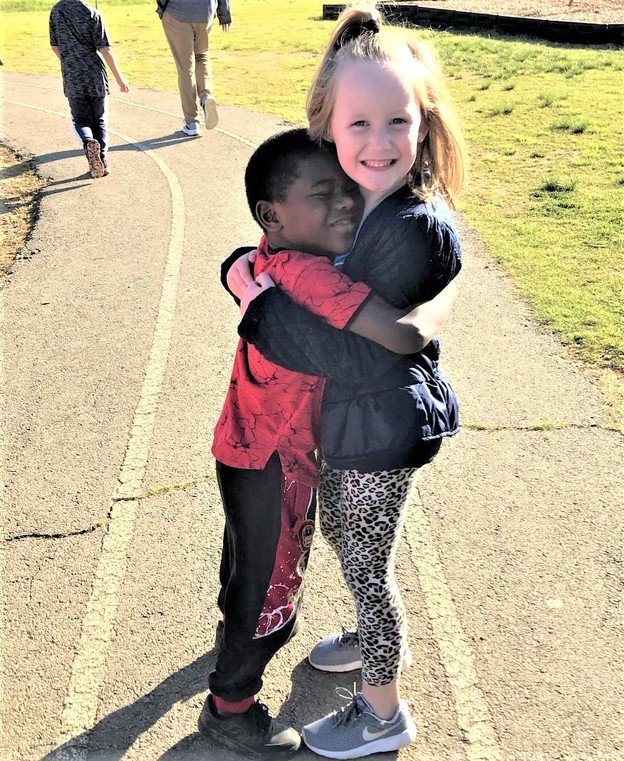
The picture of the two children from different ethnic backgrounds hugging each other with all the enthusiasm in the world captures in a nutshell what the world could look like IF ONLY........  It is lovely.

I have a favorite poem and thought it would be appropriate to share now on this post.  Here is it:

***************

All I Really Need to Know I Learned in Kindergarten  by Rober Fulghum

Share everything.  Play fair.  Don't hit people.  Put things back where you found them.  Clean up your own mess.  Don't take things that aren't yours.  Say you're sorry when you hit somebody.  Wash your hands before you eat.  Flush.  Warm cookies and cold milk are good for you.  Live a balanced life-learn some and think some draw and paint and sing and dance and play everyday some.  Take a nap every afternoon.  When you go out into the world, watch out for the traffic, hold hands and stick together.  Be aware of WONDER.

****************

Gosh, doesn't this poem say the world in 94 succinct words? 

What if Donald Trump decided to follow such rules?

Do you think there is anything vital that you learned attending South High which could be added to this list of how to get along in the world?


09/10/20 09:43 AM #48    


Susan Hemmingsen (Marchant)

Me again.  But frankly, I feel very lucky to be able to say these words because the day before yesterday I was not sure if I would be around to celebrate my (uh, humm) 77th!  The day of my adventure was Monday, Sept. 7, 2020 the day of the Great Wind in Salt Lake City and other surrounding areas.

Me, like the crazy person I can be, decide to head to the credit union to take care of getting some papers notarized INSPITE of the warning to hunker down becaue of severe winds heading to this area.  How bad could it be?.....plus my credit union was not even a half block away and, after all, I had my trusty Honda Civic, Suzie the Second to get me there. 

I caustiously headed for my car and am surrouneded  at once by much debris, leaves, small branches and garbage lying and floating about.  Next, I encounter a VERY good-sized tree branch lying across a lawn, a sidewalk and a street next to a car which, thankfully, it had not encountered.  Onward I go.

I get to my destination, get out of my car, and then the fun begins.  A huge, strong gust hits me and I grab onto Suzie the Second for dear life.  WOW! is about all I could say as my legs were hit by dirt? small rocks? huge boulders? (I josh on the boulders ) which stung sharply as they pelt my bare legs.  

Hmmm?  Do you think maybe I should have stayed home?  Well, I head into the credit union to be greeted by approximately five or quiet employees who give me the look of "You out of your mind to be out and about?"  The silence was eiry, no one said a word of greeting, nada.  I break this silence by asking if one of them is a Notary.  Well, yes, I am, and she and I sit down to take care of the paperwork.  She mentions that she just heard a report from the downtown area that 105 mph winds had been clocked.  What the -----?  105 mph winds!!!!  (actually, at the University of Utah the winds beat that record at 111 mph).

Having accomplished my ill-thought-out-mission, I take a deep breath, open the credit union door, and am faced with getting to my car in growling winds that seem to be growing even fiercer.  Finally, there is a lull so I head for the door, get it open, and then, I kid you not, again a HUGE STRONG gust about knocks me off my feet and I have to hope that Suzie is anchored enough to keep me from flying away to Somewhere over the Rainbow.

At last, the car running, Suzie and I are headed north on Richmond Street and right before us are 3, yes 3!, huge uprooted trees lying partially blocking the road.  They have been partitioned off by police barracades.  I drive as slow as I dare, taking in this sad site of these gorgeous majestics trees meeting such a fate.  The drive home brought more of this devastation - huge branches lying in the street, on the sidewalks and in the yards.  Empty streets; not another another crazy person was visable - not even an automobile.  Suzie and I were alone.

News later that eveing told a more complete story-------45 semi's (a record for one day) were overturned, countless homes and businesses were without power, one fatality had occurred , and many schools and businesses all had been forced to close. 

I am just lucky not to have been, perhaps? fatality Number two who died of her own stupity.  Right? 

I will happily greet my 77th birthday! 


09/28/20 10:52 AM #49    


Gordon Shepherd

BLIGHTED AREA

This Was America

By Gordon Shepherd

            In 1997, my brother Gary and I attended a conference session of the Society for the Scientific Study of Religion in Montreal, Canada. One of the session presenters was employed by the Church of Jesus Christ of Latter-day Saints Research Division. His talk focused on the changing demographics of the urban neighborhoods in and around Salt Lake City, the capital of Mormon Utah. The church researcher projected a PowerPoint slide on the screen which labeled and color-coded a Salt Lake City map in terms of different socio-economic sections of the city. Both of us looked closely at the projected map. Salt Lake City was our place of birth, the place where we had spent our childhood and youth before leaving Utah to pursue graduate training and academic careers out of state. We peered at the slide and then did a double-take. There in the middle of the map, highlighted in ghastly gray, were the neighborhoods of our youth. The gray section of the map was labeled “Blighted Area.”


Inline Image Not Displayed

            Say what? Blighted Area? Por favor. For us, growing up in the central city neighborhoods of downtown Salt Lake during the 1950s had been the Garden of Eden on Earth. Sure, there were problems and occasional ugliness there. As we got older, we realized we lived in the central city environs of an expanding metropolitan area. We knew that times had changed, that inner-city populations were declining, that homes and property values in the Liberty Park area had also declined while crime rates had gone up. Even as younger kids we knew there were much wealthier areas of town on the East Bench and in the rapidly growing suburbs south of Salt Lake City proper.

            But Blighted Area? That blunt designation hurt. As kids we took pride in the modest, well-cared for homes and flower bestrewn working class neighborhoods where we lived; in the older, distinctively styled LDS chapels with their elaborate stained glass windows that anchored designated ward neighborhoods every few blocks; and especially in the public schools we attended—Liberty Elementary (on 3rd East between 9th and 13th South), Lincoln Jr. High (on the corner of 13th South and State Street), and, a half a mile further down the road (at 1575 South State), South High School—where we expanded understanding of our ABCs, the birds and the bees, and valued civic lessons from growing up with ethnically diverse friends. 

           The schools we attended and the LDS Liberty/Liberty Park Ward where we went to church with our parents were housed in buildings that were aging, even then. Liberty Ward opened its chapel doors in 1909; Liberty Elementary was built in 1917; the construction of Lincoln Jr. High was completed  in 1921; and Depression era South High, lovingly crafted by WPA workers for central city kids the age of our parents, opened its doors in 1931. During the mythical age of our youth in the 1950s and early 60s, all of these structures underwent significant remodeling in naïve anticipation of sustained, if not increased local growth. The Liberty Ward chapel’s sanctuary was virtually gutted, remodeled, and refurbished with tastefully modern interior furnishings; Liberty Elementary acquired a brand-new auditorium/gym; ditto Lincoln Jr. with the installation of a big, new gym and refurbished library; and South High was enlarged substantially with a new library, a new gym, competition-sized natatorium, and a fifty-yard expansion of new classrooms to extend the school’s already lengthy brick profile on South State Street.   

            The urban demographics of rapidly evolving American cities being what they are, however, a scant few decades later, the old Liberty Elementary was demolished (but replaced with a new school building for Title I families in the twenty-first century; Lincoln Jr, was likewise demolished and overlaid with a strip-mall of random business enterprises and their corollary parking lots; and South High, where we learned our most lasting lessons of democracy, was shuttered in 1988— for four years the old campus was a virtual ghost town complex on State Street until it was converted into Salt Lake City Community College’s South City campus in 1992.  

            When we were growing up, our central city schools were attended by Greek, Italian, Mexican, Japanese, Lebanese, and African American kids with surnames like Bizakis, Kyriopoulos, Ligeros, Pappas, and Soteriou; Caputo, Ferro, Pignataro, Richeda, and Sartori; Archuleta, Balderas, DeVargas, Grego, Martinez, and Sisneros; Aoki, Aoyagi, Mayeda, Shiba, and Yano; Kaleel and Malouf; and yes, with solidly American "slave names" like Davis, Ellis, and Miller that had been imposed on the kidnapped ancestors of our African American friends. And, of course, we had plenty of Northern European classmates as well--some of whose parents' native language wasn;t English and who spoke with foreign accents. Among our friends, these included kids with names like Ekberg and Swenson (Swedish), Brandl, Dahl, Ebert, and Ruth (German), Johannessen and Loyberg (Norwegian), Schipaanboord, Van de Sluis, Van Der Wouden, and Vander Veur (Dutch). 

            For us, even in Mormon Salt Lake City, This was America. Sure, most of our classmates like us grew up in Mormon households and on Sundays bowed their heads with their families in neighborhood Mormon chapels. But not the Greek Orthodox or Italian Catholic kids we knew and not many of the Mexican, Japanese, or Lebanese kids either; and certainly not our black friends, whose religious roots were mostly Southern and Baptist and whose fathers would have been denied ordination to the LDS lay priesthood because of their race.

            But to us—at our public schools and playgrounds—these ethnic and religious distinctions didn’t seem to make a whit of difference. When we say us, we specifically mean Mormon white kids who were admonished by responsible adults at church and school to be fair and just to all and, in a taken-for-granted manner, we thought we were. Majority populations usually do. People typically prefer nostalgia to history and re-remember themselves and their past in a rosier light than the facts warrant. We certainly don’t exclude our accounts of the good old days from that caveat.

            But the facts are, we were exposed to democratic principles of justice and equality, and these values were strongly emphasized, especially in the public schools we attended. Mere exposure to community values does not, of course, mean that everyone embraces them with equal fervor and sincerity. But we’re not speaking for everyone. We’re speaking for us and how we believe our experiences growing up in central Salt Lake City affected our thinking and fundamental attitudes later in life. We don’t think our retrospective musings in this regard are sheer confabulations. 

            We weren’t paragons as individuals. We were as selfishly immature as other kids our age, had our fair share of family troubles, and were saturated with the same provincialism, unthinking prejudices, and discriminatory practices of the times as everyone else. In the abstract language of social theory that we both learned later as adults, we were deeply ethnocentric in our convictions of the inherent superiority of our local churches, schools, community institutions, and middle/working class way of life. Our ethnocentrism was the product of growing up in a miniature “gemeinschaft” world in which community bonds were based on primary relationships of personal loyalty, trust, and reciprocity. What’s wrong with that? Well, the ethnocentrism part, of course, is a universal human problem that arguably has justified, if not generated, virtually every religious, cultural, and social class conflict in history. So that needs to be considerably allayed. But the loyalty, trust, and reciprocity parts are what make life sweet and worth living.

            In spite of our youthful ethnocentrism, what we gained by growing up in the “blighted area” of Salt Lake City in the 1950s and early 1960s was making friends with a diverse set of kids of differing ethnic, racial, and religious backgrounds. We were fortunate in our friends. If we learned nothing else from our diversified, gemeinschaft associations at Liberty, Lincoln, and South, it was that cultivating personal loyalty, trust, and reciprocity transcended race and religion; that the children’s children of slaves and immigrants from the different corners of the world could find common cause as fellow citizens and human beings in our country and in our communities.

            For us growing up as kids, even in Mormon Salt Lake City, this was America. Is it so today in the City of the Saints? Is it so in our country, the United States of America? Is it what the friends and young people of our generation learned and continue to prize? We fervently hope so but you’d have to ask them. Sadly, we have our doubts.


09/29/20 09:54 PM #50    


Larry Swanger

Thanks Gordon for the trip down memory lane. You really nailed it.

09/30/20 07:59 AM #51    


Gary Shepherd (Shepherd)

Wow, Larry!  Out of the shadows from over 50 years since we last heard from or about you.  Tell us more. Meanwhile,  maybe we'll post another little story (true) in which you emerge as a focal character.  Gary


10/01/20 09:36 AM #52    


Linda Bailey (Ogden)

So much happens through the internet these days, what a change from our childhood. I remember party lines on the telephone. Now I love texting and emailing as my way of keeping in (sort of) touch with people. It has been really fun to read all the foregoing messages. I hope all are well and enjoying life (such as it is these days). I just had to update medical information as my deceased husband was my emergency contact and my doctor now requires an email request for prescription fills. I suppose doing new things keeps my mind going somewhat. Meantime hang in there former Cubs. Hopefully next year will see an improvement in all of our lives.


10/01/20 06:20 PM #53    


Gordon Shepherd

Hi Everyone,

Only a few of you attended Liberty Elementary with us in the early to mid-1950s, but all of you, on the brink of adolescence, finished elementary school somewhere and we hope that this little reminiscence will resonate in some degree with some of your own experiences.   

WILLFUL DISOBEDIENCE AND THE LAST FOXTROT

By Gordon and Gary Shepherd

            In retrospect, one of the most willfully dumb things Gordon did as a kid (there were many) was to defy Miss Jensen, Liberty Elementary School’s veteran 6th grade teacher. To eleven and twelve year old boys in 1955-56, Miss Jensen—who was close to retirement age—looked like a relic from the roaring twenties. She wore her hair bobbed short, with curling iron waves parted on the side, and she dressed in 1920s style, mid-heel oxfords with support hose.

            But Miss Jensen was not a doddering push-over. To the contrary; she was firm, authoritatively decisive in her teaching methods, and knew how to manage pre-pubescent boys. Nobody talked back to Miss Jensen. She was in charge of choosing and supervising the school’s boy traffic cops, and she made sure during activity periods that her students learned how to square dance, waltz, and especially how to do the Foxtrot (her favorite). “Foxtrot one, Foxtrot two, Foxtrot three!” she would call out in a strong, clear cadence as she glided around the room making sure that everyone was in proper step. Miss Jensen insisted on respectful manners, reading comprehension, the importance of clear writing (including good penmanship), and loyal citizenship. For what it’s worth, the first poems we ever composed—and the first original writing that we can remember ever taking ownership of or pride in—were for Miss Jensen’s 6th grade Christmas assignment. Gordon called his poem “Once Within a Stable Lay,” and Gary’s was entitled “The Christmas Bells”—both poems revealing our simple, boyhood understanding of the basics of Christianity’s origin story.

ONCE WITHIN A STABLE LAY

Once within a stable lay, a little child upon the hay

Up above him from afar, brightly shone a glowing star

It led the wisemen from the east, who came in search of love and peace

Mary lifted her head and smiled, “This is Christ the Holy Child”

He was born in Bethlehem on Christmas Day, over the ocean far away

He was kind and gentle from his birth to bring love and peace to men on earth

For men who stole, killed and lied, he was put upon the cross and died

THE CHRISTMAS BELLS

The Christmas bells always remind me

Of the Christ who was born in Galilee

How he taught the people to live a good life

In a world of darkness and toil and strife

And when upon the cross he died

The angels all were by his side

To comfort him to bear the pain

Until at last the Christ was slain

And so the bells ring on and on

To tell the story of Christ in song

***

            At the end of the 1956 school year at Liberty Elementary, Miss Jensen organized a graduation event. The following year we would be moving on to Lincoln Junior High as 7th graders. So, at noon on the last day of class, we were all excused to go home, change into our Sunday best, and return to school for a dance (where we would display our recently acquired waltz and Foxtrot skills) and the awarding of graduation certificates. The day before, Miss Jensen had given us a free period to circulate around the classroom and fill out our dance-cards. There were seven dances listed on the card, and Miss Jensen expected every girl to be asked and every boy to do the asking for all seven dances.

            This is when Gordon became willfully disobedient. He was old enough to actually like girls for being girls, but he was afraid of them. Afraid of what? Oh, he wasn’t afraid to tease them and talk scornfully about them for not being able to shoot marbles the right way or throw a baseball properly. No, that wasn’t it.  He was uncomfortably shy and simultaneously proud around girls. He was proudly afraid to talk to them, afraid he wouldn’t know what to say, afraid he would seem foolish and gauche (which, of course, was not a word he knew at the time), and he was unwilling to try for fear of failure. What if the girls he really liked had already filled out their dance-cards or were saving their dances for someone else who they really liked? Gordon was envious of Owen Wood, one of his and Gary’s classmates, whom they had known since kindergarten. Owen seemed self-confident and sophisticated around girls—able to communicate with them and win their confidence. He was already beginning to ask girls on dates, for heaven’s sake. This was far beyond Gordon’s highly constricted repertoire for interacting with the opposite sex.

            What about Gary?  He too was suddenly shy around girls. We say suddenly because up until the 6th grade neither of us really considered girls to be objects of particular fascination; they were just additional friends and classmates we had grown up with. But by the 6th grade, most of the girls had already hit the early stages of puberty and, lagging slightly behind, so had we. Girls began looking and talking differently. They now seemed increasingly alien and mysterious to us, but somehow they also had become desirable creatures, which  required of us wholly new and unfamiliar ways of interacting. And this ballroom dancing business—no longer square dancing that involved only the occasional clutching of sweaty hands, but boys and girl’s arms around each other—seemed enticingly contrary to our boyhood lessons of Sunday school virtue. Nevertheless it was sanctioned, required even, by Miss Jensen, who insisted on teaching boys the polite but manly way to hold their partners while leading them around the dance floor. Most of the girls seemed to be less nervous than we were about all of this. But for us, the forbidden sensuality of actually holding a girl was accompanied by mixed feelings of immature longing, confusion, and embarrassment.  

            Gary’s confusion and embarrassment were, for some unexamined  reason, not as overpowering as Gordon’s (a point of differentiation in the identical twin stereotype of perfect alikeness ). Overcoming his awkwardness and adhering to Miss Jensen’s instructions, Gary approached and asked the requisite number of girls to fill out his dance-card (oblivious to their undoubtedly much greater anxiety over the humiliating prospect of not being asked and then having boys compelled by Miss Jensen to return and mumble an insincere request). It should be noted, however, that Gary made sure that the first girl he approached—as fast as he could maneuver himself to her side before any other boy in the room could preempt him—was Katheryn Keat, who Gary had a crush on, and who, contrary to the rules, he inveigled to sign up with him for both the first and last graduation dances.  

            In contrast, Gordon, in his dumb, inarticulate pride, sat at his desk and refused to fill out his dance-card. At the end of the allotted hour Miss Jensen checked everyone’s card, discovered Gordon’s intransigence, and—taking matters into her own hands—commenced to fill it out with the names of girls who still didn’t have their dance-cards completed. She even penciled herself in as Gordon’s dance partner for the last dance on his card. Criminy! The ultimate humiliation!

            What to do? What to do? Gordon knew one thing for sure. He liked and respected Miss Jenson a lot, but he determined he wasn’t going back to school that afternoon. When the twins arrived home for lunch, their mother greeted them with a cheerful smile and their Sunday clothes all laid out and neatly pressed for the dance and graduation activities. As they were changing clothes, Gordon informed Gary of his improvisational plan of defiance: He would leave with Gary to go back to the school, but once they turned the corner at Third East and Herbert Ave, out of sight from their waving mother, he would double back and head for “the field”—the vacant, weed-filled lot behind Ron Swenson’s house. Before leaving the house he had managed to conceal a couple of comic books and a Freddy the Pig adventure book. His plan was to fashion a kind of bowery shelter in a corner of the field to shade himself from the sun, keep his clothes neat, read his books, and wait for the dreaded dance to be done. Gary’s part in the plot was to simply go on to school, tell Miss Jenson that Gordon had skipped out, but he didn’t know where he was (the one falsehood Gordon allowed), and then come back to the field after the graduation festivities to fetch Gordon so they could go home together and greet their mom with certificates in hand as though nothing untoward had happened.  

            And that’s exactly what happened. Gary reported to Gordon that Miss Jensen had been mad as a hornet and initially said she would refuse to sign his graduation certificate; that his parents would have to come for it with him in tow after he confessed his stunningly disobedient behavior. But then, in a surprising moment of pure grace, Miss Jensen relented. She signed Gordon’s certificate while telling Gary to tell his brother that she was disappointed in him, that she thought he would be braver than that, and that he had let her down. Ouch. Gordon was vastly relieved and simultaneously guilt-stricken. In his petty smallness, however, the relief temporarily outweighed his guilt.

            Gordon: I never had the courage to go back to Liberty School to apologize to Miss Jensen and ask for her forgiveness. I never saw her again. I regret that to this day.       

            Well, needless to say, both of us had a lot of maturing to do. And, as with most adolescents, there was still a fair amount of stumbling for us in the years ahead as we pursued our secondary education is Salt Lake City’s public schools. But as we reflect on our elementary school experience, we are grateful for the strong women teachers of that era (there was not a single male teacher or administrator at Liberty Elementary during the seven years we attended). To us, they were proof positive that educated women were just as capable as men in their knowledge and mastery of academic subjects, as well as in their ability to provide lasting character lessons and civic guidance for the development of their youthful charges. In a very essential way, our first public role models for what it meant to be adults and contributing citizens to the community in which we lived were our elementary grade schoolteachers.            

            Gordon Postscript : Dear Miss Jenson, if I were magically permitted to do it over, would you be my dance-card partner for the last Foxtrot? Thanks


10/01/20 09:53 PM #54    


Judy Granger (Bell)

Wow! That was so masterfully written! I was hanging on every word. Brilliant. Thank you for sharing I loved it.


10/02/20 11:37 AM #55    


Gwen Aupperle (Koehler)

What an entertaining and memory evoking way to spend a few moments at the computer this morning.  Thanks Gary and Gordon for your tales from growing up in Salt Lake City.  I agree, never would have thought I grew up in a "Blighted Area".  I treasure the era in which I grew up and the lessons of life learned in those times.  You did indeed "nail it" on so many fronts.  I have had sleepless nights wondering how my 2 teenage grand children will look back on the present times and how they will think our generation handled the novel challenges.  Iihope to live long enough to see the "other side" of all this and be able to hold out a hope for better tomorrows.


10/02/20 04:18 PM #56    


Nancy Pratt (Moss)

It is so fun to read about the antics of Gary and Gordon.  It took me some time to tell them apart, but both were amazingly smart, accomplished, and on their way to greatness.  I didn't go to Liberty - I went to McKinley and then to Lincoln Jr. for 8th and 9th grades.  Such fun in those days - so many new people to befriend, and I really enjoyed my time in junior high.   Thanks for the reminders of what was a simpler time.  Who thought we would ever see times like these?  

Thank you everyone for sharing your memories.  They have warmed my soul.

Nancy Pratt (Moss)


10/02/20 07:38 PM #57    


Bonnie Fry (Gilchrist)


Oh, the trip down memory lane with Gordon and Gary, was priceless. Liberty school and all the memories attached are true treasures. I feel like adding my 2 cents to those times. 
I remembering making our own dance cards, and the tissue flowers which both boys and girls wore at the dance. Who ever your dance partner for dance number one, was also your partner during our hot dog lunch in the library. You were all able to have the last dance with that person. My first and last dance was with John Mc Clain   But, it didn't end there. John and I and Steve Hardy and his date Janet Johnson, went to Liberty Park to ride the Tilta-Whurl and other fun rides. The endearing part of this sixth grade date was the fact the boys paid for this event by turning in soda bottles for cash to fund this sixth grade graduation date. Someplace, I do have a picture of John and Bonnie together at Miss Jensen's lunch/dance!
 

I wanted to comment also about growing up in the "gray blighted area"  A side note to this is, my childhood home on Williams Ave ,stayed in the family until two years ago  it may still be Central City, but it sold for $500,000 .  right the small 3 bedroom home with 1 bath is where the 4 Fry kids grew up .

Thanks, for the memories, it's far easier to recall Liberty, Lincoln and South than to remember what I had for breakfast  Stay Healthy and hope we live to have a sixtieth reunion  


10/03/20 10:32 AM #58    


Gary Shepherd (Shepherd)

Hey Susan, Gwen, Nancy, Judy, and Bonnie:  Great to see your responses to our little stories; thanks a bunch for your generous comments.  We have a few more written up and will probably post some of them here in the forum in the days ahead.

Meanwhile, it's great fun and pride-engendering for us to read your own smart and insightful takes on your lives: your current achievements, struggles, joys and sorrows, and reflections on the impactful days we all shared growing up.  

Stay tuned! (as will we) while staying  healthy. 

Gary


10/03/20 10:34 AM #59    


Gary Shepherd (Shepherd)

And you too, Linda Bailey (Ogden)!


10/03/20 06:01 PM #60    


Karen Marchant (Derbidge)

Gordon, your story of our 6th grade dance leaves me wondering...
What girls were on the dance list that you deserted that last day of school at Liberty Elementary?
Also, did you ever admit to your Mother what you did?

I have another question for both Gordon & Gary: I'm curious if you remember spending time at my home under my Mother's care when we were probably preschool age?

Karen Marchant Derbidge

10/04/20 09:15 AM #61    


Gordon Shepherd

Hi Karen! Great to hear from you. Sadly, I don’t recall which Liberty Elementary girls Miss Jenson penciled in on my dance card, and I don’t recall spending time as a preschooler under your mother’s care. BUT, I do remember your mother very well—who was a legend of neighborliness and efficiency—and also your older brothers Roger and Byron and your younger brother Dwight. I remember your birthday party when we were in the 7th grade at your bungalow brick home with its wide porch at 415 Williams Ave., a block west of Liberty Park. And perhaps most of all, I remember sitting behind you in Miss Anderson’s music class at Liberty elementary and, while listening to you sing,  realizing for the first time that you had the voice of an angel. Warmest best wishes ~ Gordon

P.S. For better or worse, Gary and I never told our mother about my going AWOL from the 6th grade graduation dance and . . . well, there were a few other misadventures growing up that we didn’t tell her about either. 😊


10/04/20 07:06 PM #62    


Karen Marchant (Derbidge)

Thanks for your nice comments about my Mother and myself. Mama was very wise and spent her life helping others, even though she had a large family of 15 children....she was amazing.

I'm grateful to my Mother's dedication for the 7th grade birthday party. She had to call me at my friends to get my help with the meal and preparations. Judy Haycock and I were busy calling friends to bring out enough boys to come. So your appearance was greatly appreciated.

10/05/20 09:17 AM #63    


Judy Granger (Bell)

I have really enjoyed reading about your lives. Thank you so much for sharing. Wow 15 children, how blessed are you.  Your mother had to have been an angel. I would love to have known her and lived in your neighborhood.  I did live for a while just west of liberty Park when I attended Lincoln.  This conversation has been very entertaining.


10/05/20 10:43 AM #64    


Gary Shepherd (Shepherd)

With advance apologies to the young women of our youth, whose own narrative experiences of what mattered most to them about growing up in the 1950s and early 60s tend to be underacknowledged or even misconstrued in our biased reminiscences, we submit the following piece as another tribute to Salt Lake City’s public school educators who played key roles in shaping our civic values.


ARE YOU IN OUR DREAMS?

Role Model Apparitions From our Youth


By Gordon and Gary Shepherd


Sometimes we tell people about our dreams, especially our wives Faye and Lauren, who counterclaim that they rarely dream, or if they do, they can’t remember them, or if they can remember them, they weren’t very clear or detailed. When we were kids growing up, before getting out of bed in the morning, we would query one another: “What did you dream about last night?” And then we proceeded to take turns narrating what we had dreamed about. So, if you’re going to remember what you dreamed, maybe you have to get in the practice of telling your dreams.

            Some people keep a record of their dreams by writing them down for their analysts to interpret. We do no such thing. And, by the way, neither of our dreams are religious, either. They’re not visions or revelations from God. They’re not instructions to other people about how to live or what to believe. Whatever their crazy narratives might entail, almost always our dreams are populated with various family members or friends, both old and new (especially including old friends and significant adults, like omnipresent apparitions, from our childhood and youth).

            The point is, the people we  dream about are the people, both living and dead, who have meant the most to us, or they’re people who in some way, for better or worse, have had an enduring influence on our lives. So, if you’re in our dreams, you’re somebody who is important to us, and, from our egocentric points of view, that’s what ‘s important to understand. Often we both dream about being in Mexico again, and in those dreams we can still speak fluent Spanish. But more often, we dream about being back in school—the schools of our childhood and youth.

            Do we ever dream about our old teachers, you ask? Yes, sometimes, but strangely enough, not that often, given the important role that many of them played in our lives—especially the dedicated women teachers whom we still remember with fondness and appreciation at Liberty Elementary (whose administrative and instructional staff did not include a single male): Teachers like Mrs. Madron, Blunt, Poulson, Lawrence, Murphy, McDermaid, Anderson, Taylor, and Jensen, among others. To an unsung degree, these women helped impetuously energetic and curious boys like us acquire a basic sense of fairness and responsibility toward others in a socializing context of learning how to read, write, do arithmetic, and learn about history and other countries in the public school system. God bless our underpaid, women public school teachers. Saying this in perfect sincerity about the many women teachers we admired, we must also admit that the teachers from our youth who are most likely to make appearances in our dreams today are men, two in particular: Hal Hardcastle and Dean Papadakis. Hardcastle and Papadakis were the boys’ P. E. teachers at Lincoln Junior High.

            When it came to directing adolescent boys—capturing their attention, channeling their underdeveloped potential and inchoate aspirations, while simultaneously imposing elementary discipline on their behavior—it wasn’t the school principal (whose name we can barely remember—Richards, maybe?), or any of the academic faculty: It was Hardcastle and Papadakis.

Hardcastle and Papadakis. Their names went together. They were a tag-team, complementing and supplementing each another in organizing and running Lincoln’s elaborate boys’ P.E. program. Their authority and oversight of the school’s young men were unquestioned. And, to the extent that the predictably intemperate behavior of teenage boys between the ages of thirteen and fifteen can be disruptive of institutional order, it may be said, practically speaking, that Hardcastle and Papadakis virtually ran the school. 

            Is that an overstatement? Undoubtedly it is. But we want to emphasize the critical role played by Hardcastle and Papadakis in nurturing a budding sense of educational community and therefore increasing awareness of civil norms of mutual respect and reciprocity among their adolescent male charges. In doing this, they became our most important adult role models at Lincoln Junior High.

            Salt Lake City Junior high schools in the 1950s did not, as a rule, sponsor competitive athletic programs with other schools. For that, one had to wait for high school. Instead, there were intramural sports that pitted different gym classes in competition against one another throughout the school year. At Lincoln there were traditional team sports (flag football, basketball, and track and field events). But in between these there were numerous other competitions as well, including wrestling, the sit-up contest, the rope climbing contest, the free-throw shooting contest, the weightlifting contest, and the softball throwing contest. Not only were individual winners recognized in these events for their achievements, but points were allocated to different gym classes over the year to determine which class was the overall grade-level champion. And, of great motivational importance to aspiring boy athletes, school records were kept, updated, and posted yearly.

            We both disliked wrestling (sweaty, smelly, exhausting, and we always hated getting pinned by huskier kids), so we’ll skip past that to highlight some of the school’s other individual sports.       The sit-up contest, for instance, was pretty basic: How many sit-ups could you do in twenty minutes?  As 7th graders, we recall the school record was over 500. The next year, Dennis Madsen, a slight, wiry kid, obliterated the old record by doing over 1,000. We remember watching him for twenty minutes in mesmerized amazement as he popped up and down like a well-oiled metronome. In the 9th grade, Gordon tried competing in the sit-up contest as the rep from his gym class, and painfully squeezed out approximately 500—not enough that year, sad to say, for even an honorable mention.

            The rope-climbing contest was a timed event to see how fast you could scale a fifty-foot rope from the gym floor to a beam in the ceiling. We had been given instruction on the proper techniques for climbing, which involved coordinating “foot wraps” with one’s arms systematically hoisting one’s body, hand over hand, to the top of the rope. A good climb would take less than ten seconds. Johnny Grego, a handsome, broad-shouldered Mexican American kid, disregarded the foot-wrap part of the technique and simply scrambled up the rope by pulling himself with agility and sheer upper body strength to set a new school record of a little over five seconds. (We only mention that he was handsome because all the girls seemed to be cheering for him to win.)

            Free-throw shooting was a test of consistent basketball shooting accuracy: How many free-throws could you shoot in a row without missing? If we remember right, the record before our 9th grade year was somewhere in the low twenties. Alan Owens, a quiet kid better known for his math and slide-rule skills, proceeded to swish fifty in a row. Fifty. We kid you not.

            In weightlifting, our neighborhood hero was Larry Swanger. Swanger was one of those kids who matured early and inherited big biceps from his gregarious, blue collar dad. To most of us, Larry Swanger looked like Sampson. He was tall, ruggedly handsome, and girls liked his 1950s Elvis-style hairdo. In the finals he was opposed by . . . by . . . well, hell, we can’t remember the other kid’s name (he didn’t continue on with us to high school). In any event, he was squat, had a crewcut and short, thick arms. Unlike Swanger, you couldn’t see his muscles. Neither of us recalls how many standing, overhead presses it took, but eventually Swanger couldn’t lift anymore but the squat kid kept going. He won and set a new school record! Our champion Swanger had gone down to gallant defeat. But such was life, we were beginning to learn. 

            Finally, in the softball throw, a contestant would stand behind a line at one end of the playing field, run forward a few steps for momentum, and heave the ball as far as he could. In our 8th grade year the school record was shattered by Dennis Borup, the 9th grade student body president. Borup, like Larry Swanger, had matured early and was a head taller than everyone else. When he threw the ball, it hit the side of the auditorium that stood twenty yards past the end of the field. Thereafter, we suppose, a new record would have to be measured by how far up the auditorium wall the ball hit. 

            Well, as we said, these (and others) were the individualized sports and the corollary prospects they offered for individuals to set new school records; they were a big part of the socializing allure of sports competition for sports-addled boys at Lincoln Junior High. The big team sports in the intramural program—flag ball and basketball—were seasonal sports that bestowed bragging rights and class points to the accumulating totals, but for which no statistical records were kept. Arguably, however, the biggest sports event at Lincoln was the annual track and field meet, again pitting different gym classes against each other in the late spring, toward the end of the school year. For this track meet, all classes were dismissed, and the entire student body became an audience to what transpired. (Yes, in the long decades of public-schooleducation prior to Title IX, girls were expected—if not required—to attend and support boy’s sporting events, and many did so with what appeared to be more interest in the boys themselves than whatever it was they were doing on the gym court or athletic field). And because track and field events feature individual contests that can be quantified by measures of time and distance, school records were also made and broken, and the results posted for subsequent student cohorts to admiringly contemplate on the walls of Hal Hardcastle’s and Dean Papadakis’ gym offices.

            Which brings us back to reflect on the dynamic duo of Hardcastle and Papadakis and what they meant to most of the boys at Lincoln Junior High. We’re perfectly confident that every Salt Lake City junior high school in those days had intramural programs similar to Lincoln’s. But in blissful ethnocentrism, we’re also confident in asserting that no other school’s intramural programs were managed as effectively and inspirationally as they were at Lincoln by Hardcastle and Papadakis. If you think we’re wrong, prove it.

            Both men, of course, were athletes themselves, so that was good. They had somewhat contrasting personalities, but that was also good because, as we already said, they complemented and supplemented each other. Hardcastle was a little more intense; Papadakis was a little more relaxed. Most importantly, they were respectful friends who agreed on how best to co-manage the many sports programs that involved every boy at all three grade levels at Lincoln Junior High. They were like conscientious parents who presented a united front to their kids. And what they were united on was what was most important for the kids they taught: honest effort, fair play, and mutual respect for your classmates, regardless of their presumed natural abilities in sports.

            Hardcastle was ruddy, blonde, crewcut, broad shouldered and thick-chested. He was a football player who threw the hammer at the University of Utah (an ancient, esoteric field event still included in the Olympic Games) that requires agility, speed, and significant upper body strength. Papadakis—an exemplary specimen of Salt Lake’s Greek community—was a couple ofinches taller than Hardcastle, with dark hair combed in a modest pompadour, an easy smile, and Mediterranean features. Papadakis was a basketball player with a deft, lefthanded shot. He was also an artist, who applied his skill to the production of first-rate posters and charts to promote and record the sporting events of Lincoln’s unparalleled intramural programs. 

            But, as adult role models for boys, it wasn’t just sports that they were good at. We looked up to Hardcastle and Papadakis for guidance, and they didn’t disappoint. One of the other activities we were exposed to in our junior high gym classes was a week of learning how to dance with girls from the girls’ gym class that met the same period we did. When we say dance, we mean old fashioned ballroom dancing. The jitterbug, bop, and later the twist and other popular dance styles, presumably were dance moves that kids would pick up on their own. In retrospect, the main thing about our gym class get-togethers with girls was not so much to teach us how to dance the minuet, but how to act properly around girls. We can remember both Hardcastle and Papadakis lecturing us ahead of time to mind our manners and also reminding us that they would be chaperoning the dances. Even though both men had a good sense of humor and were well aware of the smart-aleckyness and arrogance of some of the boys under their charge, the bashfulness of others, and the immaturity of almost all of us at that age, they insisted that we be respectful to the girls at school.

            We remember one occasion in particular. An African American girl was a new student at Lincoln and, Hardcastle informed us, she would be dancing with the boys in our class like everyone else. There would be no refusing, no eye-rolling, no smirky quips or comments. We would be friendly, politely take our turns, and we would damn well like it. We respected that then, and we still do.

            On another vividly remembered occasion, a fairly large group of kids showed up on the steps of the school at lunch time for a fight (some of them were Lincoln students, some of them were not). A dozen fist fights and brawling quickly erupted. For a moment it looked like all hell was breaking loose. But suddenly, Hardcastle and Papadakis came flying out of the building—not the school principal or anybody from the administrative office. When someone ran into the school for help, to report what was going on outside, they went straight to the gym offices of Hardcastle and Papadakis. The insurgent fighting was over in a matter of seconds. Hardcastle and Papadakis each grabbed two brawling kids apiece, knocked their heads together, and angrily ordered everybody off the steps. The sizable crowd that had formed because of the fight quickly dispersed. Nobody else at Lincoln could have done that. No other adult authority on the school premises could have acted so quickly and so effectively to snuff out a potentially dangerous moment of harm to the school and its students. No other adults on campus would have been obeyed with such alacrity by a pack of overheated juvenile boys. We respected that then, and we  still do.

            Hardcastle and Papadakis. Two adult role models from our youth, who continue to inhabit our dreams at night. Are you too in our dreams? Feel free to ask us some time.


go to top 
  Post Message
  
    Prior Page
 Page  
Next Page      


agape